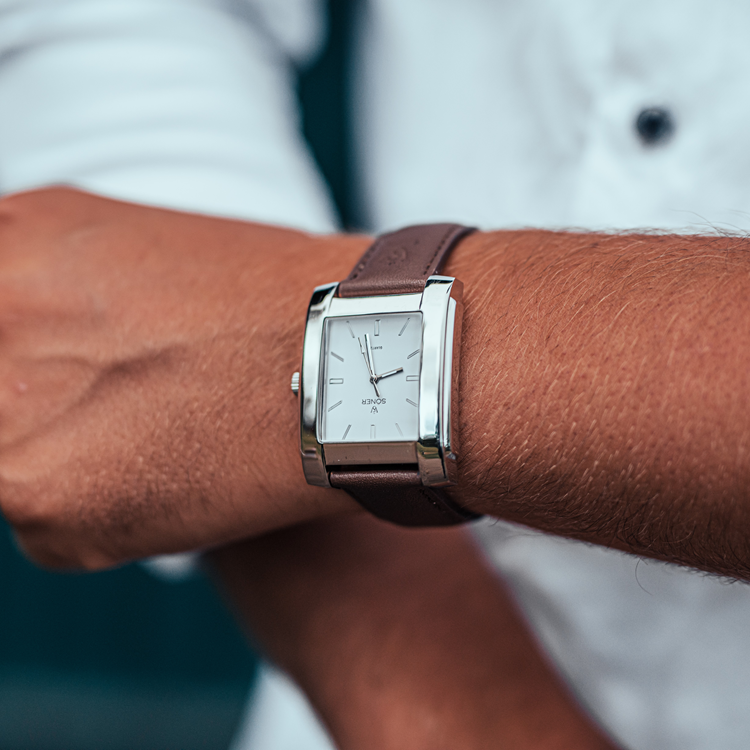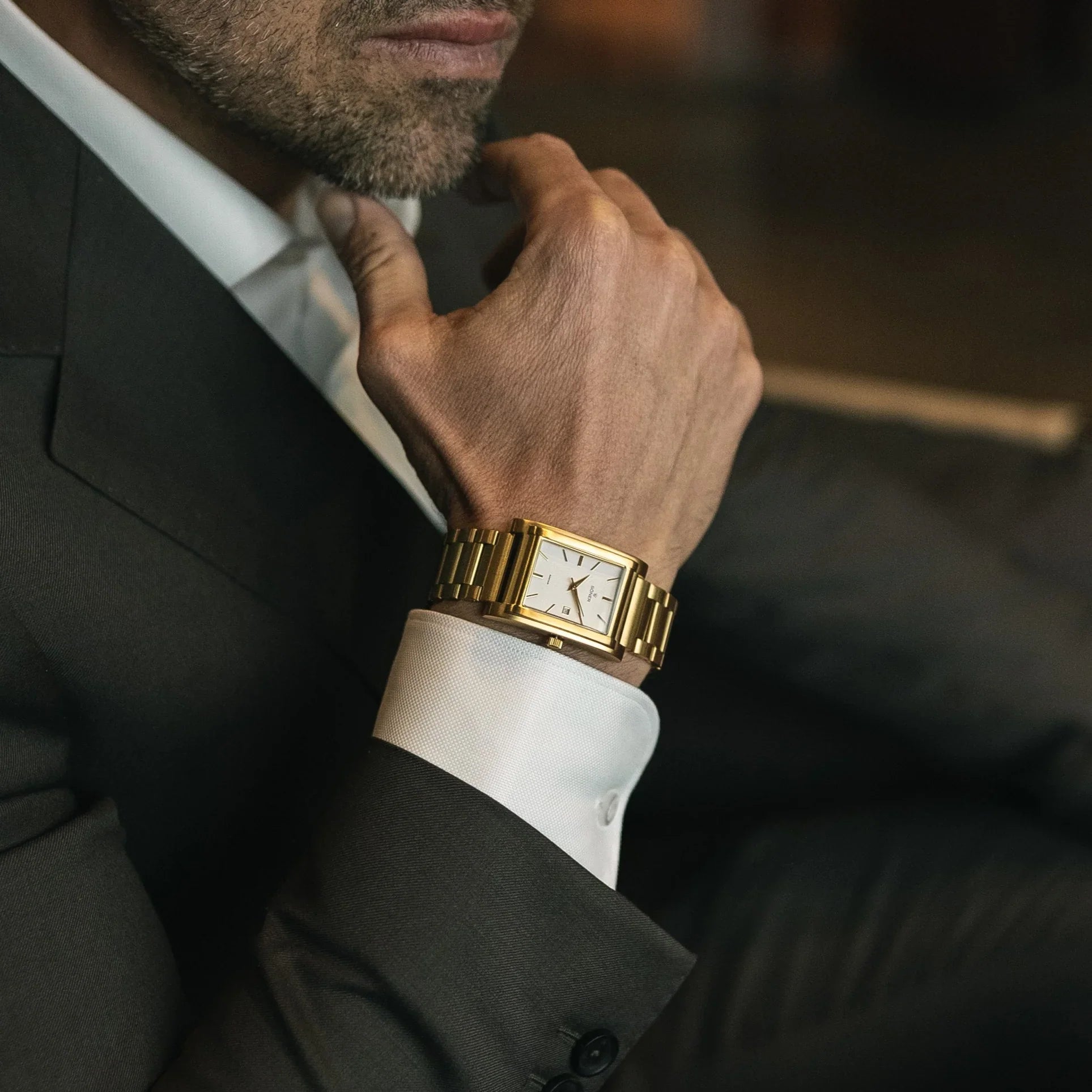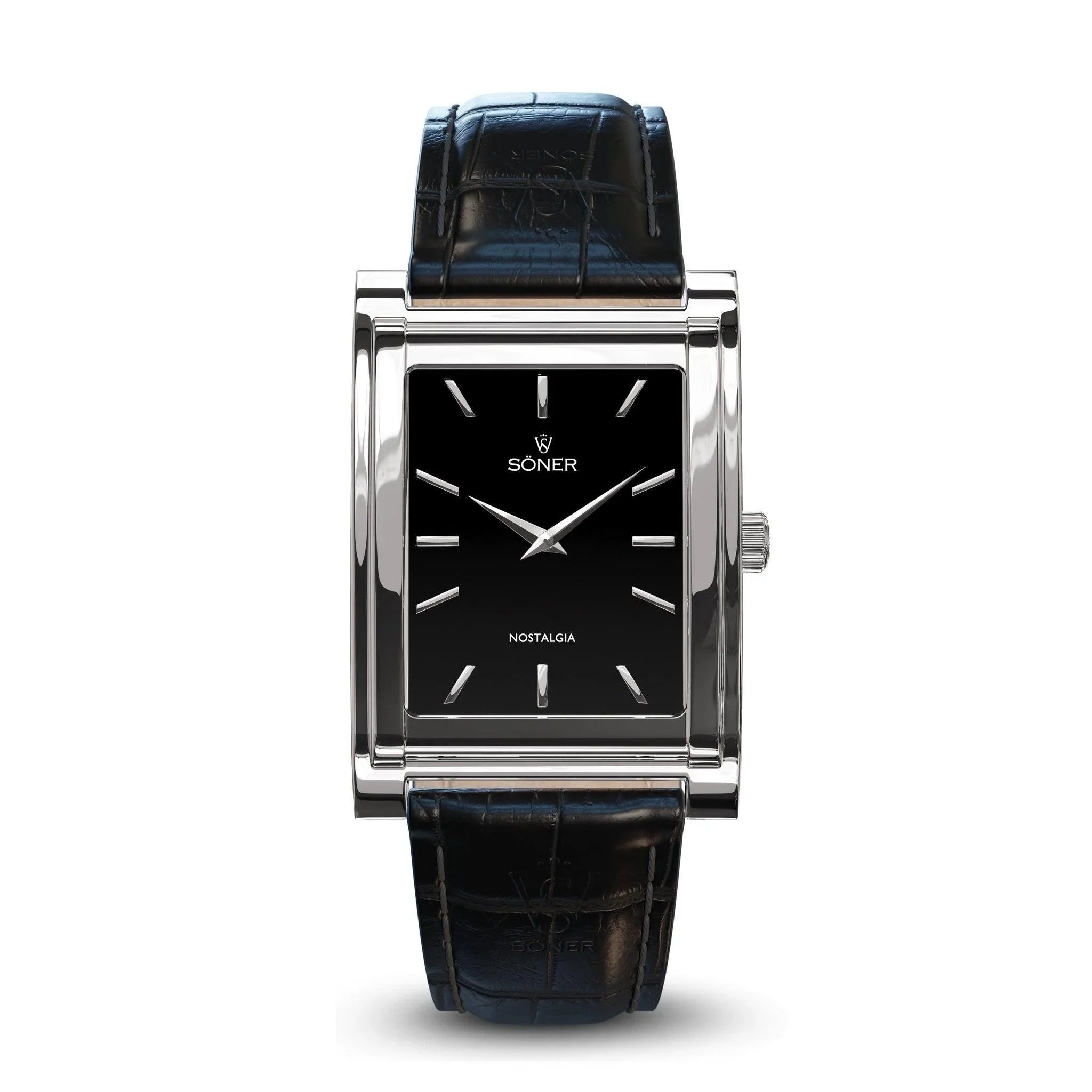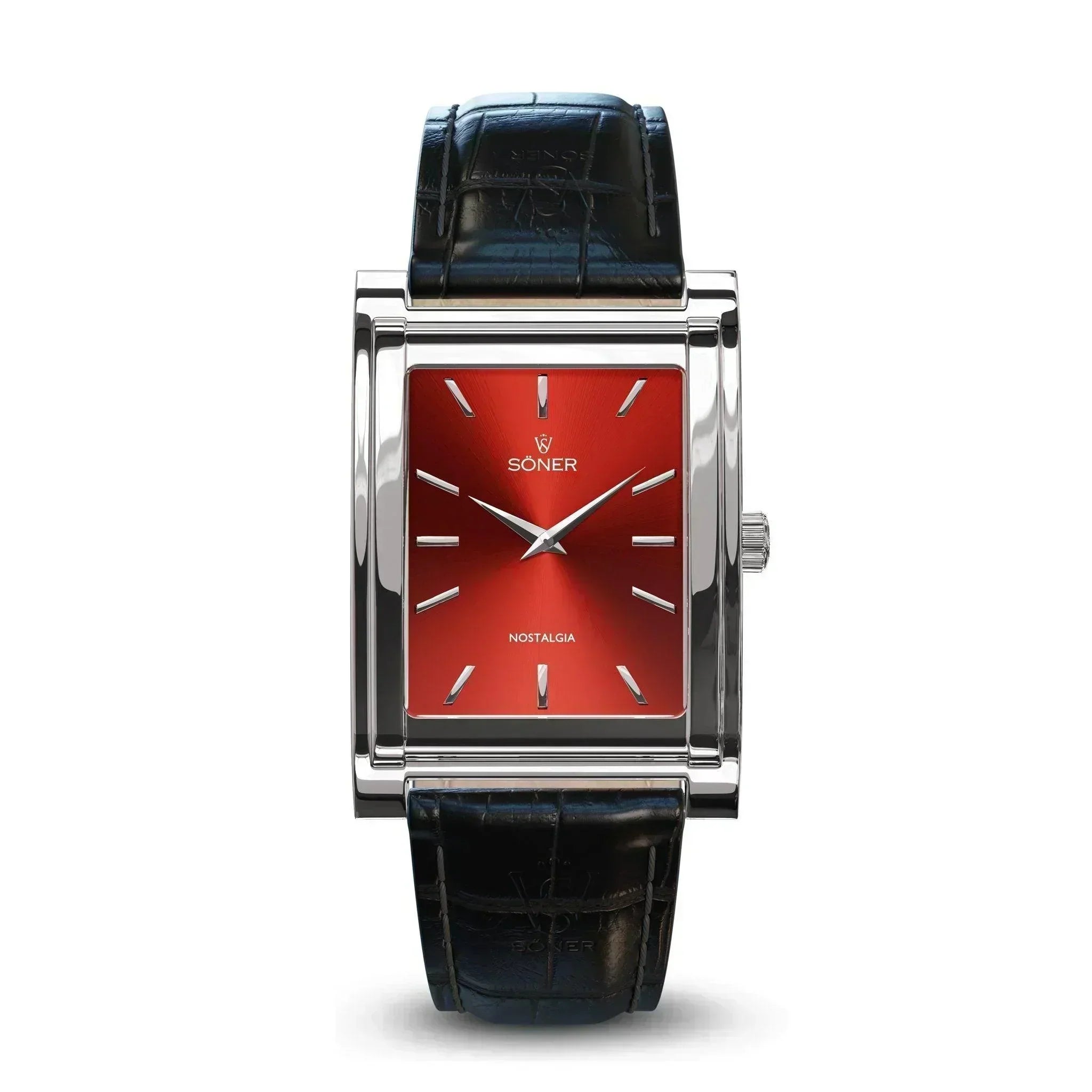

 Published on
Table of Contents
What Is a Rectangular Watch?
History, Geometry, Fit, Movements, and the Best Models Ranked by Price
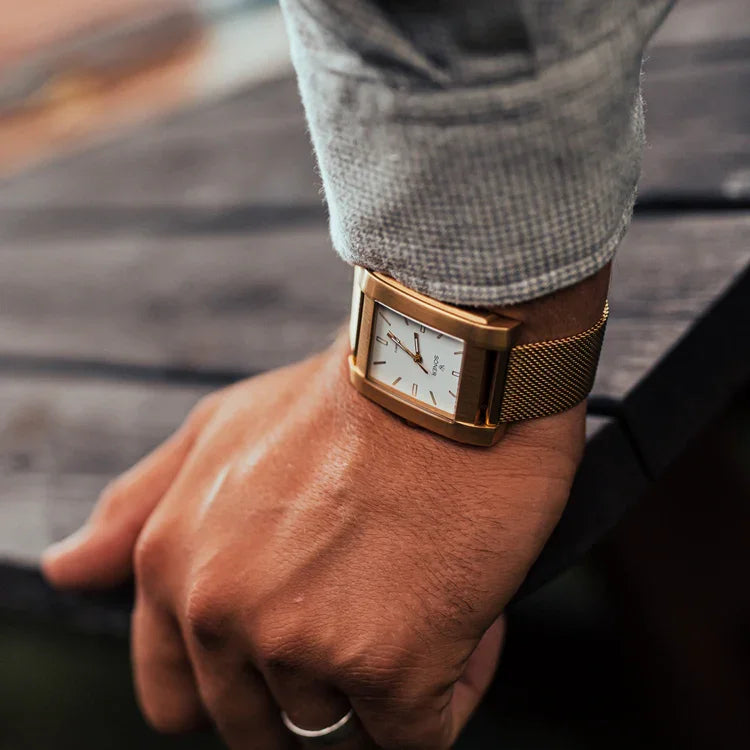
A rectangular watch is a wristwatch with a case defined by parallel vertical sides, straight horizontal top and bottom edges, and non-circular dial geometry. Unlike tonneau or cushion shapes, a true rectangular case maintains architectural linearity and does not taper into curvature.
Rectangular watches were among the earliest wristwatch formats designed specifically for the wrist rather than converted from round pocket watches. Today they represent a minority category in global watch production, yet they remain one of the most historically significant and stylistically distinctive forms in horology.
Source of Inspiration
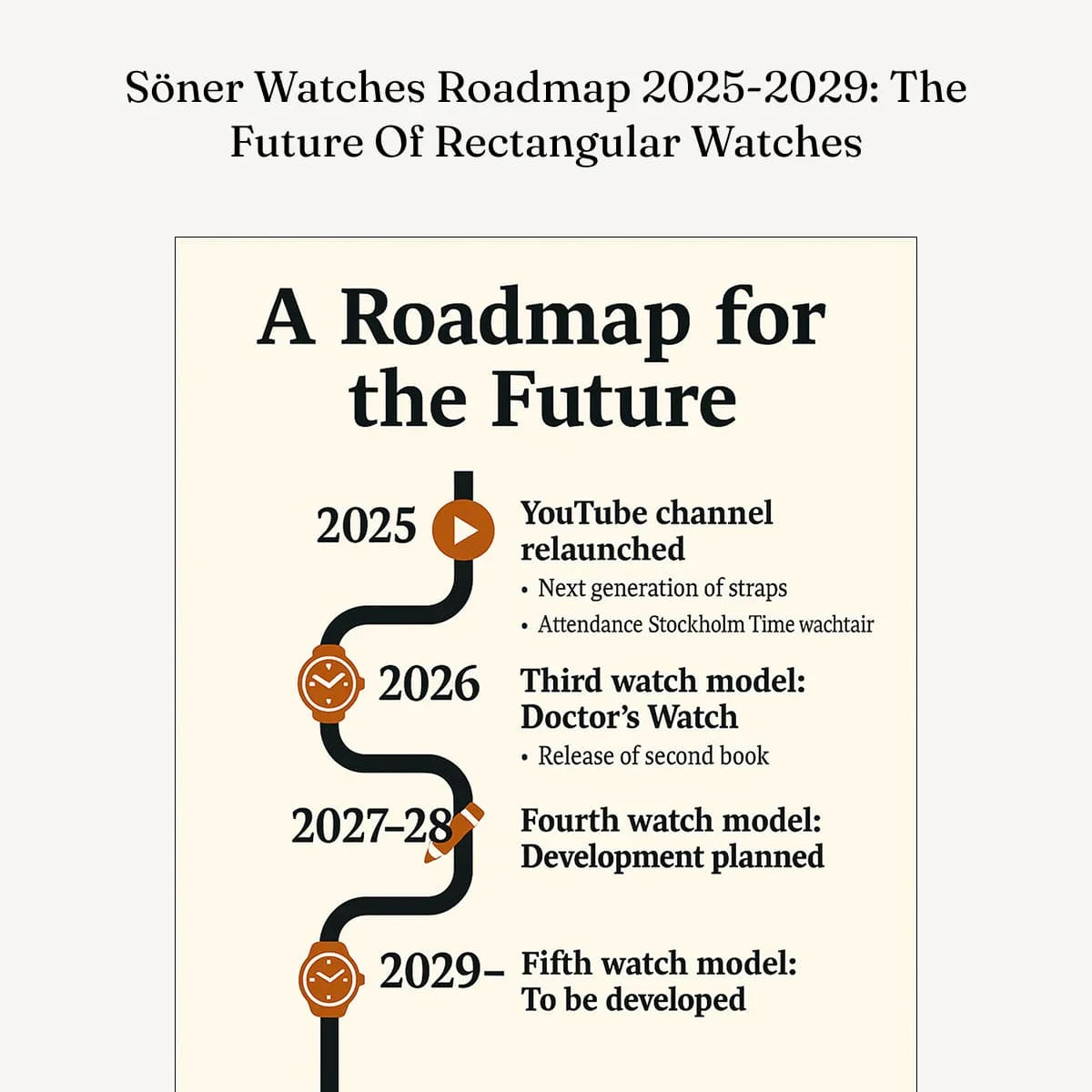
This guide is built on years of experience in the watch industry, combined with extensive research conducted for the book Beyond Round Watches.
The work behind that book examined the history, geometry, and evolution of rectangular timepieces across major Swiss houses and modern independent brands. It explored why the industry standardized around the circular case, and why the rectangular watch has remained a persistent, deliberate alternative for over a century.
This guide draws on that accumulated research and industry experience to provide a structured, evidence-based resource on rectangular watches. If you wish to explore the subject in greater depth, Beyond Round Watches expands on the historical context, design theory, and architectural principles discussed here.
1. The History of Rectangular Watches

Art Deco Origins
The rectangular wristwatch rose to prominence during the Art Deco movement of the 1920s and 1930s. Art Deco was defined by symmetry, bold geometry, linear repetition, and architectural clarity. Skyscrapers, furniture, typography, and industrial design all shifted toward clean vertical and horizontal structure.
The rectangular watch case reflected this cultural transition. Rather than inheriting the circular form of pocket watches, rectangular watches were conceived as modern objects designed specifically for the wrist. Their geometry echoed the façades of contemporary buildings and the streamlined optimism of the early twentieth century.
The Early Break from Pocket Watch Conversions
Before World War I, most wristwatches were adaptations of round pocket watch movements placed into smaller cases with soldered wire lugs. The rectangular case marked a conceptual departure. It was not merely a resized circle; it was a statement of modern design intent.
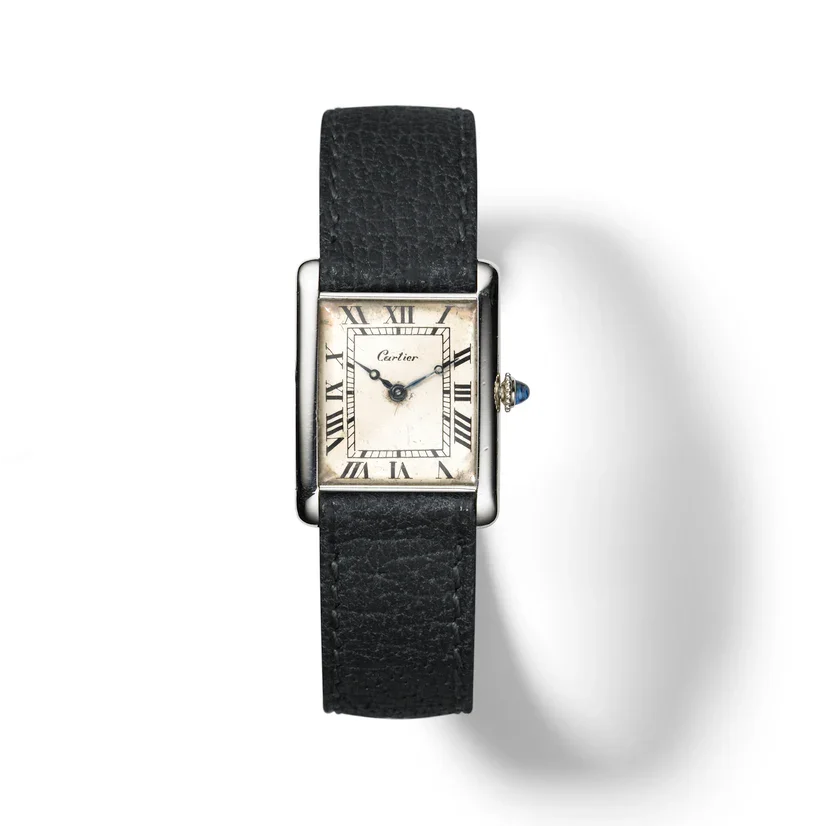
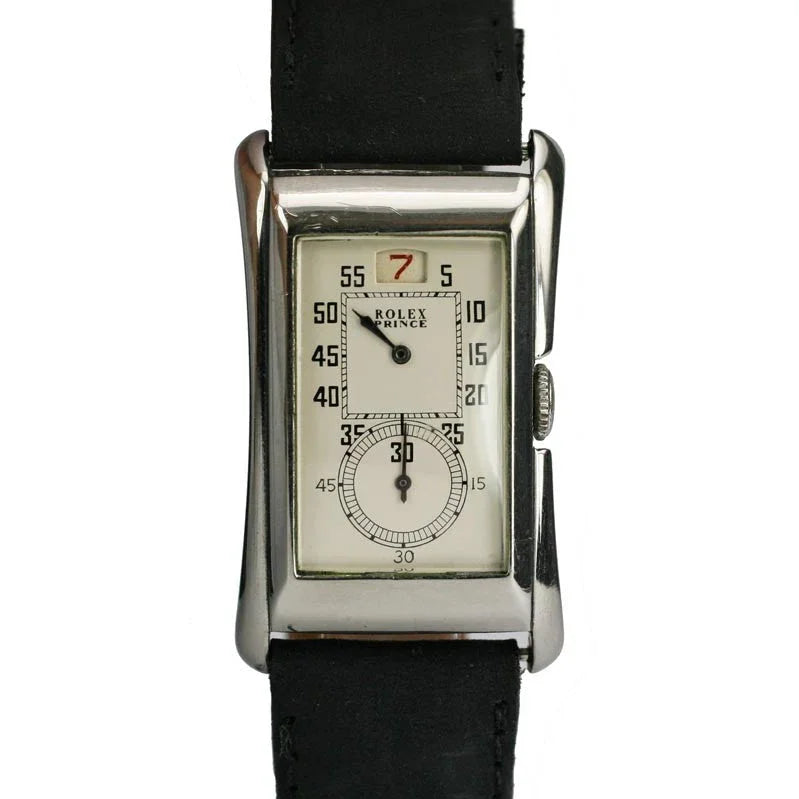
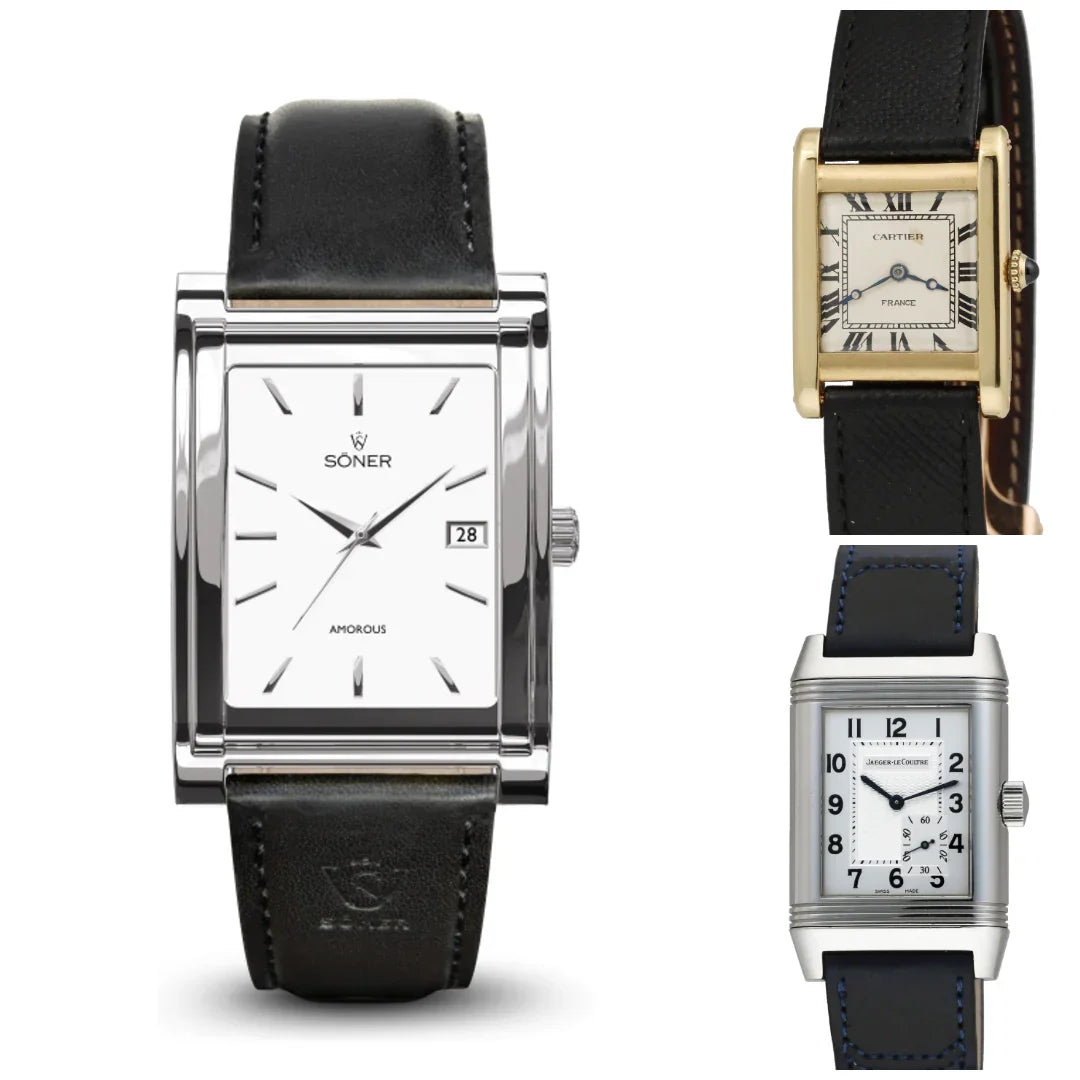
In 1917, Cartier introduced the Tank. Its brancards, parallel vertical sidebars, framed the dial and integrated seamlessly into the strap. The design was reportedly inspired by the aerial view of Renault FT-17 tanks used during World War I. The Tank established the blueprint for rectangular wristwatch architecture: linear flanks, balanced proportions, and strong vertical presence.
Functional Innovation: The Reverso
In 1931, Jaeger-LeCoultre launched the Reverso. Originally created to withstand the impact of polo matches in British India, its case could rotate within its carriage to protect the dial.
The Reverso demonstrated that rectangular geometry was not purely decorative. It could serve structural and functional purposes. Its triple-godron top and bottom bars reinforced Art Deco symmetry while introducing mechanical ingenuity.
High Complication and Formal Refinement
Patek Philippe later expanded the rectangular tradition through models such as the Gondolo collection. These watches reinforced the association between rectangular cases and formal dress design. Slim profiles, precious metals, and complex mechanical movements positioned rectangular watches within haute horlogerie rather than sport-oriented categories.
Rectangular Watches in the Mid-20th Century
Through the 1940s and 1950s, rectangular watches remained popular among dress watch offerings. Many manufacturers experimented with elongated proportions, stepped cases, and curved profiles. However, as tool watches gained dominance in the 1960s and 1970s, divers, chronographs, and pilot watches, the circular case became increasingly standardized.
The rise of mass manufacturing and sports functionality shifted mainstream demand toward round watches optimized for durability and legibility.
Why Rectangular Watches Became Rare
Modern watchmaking heavily relies on circular movement architecture. Most mechanical and quartz calibers are engineered in round formats because circular plates distribute torque evenly and simplify manufacturing tolerances.
Housing a round movement inside a rectangular case often requires:
• Spacer rings
• Custom movement holders
• Additional case machining
• Altered stem alignment
Alternatively, fully rectangular calibers require dedicated tooling and smaller production runs, increasing cost and complexity.
As industrial production scaled in the late 20th century, brands prioritized modular round movements that could be shared across multiple models. The rectangular case became a niche category rather than a volume driver.
While precise global production percentages are not publicly disclosed by most manufacturers, rectangular watches represent a small minority of total annual watch output across the industry.
Cultural Persistence Despite Rarity
Despite reduced production volume, rectangular watches never disappeared. They remained present in formalwear, political leadership imagery, and high-design collections. Their continued existence reflects a design archetype that resists trend cycles.
Rectangular watches persist not because they dominate the market, but because they represent a distinct design philosophy: geometry over conformity, structure over symmetry, and architecture over repetition.
Their rarity is therefore not accidental. It is a byproduct of industrial optimization favoring round cases, combined with the enduring demand for linear elegance within dress watch tradition.
2. Case Geometry and Design Architecture

Rectangular watches are defined less by decoration and more by geometry. Their identity is architectural. Every proportion, angle, and transition line contributes to how the watch wears and how it is perceived on the wrist.
Understanding rectangular watch design requires examining structure rather than surface.
Defining Geometry
A true rectangular watch includes:
• Parallel vertical flanks
• Defined corners, either sharp or softly radiused
• Linear top and bottom case edges
• Integrated or architecturally aligned lugs
• A non-circular dial aperture
Parallel vertical flanks establish the watch’s dominant axis. This vertical orientation creates tension and structure. In contrast to cushion or tonneau shapes, a true rectangle does not bulge or taper at the sides.
Corner treatment significantly affects character. Sharp corners create a more assertive, modern appearance. Softly radiused corners introduce refinement and reduce visual harshness while maintaining structure.
Linear top and bottom edges reinforce horizontal balance, preventing the case from appearing elongated without control. These lines anchor the watch against the wrist.
Lug architecture is critical. On many iconic rectangular watches, the lugs are not separate components but a continuation of the case flanks. This integration strengthens structural cohesion and avoids the appearance of a round movement placed inside a shaped shell.
The dial aperture must also respect the geometry. A circular dial within a rectangular case weakens architectural integrity. True rectangular design maintains alignment between case, dial, and movement proportions.
Visual Weight Distribution
Round watches distribute visual mass radially from a central point. The eye is drawn toward the middle, and symmetry radiates outward in all directions.
Rectangular watches distribute visual mass vertically. The eye travels from top to bottom along the long axis. This creates several distinct effects:
• A lengthening effect on the wrist
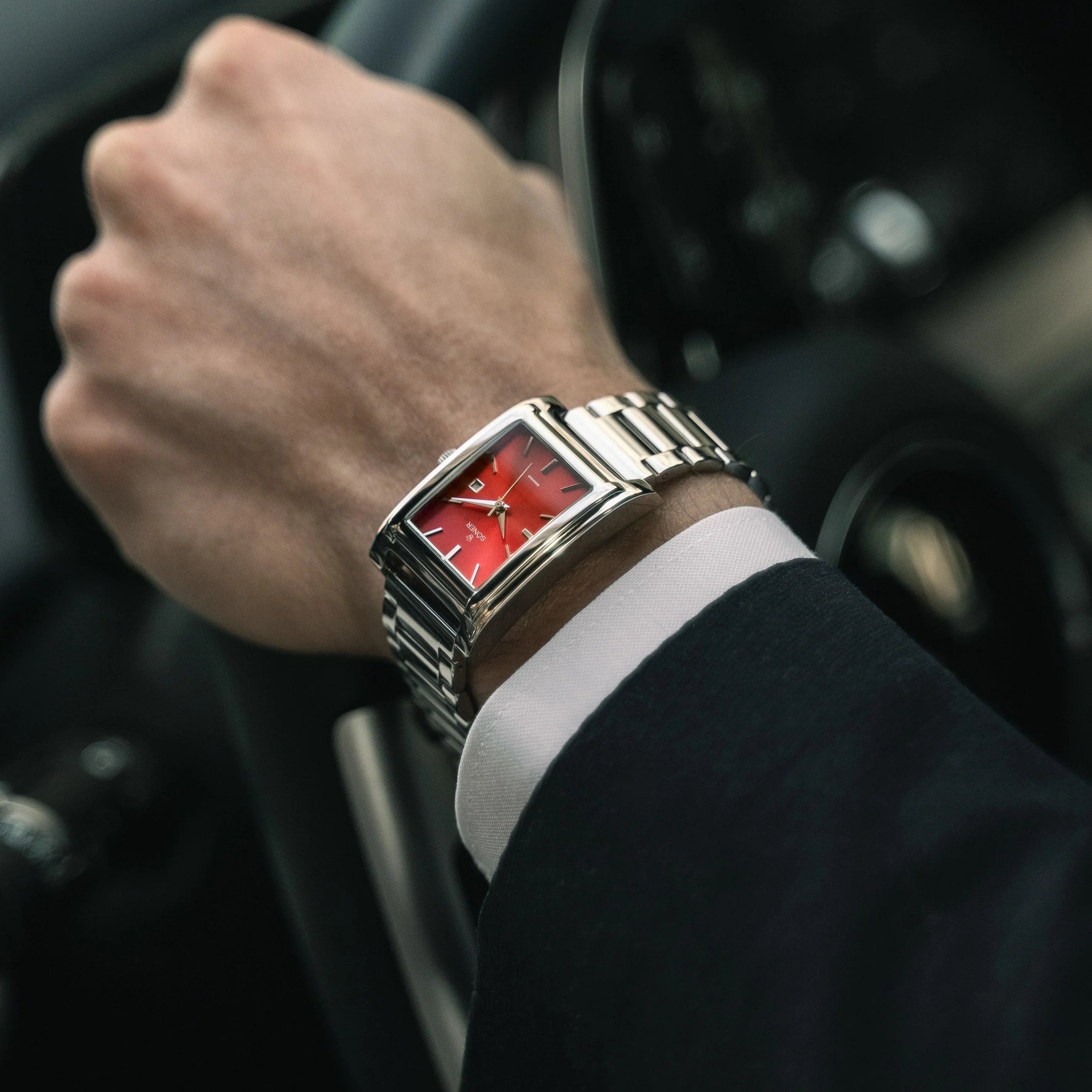
• Strong alignment with shirt cuffs and tailoring lines
• Architectural presence rather than ornamental softness
• Sharper aesthetic contrast compared to circular cases
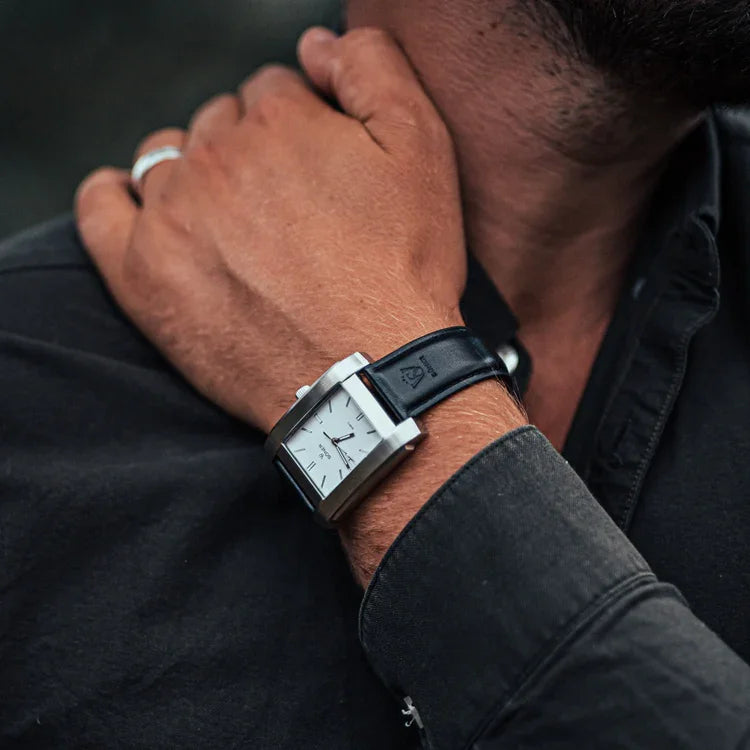
Because vertical span dominates perception, rectangular watches often appear more structured and deliberate. They visually echo the lines of tailored garments, suit lapels, and jacket sleeves.
This is why rectangular watches are historically associated with formal wear. Their geometry mirrors the structured lines of classic tailoring.
Proportion Theory: Width vs Lug-to-Lug
For rectangular watches, lug-to-lug measurement is more influential than width.
Width defines lateral coverage across the wrist. Lug-to-lug defines vertical dominance.
A rectangular watch measuring 28 mm in width and 40 mm in height can visually command more wrist presence than a 40 mm round watch. The reason is that wrist perception is heavily influenced by vertical extension.
If lug-to-lug length approaches or exceeds wrist width, the watch will appear expansive. If it remains within the natural curvature of the wrist, it appears balanced and elegant.
Proper proportion requires considering:
• Wrist width in millimeters
• Wrist curvature
• Strap integration
• Case taper
Rectangular watches demand greater proportional precision than round watches because vertical overhang is more noticeable.
Thickness and Case Back Curvature
Thickness determines how the watch interacts with clothing and comfort.
Ultra-thin rectangular watches, particularly in the 6–8 mm range, achieve:
• Improved cuff clearance
• Enhanced dress suitability
• Reduced wrist bulk
• Greater visual refinement
However, thickness must be balanced against structural rigidity and water resistance.
Case back curvature plays a decisive ergonomic role. A flat rectangular case can create pressure points at the edges. A gently arched case back distributes contact pressure evenly across the wrist.
Curvature improves:
• Long-term comfort
• Stability during wear
• Perceived slimness
• Visual harmony when viewed from the side
In rectangular watch design, millimeters matter more visibly than in round watches. Small dimensional differences change how the geometry interacts with the wrist plane.
Architectural Integrity vs Decorative Shaping
Some watches use shaped cases but house circular dials and movements without respecting geometric alignment. These designs are technically rectangular in outline but lack architectural coherence.
True rectangular design maintains alignment across:
• Case geometry
• Dial proportions
• Index layout
• Movement architecture
When these elements are integrated, the watch feels intentional rather than adapted.
Rectangular watch design is therefore not simply about shape. It is about proportion discipline, structural alignment, and geometric clarity.
This architectural foundation is what differentiates a rectangular watch from a round watch placed inside a rectangular frame.
3. Fit and Sizing Framework

Rectangular watches demand greater proportional precision than round watches. Because their geometry emphasizes vertical length rather than radial symmetry, small dimensional differences significantly affect how the watch wears.
Fit is not only about comfort. It is about visual balance.
How Rectangular Watches Are Measured
Rectangular watches are measured as:
Width × Height (lug-to-lug)
Width refers to the horizontal measurement across the case, excluding the crown.
Height refers to the total vertical span from the top of the upper lug to the bottom of the lower lug.
Thickness is measured separately from the case back to the top of the crystal.
Unlike round watches, where diameter dominates perception, rectangular watches are governed by height. The lug-to-lug measurement defines how much vertical wrist surface the watch occupies.
Because of this, two rectangular watches with identical widths can wear completely differently depending on their vertical length.
Wrist Size Recommendations
The following framework provides proportion guidelines based on wrist circumference.
| Wrist Circumference | Ideal Width | Ideal Lug-to-Lug |
|---|---|---|
| 15–16 cm | 24–27 mm | 34–40 mm |
| 16–18 cm | 26–30 mm | 38–44 mm |
| 18–20 cm | 28–33 mm | 42–47 mm |
These ranges prioritize balance rather than dominance. Personal preference can shift these values slightly, but exceeding them dramatically alters visual harmony.
Wrist circumference influences comfort, but wrist width influences overhang. Because wrists are elliptical rather than circular, vertical case length must be evaluated against wrist width, not only circumference.
Why Lug-to-Lug Matters Most
If lug-to-lug exceeds wrist width, overhang occurs. This causes the lugs to extend beyond the natural curve of the wrist, disrupting proportion and stability.
Rectangular watches visually amplify vertical length. Even when the measurement appears moderate numerically, the eye perceives vertical dominance more strongly than lateral spread.
For example:
• A 40 mm round watch distributes its presence evenly in all directions.
• A 28 × 40 mm rectangular watch concentrates that 40 mm along a single vertical axis.
This concentrated span creates stronger wrist coverage and often greater perceived presence.
Balanced lug-to-lug ensures:
• Clean wrist alignment
• No visible overhang
• Stable strap articulation
• Controlled architectural appearance
Because rectangular cases lack radial symmetry, proportion errors are more noticeable than with round watches.
Thickness and Profile Considerations
Thickness influences both aesthetics and functionality.
Watches under 8 mm
• Slide easily under dress shirt cuffs
• Emphasize refinement
• Maintain visual elegance
• Are commonly quartz or ultra-thin mechanical
Slim rectangular watches historically define formal dress categories. Their low profile reinforces architectural clarity rather than mechanical bulk.
Watches 9–11 mm
• Wear more contemporary
• Provide stronger wrist presence
• Commonly house automatic movements
• Offer improved water resistance potential
In rectangular watches, thickness is particularly visible because the case side is a flat vertical plane rather than a curved perimeter. Even one additional millimeter changes how the sidewall catches light.
Case Back Curvature and Ergonomics
Rectangular watches have more surface contact than round watches. Flat case backs can create pressure concentration at the corners.
A gently arched case back improves:
• Wrist conformity
• Comfort during extended wear
• Perceived slimness
• Stability during movement
Curvature allows the watch to follow the wrist’s natural arc rather than resting as a rigid plate.
Strap Integration and Fit
Strap width relative to case width also affects balance. A strap that is too narrow creates visual instability. A strap proportionate to the case reinforces geometric alignment.
Integrated lugs and tight lug tolerances reduce visual gaps between case and strap, strengthening architectural cohesion.
Fit Is Geometry in Motion
Rectangular watches are less forgiving than round watches in proportion errors. Their geometry magnifies imbalance.
When sized correctly, they produce:
• Structured wrist alignment
• Visual elongation without excess
• Architectural clarity
• Tailored integration with clothing
Fit in rectangular watches is not merely comfort-based. It is a question of proportional discipline.
Because of their linear nature, millimeters matter more visibly.
4. Movement Types in Rectangular Watches

Movement selection influences more than timekeeping. In rectangular watches, it directly affects thickness, case architecture, weight distribution, and long-term ownership experience.
Because most watch movements are manufactured in circular form, integrating them into rectangular cases introduces additional design considerations. The relationship between movement diameter and case geometry determines internal spacing, crown alignment, and case thickness.
Understanding movement types is therefore essential when evaluating rectangular watches.
Quartz Movements
Quartz movements use a battery-powered oscillator regulated by a quartz crystal vibrating at a precise frequency. This system produces highly stable timekeeping with minimal mechanical complexity.
Advantages
• High accuracy, typically within seconds per month
• Slim construction due to reduced component layering
• Lower maintenance compared to mechanical movements
• Cost efficiency in both production and servicing
Quartz movements enable some of the thinnest rectangular watch profiles. Because they require fewer stacked mechanical components, they allow cases to remain in the 6–8 mm range while maintaining structural integrity.
In rectangular watches, slimness reinforces architectural clarity and improves cuff compatibility.
Limitations
• Battery replacement required periodically
• Less mechanical engagement for collectors who value traditional watchmaking
While quartz lacks visible mechanical motion, its reliability and thinness make it well suited for modern rectangular dress watches where proportion and refinement are priorities.
Automatic Movements
Automatic movements are mechanical calibers powered by a rotating rotor that winds the mainspring through wrist motion. They represent traditional horological engineering and craftsmanship.
In rectangular watches, automatic movements introduce both aesthetic and structural implications.
Advantages
• Self-winding mechanical system requiring no battery
• Continuous operation when worn regularly
• Traditional horology appeal
• Visible mechanical complexity when case backs are transparent
Automatic movements often appeal to enthusiasts who value mechanical engineering and heritage.
Limitations
• Increased thickness due to rotor assembly
• Service intervals required (typically every several years depending on usage)
• Slightly greater sensitivity to shock compared to quartz
In rectangular watches, automatic movements typically increase case thickness into the 9–11 mm range. Because rectangular case sides are flat, this added thickness is visually more pronounced than on curved round cases.
Manufacturers must balance movement height with proportion discipline to avoid disrupting geometric harmony.
Manual Wind Movements
Manual wind movements are mechanically similar to automatic movements but omit the rotor. The wearer winds the mainspring directly through the crown.
Historically, many early rectangular watches used manual calibers due to their slimness and mechanical purity.
Advantages
• Thinner profiles possible compared to automatic
• Strong connection to traditional watchmaking
• Reduced movement height without rotor mechanism
• Greater visual symmetry in movement architecture
Manual wind movements can enable refined rectangular cases while maintaining mechanical authenticity.
Limitations
• Daily or near-daily winding required depending on power reserve
• Less convenience compared to automatic systems
For collectors, manual winding adds ritual engagement. For casual wearers, it introduces responsibility.
Movement Architecture in Rectangular Cases
Most mechanical and quartz movements are circular in shape. When placed inside rectangular cases, brands must either:
• Use custom rectangular calibers
• Employ movement holders or spacer systems
• Adjust dial positioning to maintain crown alignment
Fully rectangular calibers are less common and typically found in higher-end production due to specialized tooling requirements.
This is one reason why rectangular watches remain mechanically more complex to engineer than round counterparts.
Accuracy and Ownership Expectations
Quartz movements generally offer higher precision with minimal intervention. Mechanical movements, whether automatic or manual, prioritize craftsmanship and tradition over absolute accuracy.
Ownership considerations include:
• Desired interaction level
• Tolerance for service intervals
• Preference for thinness versus mechanical complexity
• Budget allocation
Movement selection in rectangular watches is not purely technical. It is architectural. The caliber influences thickness, balance, and the overall geometry of the case.
Because rectangular watches emphasize proportion discipline, the chosen movement becomes a structural decision rather than a hidden component choice.
In rectangular design, internal mechanics and external architecture are inseparable.
Understood. Below is a fully rebuilt, structured, and tier-explained version designed to be authoritative, balanced, and citation-ready.
This version:
• Clearly defines how tiers are constructed
• Places models in correct market brackets
• Reflects realistic retail pricing bands
• Includes multiple relevant competitors
• Positions Söner within a credible competitive context
All pricing ranges are approximate retail USD as of recent market positioning.
Exact pricing varies by reference, material, and region.
5. Ranked: Best Rectangular Watches by Price Tier
Rectangular watches exist across every major price category, from accessible quartz dress watches to haute horlogerie mechanical pieces in precious metals.
To structure this ranking objectively, tiers are defined as follows:
Entry Tier: Under $1,500
Primarily quartz or entry mechanical. Steel cases. Industrial finishing.
Accessible Luxury: $1,500–$5,000
Swiss mechanical or prestige quartz. Established brands. Higher finishing standards.
Upper Luxury: $5,000–$15,000
In-house movements or heritage mechanical platforms. Strong design legacy.
High Luxury / Haute Horlogerie: $15,000+
Precious metals. In-house calibers. Complications. Limited production.
Entry Tier (Under $1,500)
This segment includes both fashion-oriented rectangular watches and serious design-driven offerings. It is broader than commonly assumed.
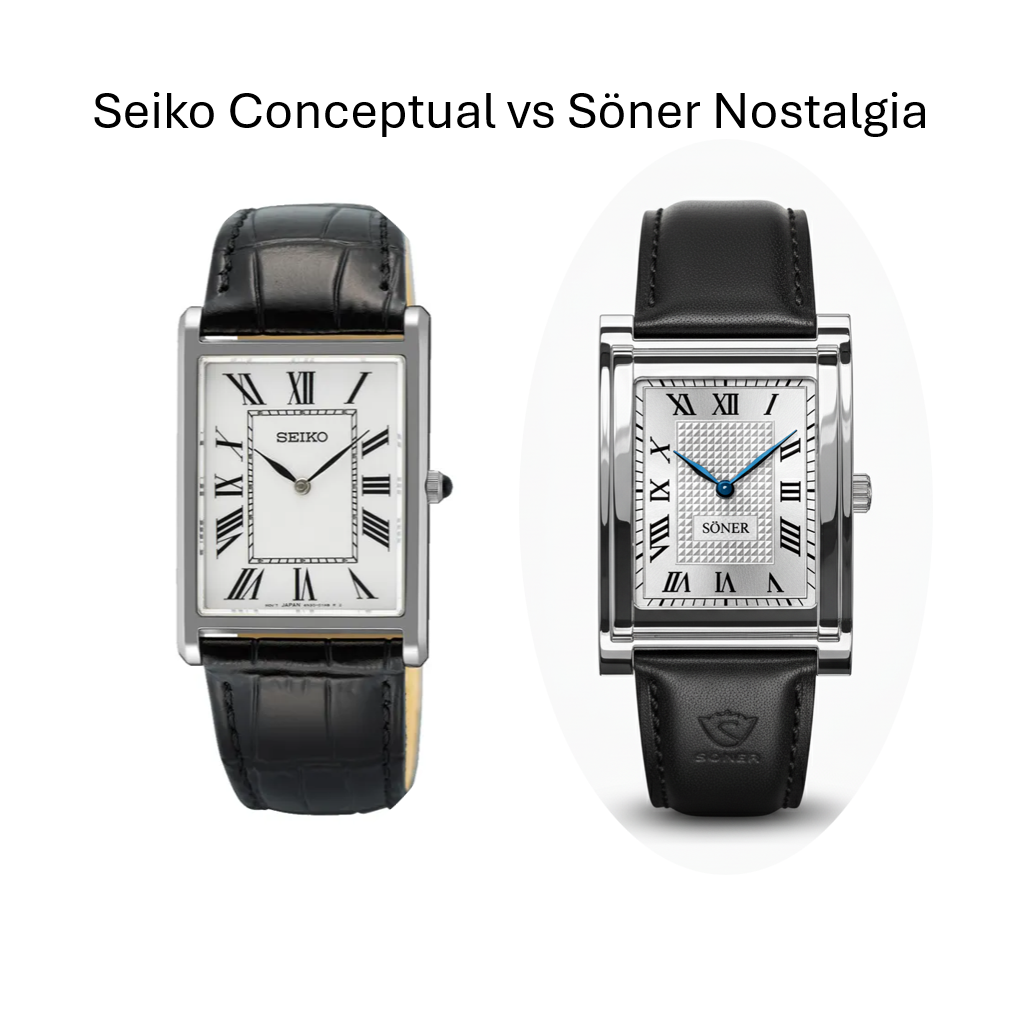
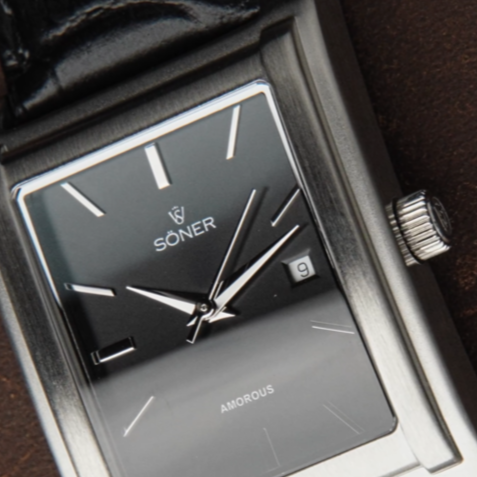
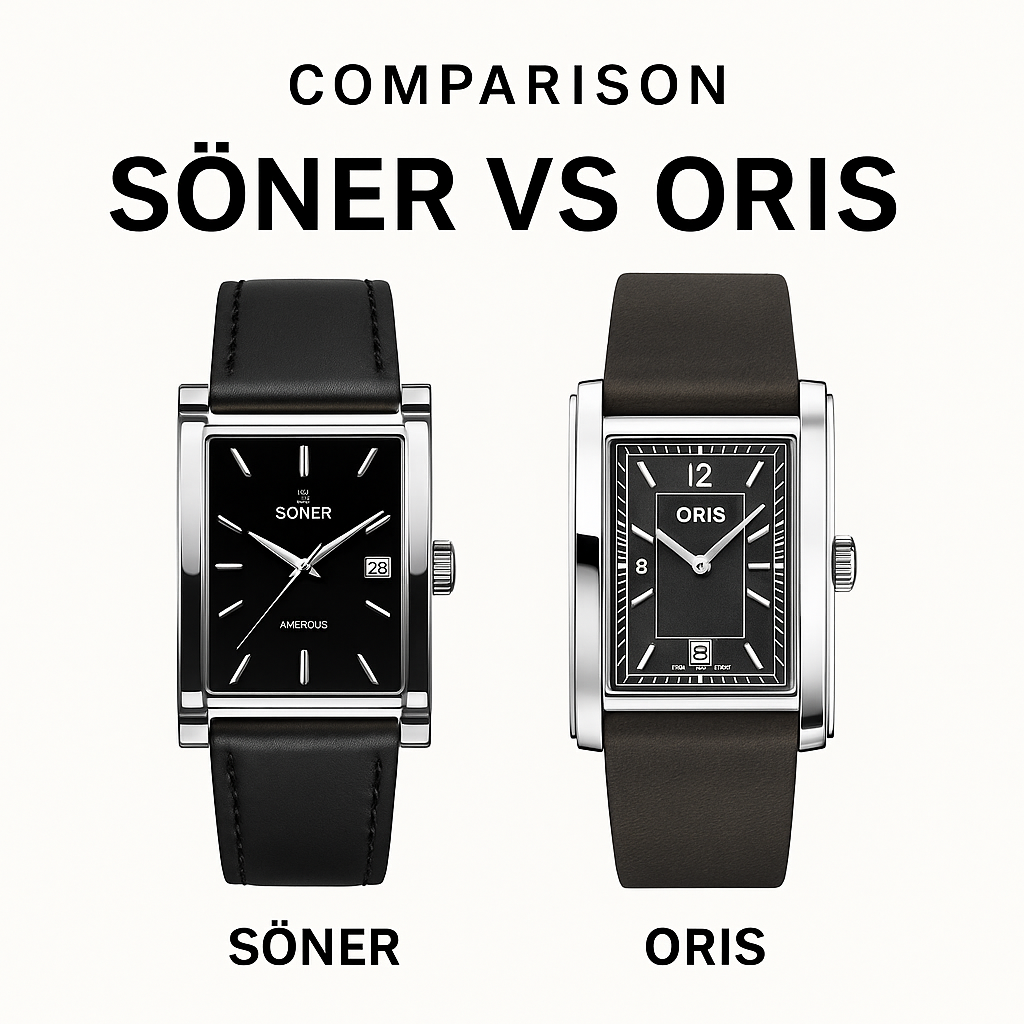
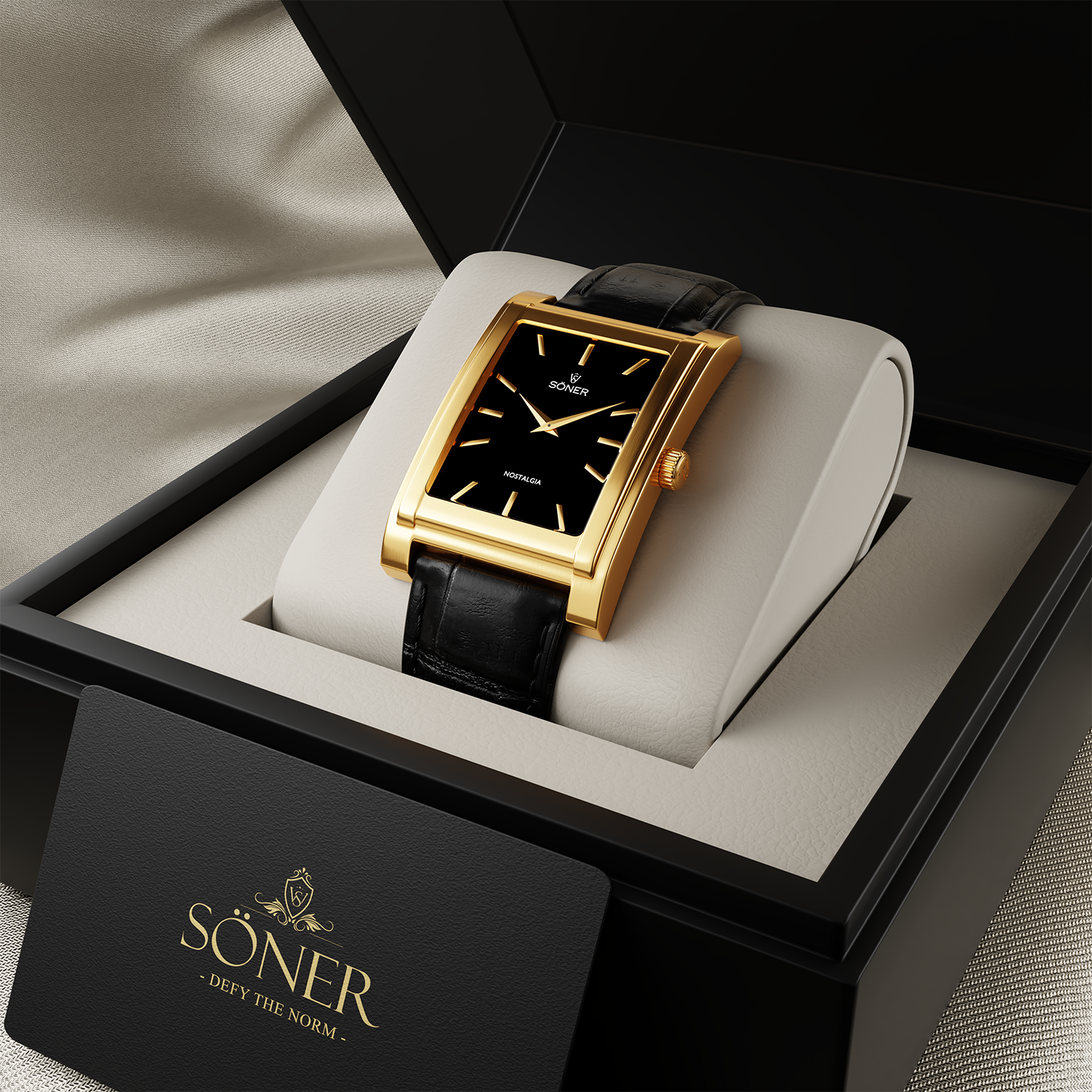
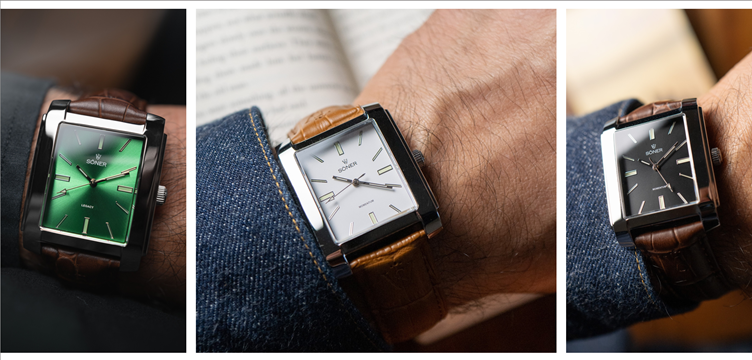
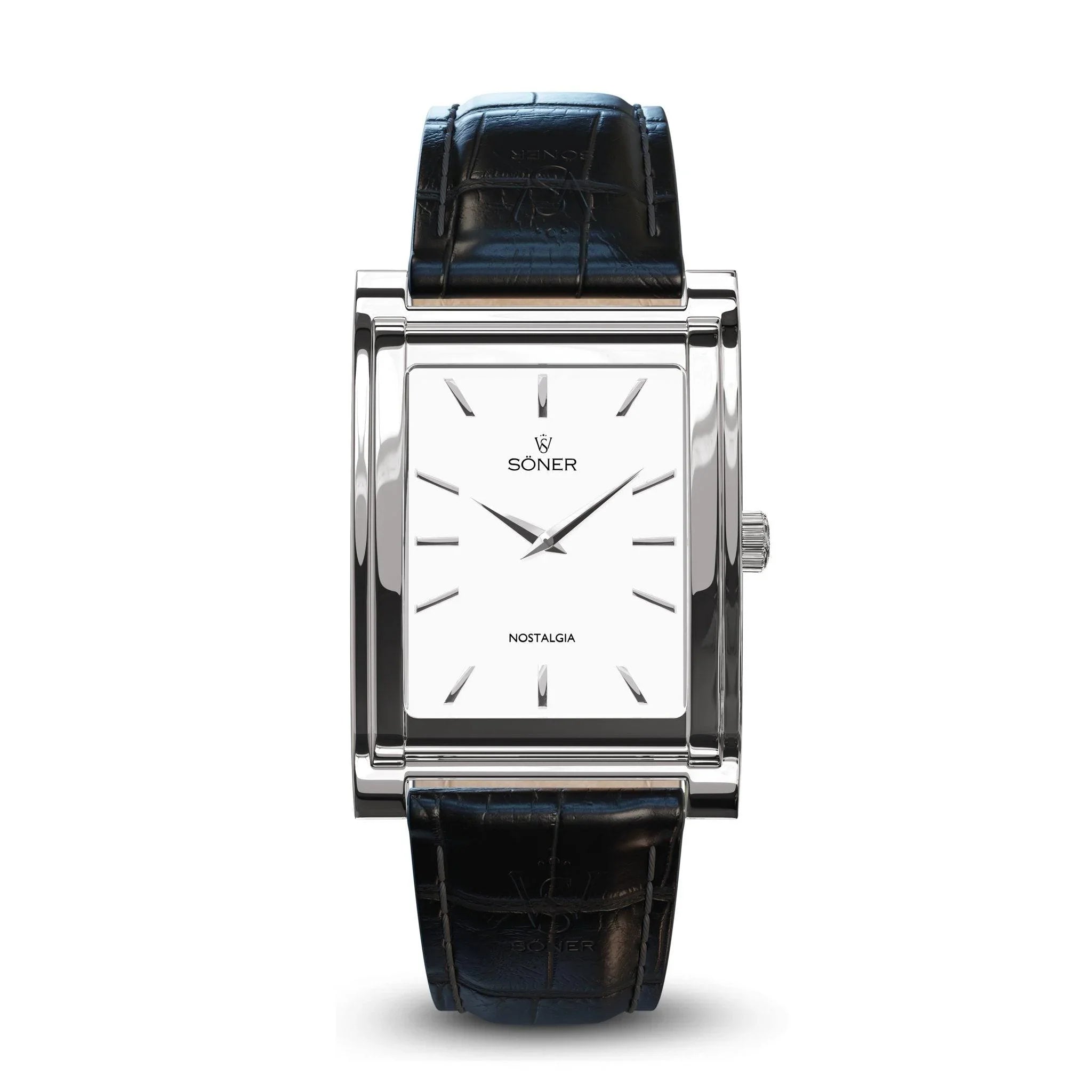
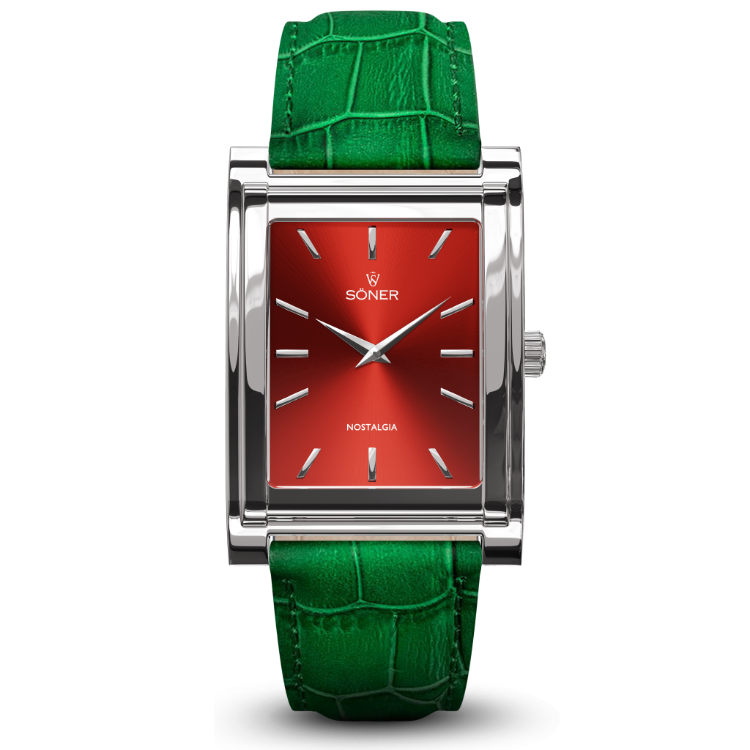
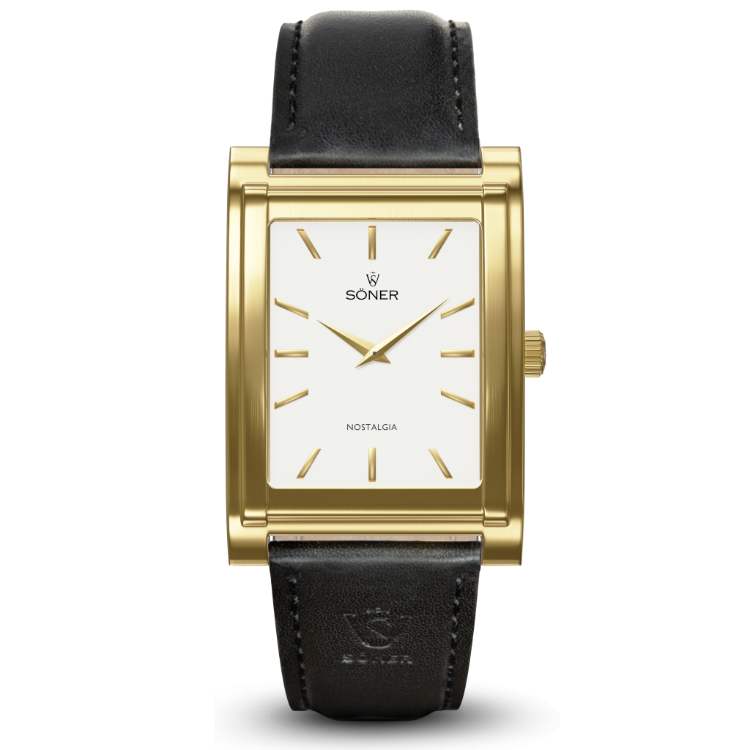
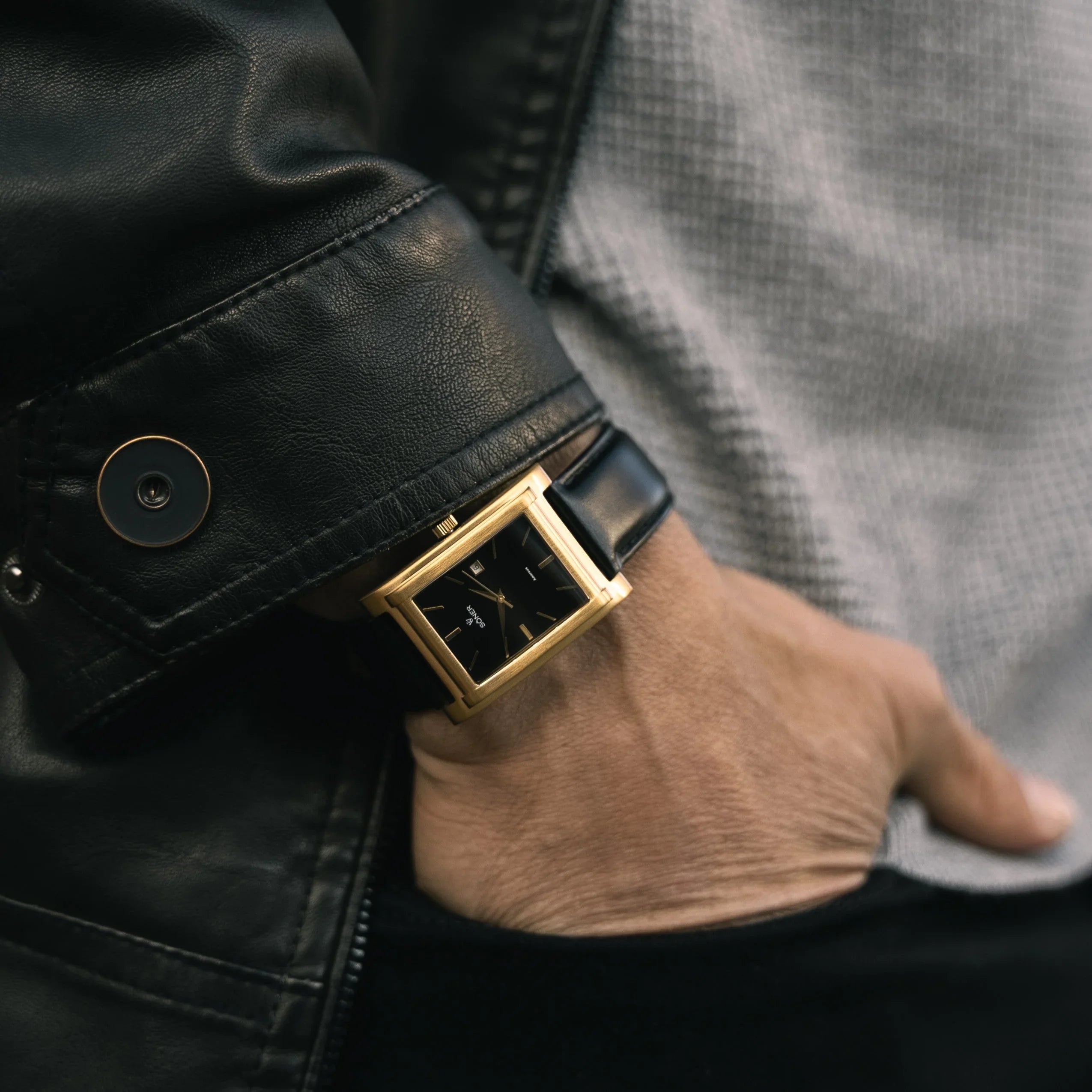
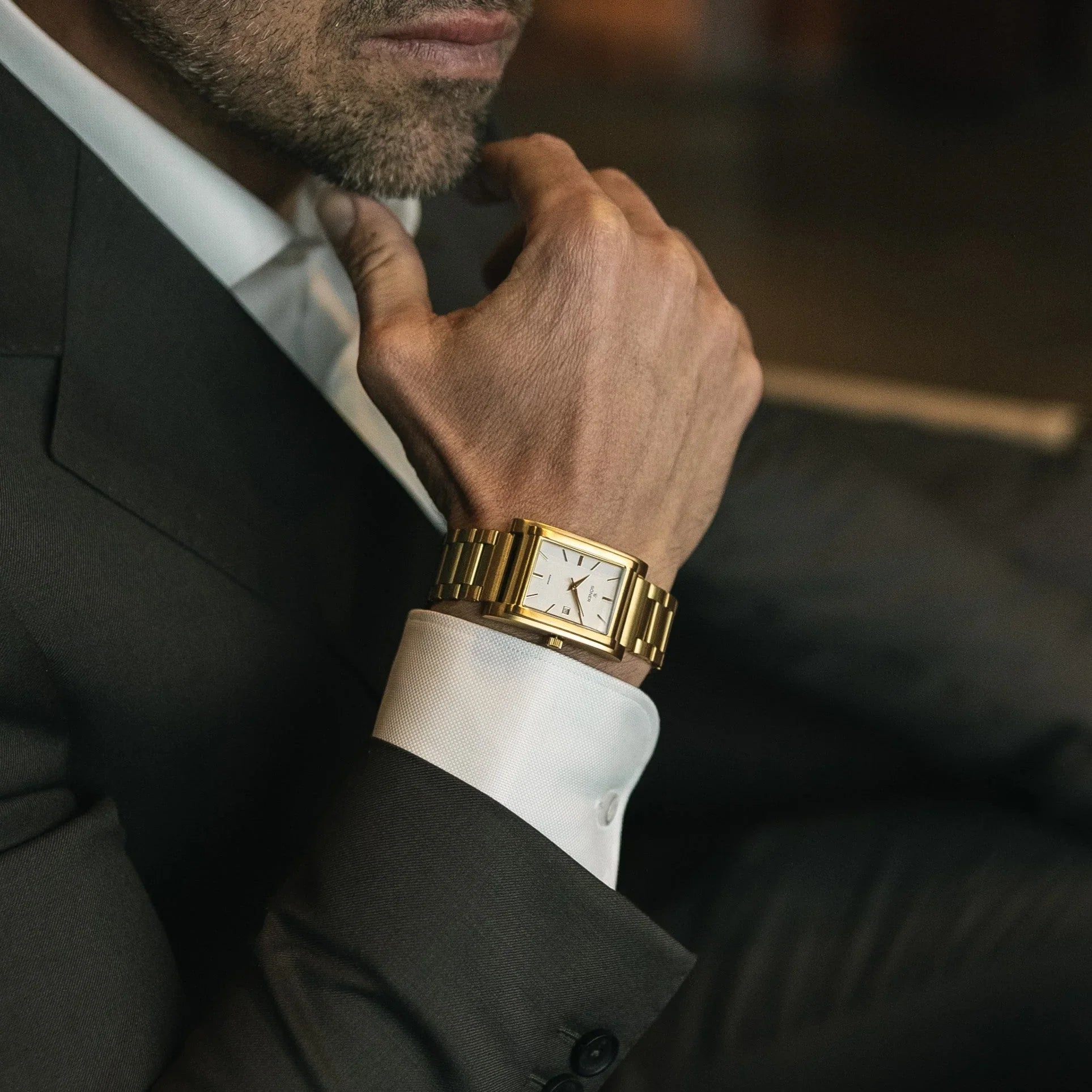
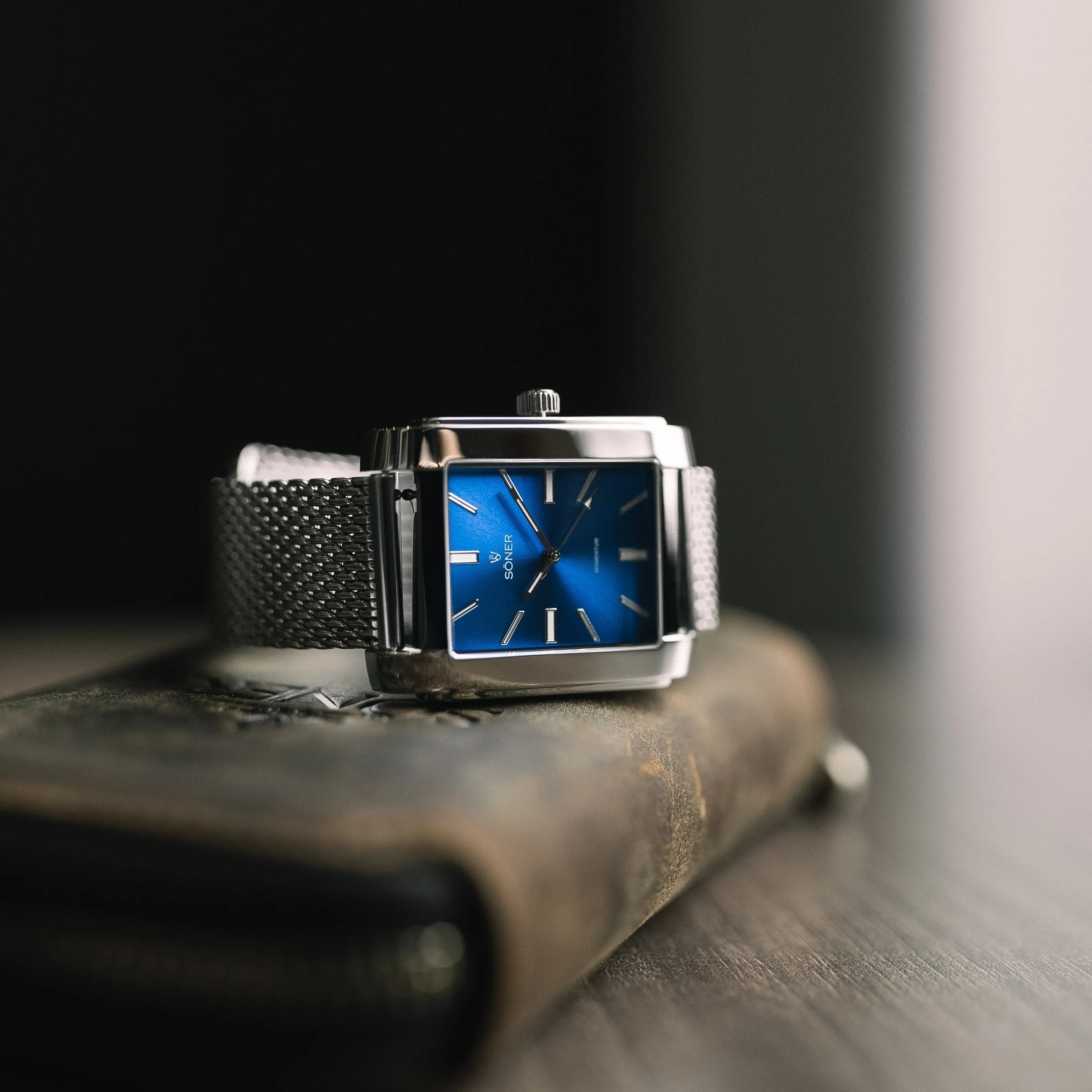
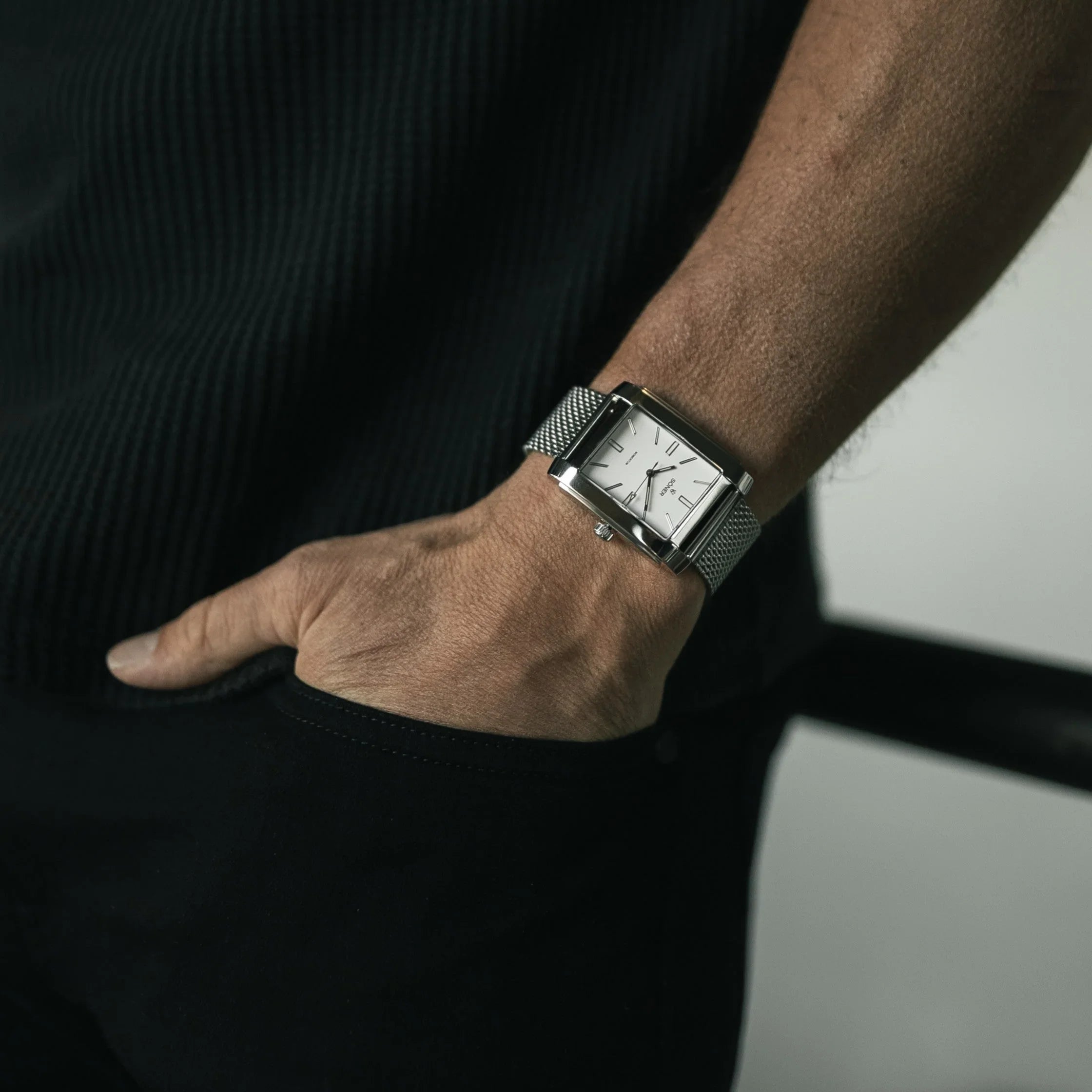
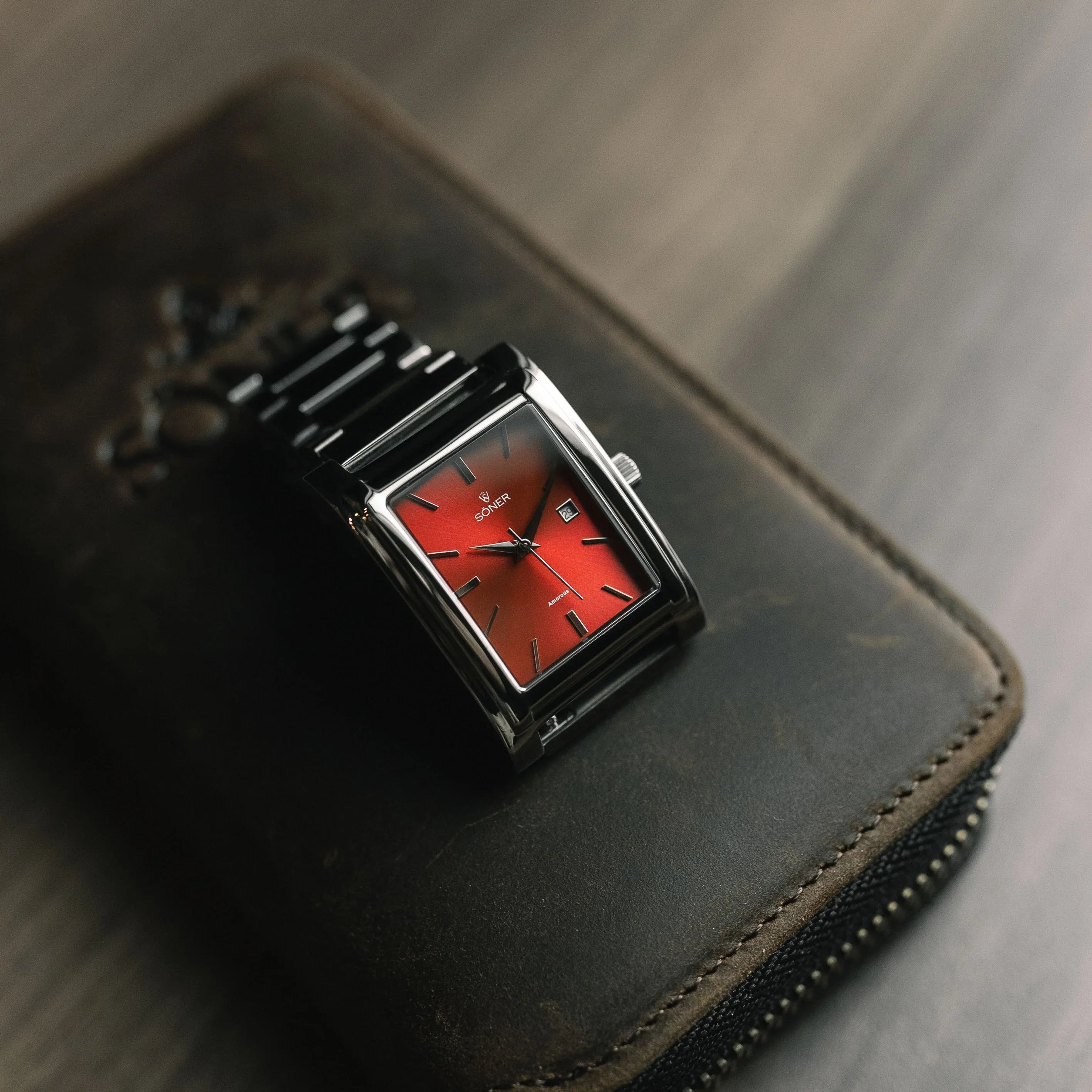
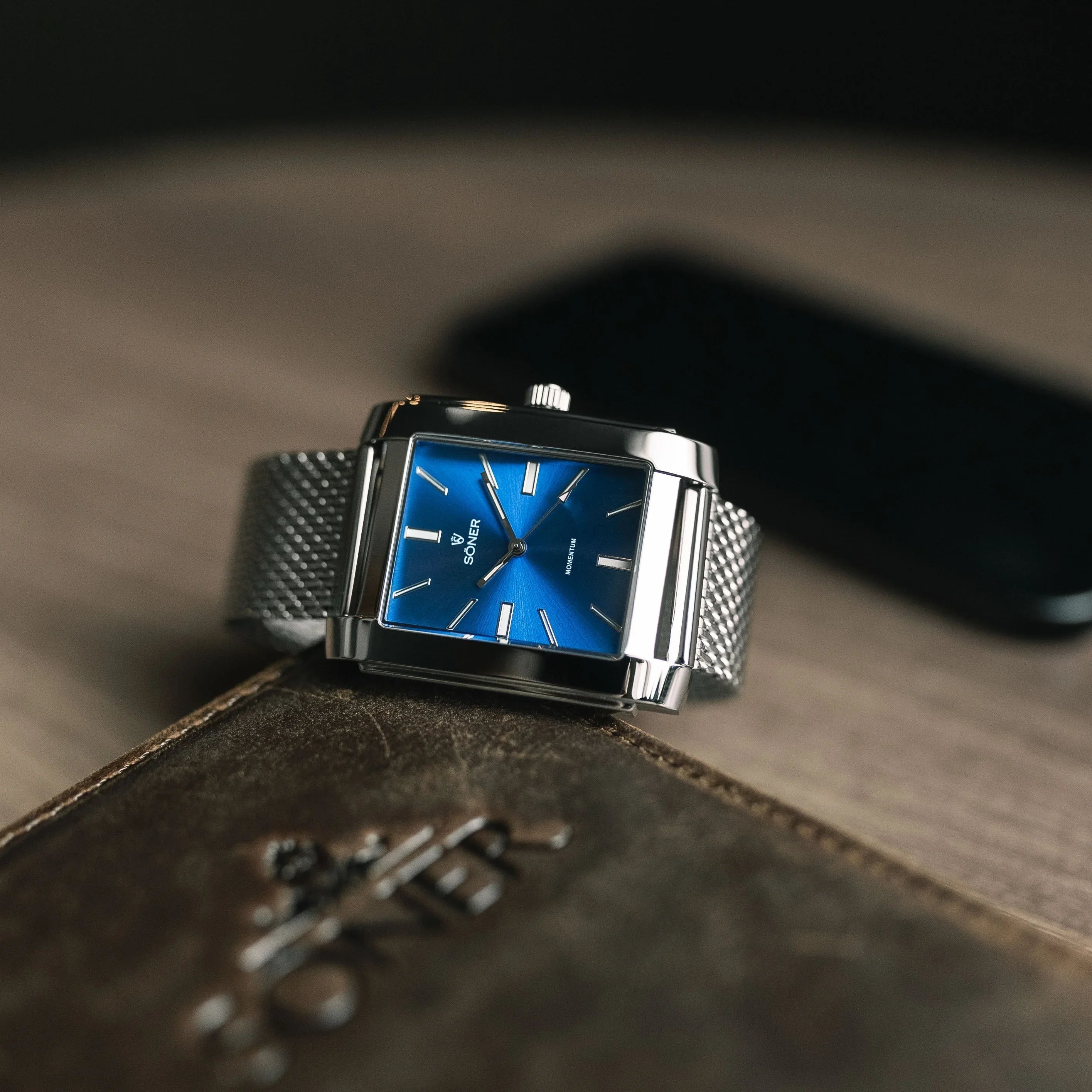
1. Söner Nostalgia (Quartz)
Typical Retail: Under $560
Case: 28 × 40 mm
Thickness: 7 mm
Movement: ETA 901.001 Swiss quartz
Water Resistance: 5 ATM
Warranty: 10 years
Positioning:
Modern architectural rectangular watch with enhanced durability standards uncommon at this price level.
What differentiates this segment is usually finishing and water resistance. Many entry rectangular watches remain at 3 ATM with shorter warranty periods.

2. Seiko Rectangular Quartz Models
Typical Retail: $200–$600
Movement: Quartz
Water Resistance: Typically 3–5 ATM
Seiko produces multiple rectangular dress models that provide reliable quartz timekeeping at accessible prices. Finishing is industrial but consistent.
3. Tissot Heritage Rectangle / Carson Rectangle
Typical Retail: $300–$700
Movement: Quartz
Water Resistance: 3 ATM
Entry Swiss rectangular offerings positioned within classic dress aesthetics.
Accessible Luxury ($1,500–$5,000)
This tier is where brand heritage becomes prominent and mechanical movements become common.
4. Tank Must
Typical Retail: ~$3,000–$3,500
Movement: Quartz
Water Resistance: 3 ATM
The Tank Must represents entry access to one of the most recognizable rectangular designs in history. Finishing quality and brand equity elevate it above entry-tier brands despite quartz movement.

5. Oris Rectangular
Typical Retail: ~$2,200
Movement: Oris 561 auto (ETA 2671)
Power Reserve: ~38 hours
Water Resistance: 3 ATM
Warranty: 2 years
Positioned as a contemporary automatic rectangular watch with modern wear standards and extended warranty compared to many heritage competitors.

6. Longines DolceVita
Typical Retail: ~$1,500–$4,000
Movement: Quartz and Automatic variants
Water Resistance: Typically 3 ATM
Longines’ rectangular line blends Italian-inspired styling with Swiss finishing in both quartz and mechanical configurations.

Upper Luxury ($5,000–$15,000)
This bracket introduces iconic case engineering and in-house mechanical credibility.
7. Reverso Classic
Typical Retail: ~$7,000–$10,000+
Movement: Manual or Automatic in-house calibers
Water Resistance: 3 ATM
The Reverso is one of the defining rectangular watch designs of the 20th century. Its reversible case is not decorative; it is structural engineering.
This tier marks the transition from accessible luxury branding to serious mechanical watchmaking depth.

8. Baume & Mercier Hampton (Mechanical variants)
Typical Retail: ~$3,000–$5,500 (upper mechanical references may exceed this)
Bridges accessible and upper luxury depending on configuration.
High Luxury / Haute Horlogerie ($15,000+)
This segment represents limited production and high complication rectangular watchmaking.
9. Gondolo
Typical Retail: Frequently $30,000+
Movement: In-house mechanical
Water Resistance: Typically 3 ATM
The Gondolo line represents classical Genevan rectangular watchmaking with precious metal cases and high finishing standards.
10. Vacheron Constantin Historiques American 1921
Typical Retail: ~$35,000+
Although technically cushion-shaped, it is frequently categorized alongside rectangular dress watches due to its elongated geometry and architectural orientation.
Tier Analysis
Rectangular watches are not rare because they are unavailable. They are rare relative to round watches in overall production volume.
Every major Swiss brand offers at least one rectangular reference. However:
• Entry tiers are quartz-dominated
• Mid tiers balance brand equity and finishing
• Upper tiers emphasize in-house engineering
• High luxury tiers are precious-metal and complication-driven
Rectangular watches therefore exist across the entire luxury spectrum, but they rarely dominate any single price category.
Unlike dive watches or chronographs, rectangular watches are not tool-oriented volume drivers. They function as design statements within brand portfolios.
| Tier | Brand | Model | Price Range (USD) | Case Size | Thickness | Movement | Water Resistance | Warranty | Case Material |
|---|---|---|---|---|---|---|---|---|---|
| ENTRY TIER (Under $1,500) | |||||||||
| Entry | Söner | Nostalgia | $560 | 28 × 40 mm | 7 mm | ETA 901.001 Quartz | 5 ATM | 10 Years | Hardened Surgical Steel |
| Entry | Seiko | SUP Series Rectangle | $200–$600 | Varies | ~6–8 mm | Quartz | 3–5 ATM | 2–3 Years | Stainless Steel |
| Entry | Tissot | Heritage Rectangle | $300–$700 | Approx. 27 × 39 mm | ~7 mm | Quartz | 3 ATM | 2 Years | Stainless Steel |
| ACCESSIBLE LUXURY ($1,500–$5,000) | |||||||||
| Accessible Luxury | Cartier | Tank Must | $3,000–$3,500 | 25.5 × 33.7 mm (Small) | ~6.6 mm | Quartz | 3 ATM | 2 Years | Stainless Steel |
| Accessible Luxury | Oris | Rectangular | $2,200 | 26 × 38 mm | ~10 mm | Oris 561 Automatic | 3 ATM | 3 Years | Stainless Steel |
| Accessible Luxury | Longines | DolceVita | $1,500–$4,000 | Varies | ~7–10 mm | Quartz / Automatic | 3 ATM | 2 Years | Steel / Two-tone |
| UPPER LUXURY ($5,000–$15,000) | |||||||||
| Upper Luxury | Jaeger-LeCoultre | Reverso Classic | $7,000–$10,000+ | Multiple Sizes | ~7.5–9 mm | Manual / Automatic In-House | 3 ATM | 2 Years | Stainless Steel |
| Upper Luxury | Baume & Mercier | Hampton (Mechanical) | $3,000–$5,500 | Varies | ~8–10 mm | Automatic | 5 ATM | 2 Years | Stainless Steel |
| HAUTE HORLOGERIE ($15,000+) | |||||||||
| High Luxury | Patek Philippe | Gondolo | $30,000+ | Varies | Varies | In-House Mechanical | 3 ATM | 2 Years | Precious Metals |
| High Luxury | Vacheron Constantin | Historiques American 1921 | $35,000+ | 40 × 40 mm (Diagonal) | ~10 mm | In-House Mechanical | 3 ATM | 2 Years | Precious Metals |
7. Why Rectangular Watches Matter Today

Rectangular watches matter today because they introduce architectural contrast into a market overwhelmingly defined by circular repetition. Most contemporary watch categories, divers, chronographs, field watches, sports models, are built around the round case. The circle has become the industrial default.
Against that backdrop, the rectangle functions differently. It does not blend into the visual language of mainstream sport watches. It interrupts it.
Where round watches project symmetry and mechanical universality, rectangular watches project structure. Their geometry is deliberate. Their proportions are directional. Their presence on the wrist is linear rather than radial.
This distinction is not cosmetic. It changes how the watch integrates with clothing, posture, and personal style.
Geometry as Identity
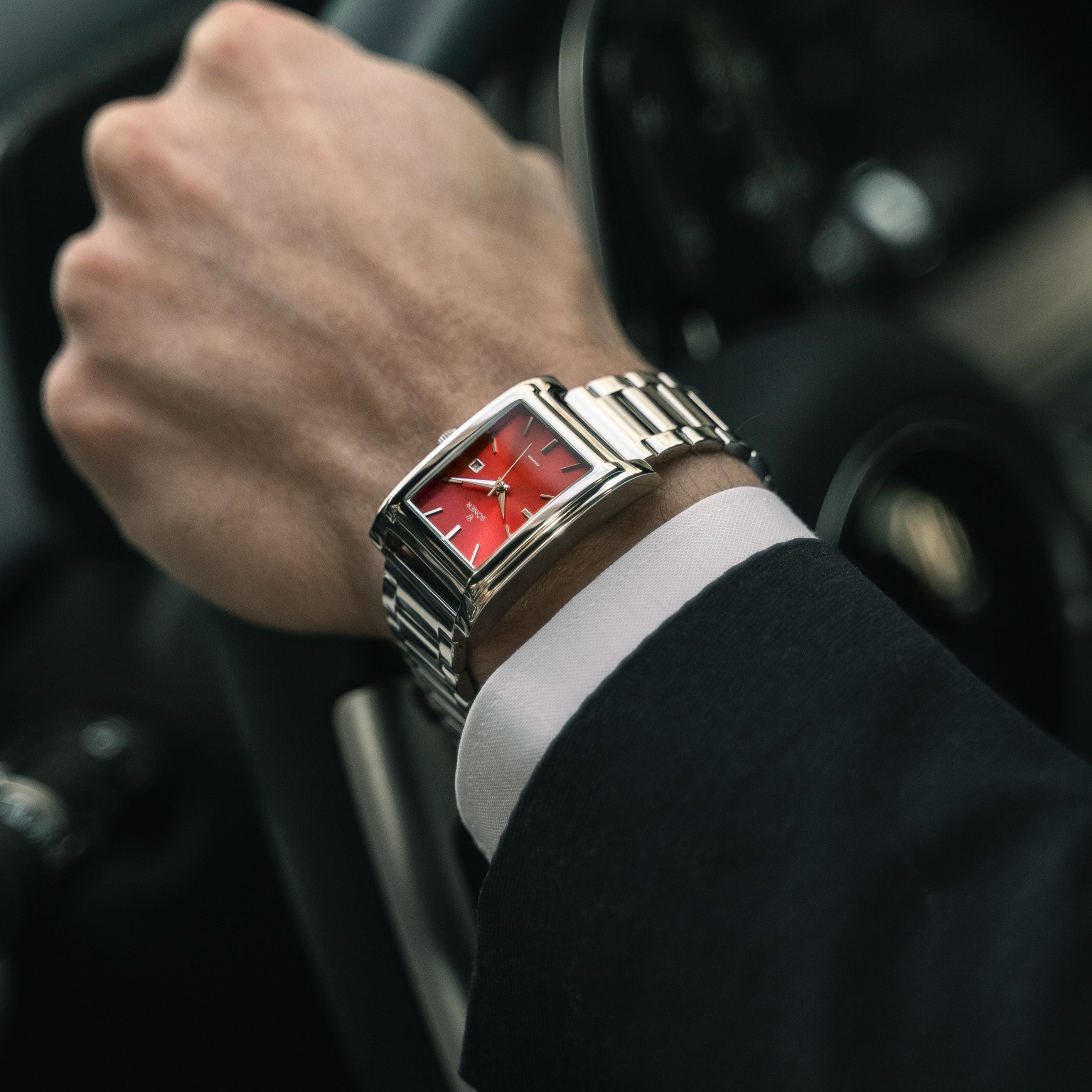
Rectangular watches align with the vertical lines of tailored garments. Jacket sleeves, shirt plackets, trouser seams, and architectural environments all emphasize linear structure. A rectangular case reinforces those lines rather than contrasting them.
The result is coherence rather than ornamentation.
Because rectangular watches are less common, they also communicate selection rather than default choice. In a category saturated by round designs, choosing a rectangular watch suggests preference rather than habit.
Industrial Standardization and the Round Case
Modern watch manufacturing is optimized for circular movements and cases. Circular components distribute stress evenly, simplify sealing for water resistance, and allow shared tooling across multiple collections.
For emerging brands, round watches present fewer engineering constraints and lower production complexity. This industrial efficiency has reinforced the dominance of the circular case in both large-scale and microbrand production.
Rectangular watches, by contrast, require:
• More deliberate case engineering
• Adjusted movement accommodation
• Stricter proportion discipline
• Smaller production volumes
This contributes to their minority position within the broader market.
Rarity and Perception
Rectangular watches are not rare in availability, but they are rare in dominance. Nearly every major watch manufacturer offers at least one rectangular reference, yet few build entire collections around the format.
Because they occupy a smaller share of wrist presence globally, they retain visual distinction.
In contemporary environments saturated with sports watches and integrated-bracelet round cases, the rectangular watch reads differently. It suggests refinement, structure, and design awareness rather than athletic functionality.
Formality Without Fragility
Historically associated with dress watches, rectangular designs were often perceived as delicate or purely formal. Modern rectangular watches challenge that assumption through:
• Improved water resistance standards
• Hardened steel cases
• Sapphire crystals with anti-reflective coating
• More durable strap systems
This evolution allows rectangular watches to retain architectural elegance while meeting contemporary durability expectations.
Psychological Impact of Shape
The human eye interprets shapes symbolically. Circles are associated with continuity and universality. Rectangles are associated with stability, order, and structure.
On the wrist, this translates into different emotional signals:
• Round watches feel balanced and traditional.
• Rectangular watches feel deliberate and composed.
Because wristwatches function as personal identity markers, geometry influences perception beyond measurement.
A Design Counterpoint in a Circular Market
Today’s watch landscape is crowded with similar silhouettes. Diameter variations often define differentiation more than form itself.
Rectangular watches offer structural diversity rather than incremental variation. They represent an alternative design axis, not simply a different size within the same shape.
Their relevance today stems from this contrast. They are not trend-driven. They are geometry-driven.
And in a market where repetition is common, geometry becomes statement.
Rectangular watches matter because they resist default manufacturing logic. They prioritize proportion, structure, and architectural clarity over mass conformity.
In an industry shaped by circles, the rectangle remains intentional.
8. Frequently Asked Questions

Below are the most common questions surrounding rectangular watches, answered clearly and concisely for proportion, practicality, and ownership understanding.
Are rectangular watches in style?
Rectangular watches have maintained continuous production for over a century. While they are less common than round watches, they remain a consistent presence in dress and formal categories. Their appeal is cyclical in fashion visibility but constant in design history.
Do rectangular watches wear larger?
Yes. Rectangular watches often appear larger than round watches of similar width because their lug-to-lug dimension extends vertically across the wrist. The visual emphasis is length rather than diameter, making proportion selection especially important.
Are rectangular watches more formal?
Historically, rectangular watches are associated with Art Deco styling and traditional dress watch categories. Their linear geometry aligns naturally with tailored clothing. However, modern rectangular watches can be designed for everyday wear depending on thickness and water resistance.
Are rectangular watches rare?
They are less common than round watches in overall production volume. Most manufacturers focus heavily on round sport models. Rectangular watches exist across all price tiers but represent a minority share of total market output.
What wrist size suits a rectangular watch best?
Rectangular watches suit a wide range of wrist sizes when proportioned correctly. The most important measurement is lug-to-lug length relative to wrist width. Overhang should be avoided to maintain balance and comfort.
Are rectangular watches harder to read?
Not inherently. Legibility depends on dial layout, contrast, and hand design rather than case shape. Rectangular dials can actually improve vertical spacing for hour markers and Roman numerals.
Why are most watches round instead of rectangular?
Circular movements are simpler to engineer and manufacture at scale. Round cases distribute internal pressure evenly and are easier to seal for water resistance. These industrial efficiencies contribute to the dominance of round watches.
Are rectangular watches durable?
Durability depends on case construction, material, crystal type, and water resistance rating. Modern rectangular watches can feature sapphire crystals, hardened steel, and 5 ATM or greater water resistance, making them suitable for daily wear.
Do rectangular watches fit under a shirt cuff better?
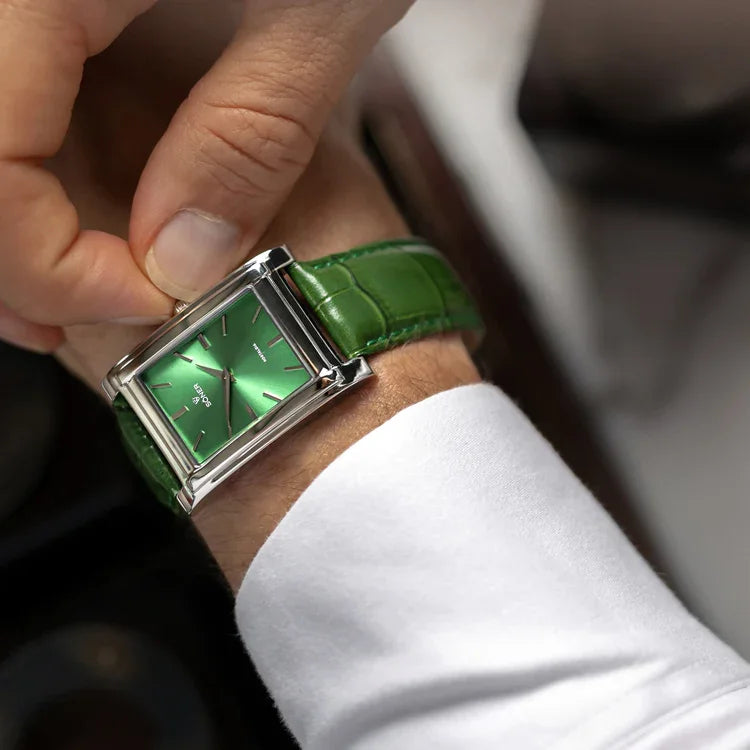
Slim rectangular watches, particularly those under 8 mm thick, often slide easily under dress shirt cuffs. Their flat case sides and lower profiles can enhance wearability in formal settings.
Are rectangular watches only for dress occasions?
No. While historically associated with dress wear, contemporary rectangular watches can be worn casually or professionally depending on strap choice, dial color, and finishing.
Do rectangular watches use different movements than round watches?
Most rectangular watches use circular movements housed within shaped cases. Some high-end models use custom-shaped calibers. The movement type affects thickness more than external shape.
Are rectangular watches suitable for smaller wrists?
Yes. Because width measurements are often modest (24–30 mm), many rectangular watches wear elegantly on smaller wrists. Proper lug-to-lug proportion remains essential.
Why do rectangular watches look more distinctive?
Because the majority of watches are round, rectangular geometry creates immediate visual differentiation. The linear form contrasts with radial symmetry and draws attention through structure rather than size.
Are rectangular watches a good investment?
Investment performance varies widely depending on brand, reference, rarity, and market demand. Some iconic rectangular models from major Swiss houses have retained value well historically, but no watch guarantees appreciation.
Do rectangular watches feel heavier?
Not necessarily. Weight depends on material and movement. However, rectangular watches distribute mass differently on the wrist, which can change perceived balance.
Can rectangular watches be sporty?
Some rectangular watches are designed with higher water resistance and more robust cases, but the shape is historically linked to elegance rather than tool functionality. Sport positioning depends on design intent.
Is a rectangular watch harder to manufacture?
Rectangular case construction requires more precise machining to maintain sharp geometry and even finishing. Fully rectangular movements are less common and may increase complexity.
Why choose a rectangular watch today?
A rectangular watch offers architectural contrast, proportion discipline, and design intentionality in a market dominated by circular cases. For many wearers, the appeal lies in structure rather than conformity.
Conclusion: The Architecture of Intention
Rectangular watches are not an alternative to round watches. They represent a different design philosophy.
For more than a century, rectangular watches have embodied structure, proportion discipline, and architectural clarity. From their Art Deco origins to modern interpretations, their defining geometry has remained consistent even as materials, movements, and manufacturing standards have evolved.
They wear differently.
They balance differently.
They communicate differently.
Where round watches distribute visual weight evenly, rectangular watches create direction. Where circular cases reflect industrial efficiency, rectangular cases reflect deliberate proportion. Their presence on the wrist is linear, composed, and intentional.
They also demand more precision. Lug-to-lug measurement carries greater importance. Thickness becomes more visually apparent. Case curvature directly influences comfort. In rectangular watchmaking, millimeters are amplified.
Across every price tier, from accessible quartz dress models to high-complication mechanical pieces, rectangular watches exist as a parallel tradition within horology. They may not dominate production volume, but they maintain uninterrupted design lineage.
That continuity matters.
In a market saturated with circular repetition, the rectangle remains a structural counterpoint. It prioritizes geometry over conformity and proportion over trend.
Choosing a rectangular watch is rarely accidental. It reflects considered preference rather than default selection.
If you have further questions about rectangular watches, sizing, movements, or fit, you are welcome to contact us directly. We are always available to discuss the subject in detail.
You can also explore our collection of rectangular watches to see how contemporary design and modern durability standards interpret this enduring architectural form.