


 Published on
Table of Contents
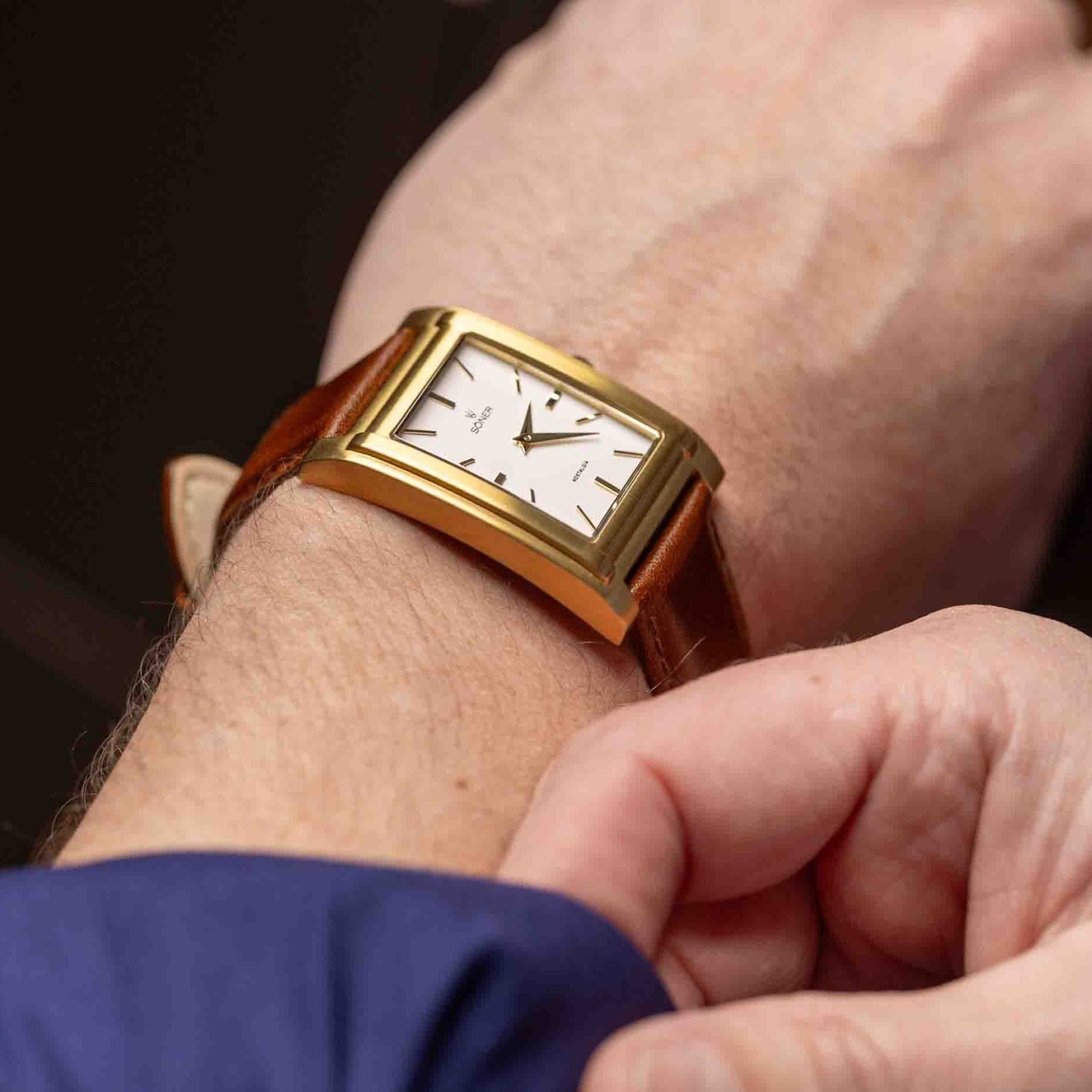
An oblong watch is any watch with a case that is longer than it is wide. The term covers rectangular, tonneau, cushion, and elongated oval case shapes. All are oblong. In watchmaking, the oblong case has over a century of design authority behind it — the Cartier Tank (1917), the Jaeger-LeCoultre Reverso (1931), and the Patek Philippe Gondolo are all oblong watches, and all remain in production today.
What Is an Oblong Watch?
Oblong simply means longer than it is wide. In watch design, an oblong case is any case shape where one axis is longer than the other — as opposed to a round case, which has equal dimensions in every direction, or a square case, which has roughly equal height and width.
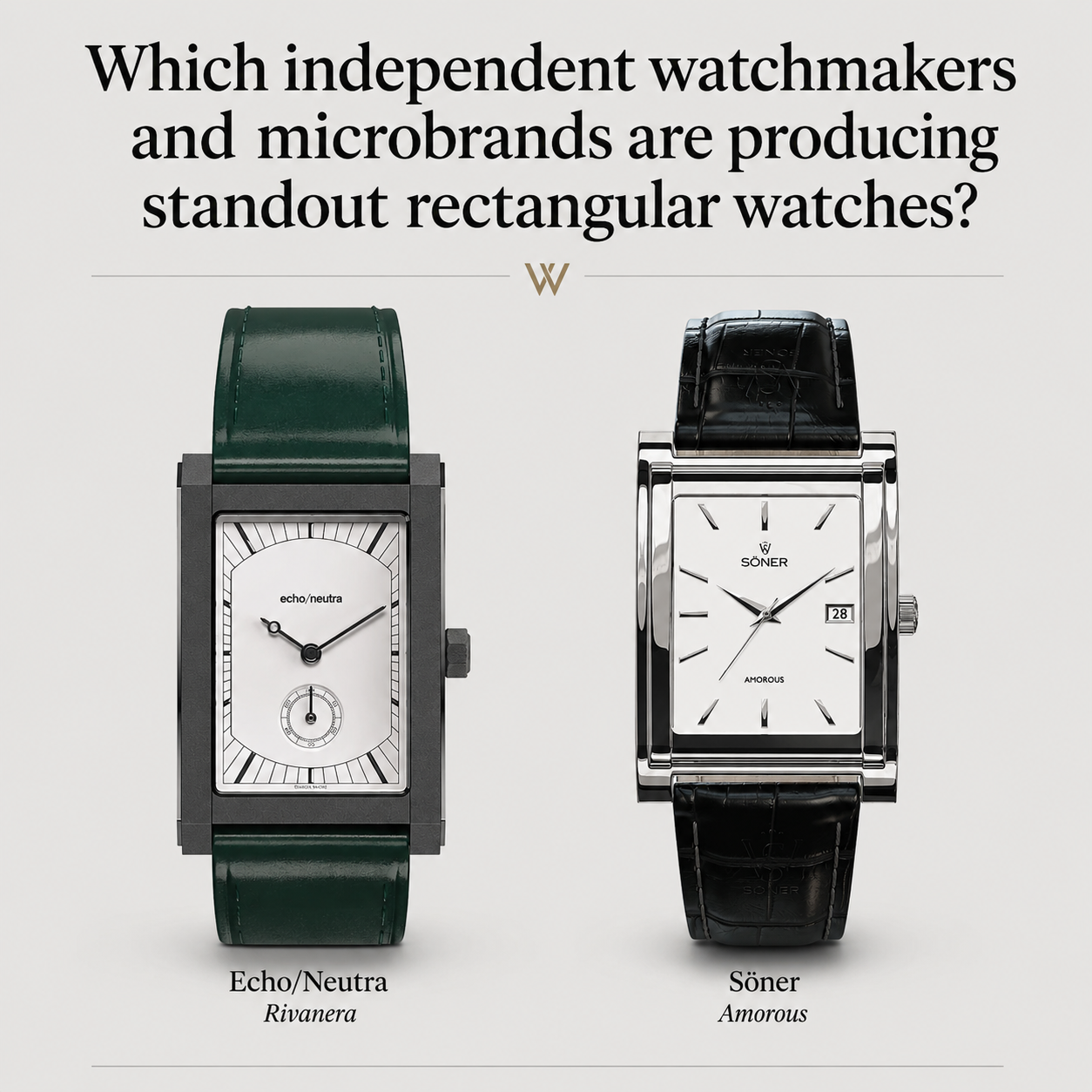
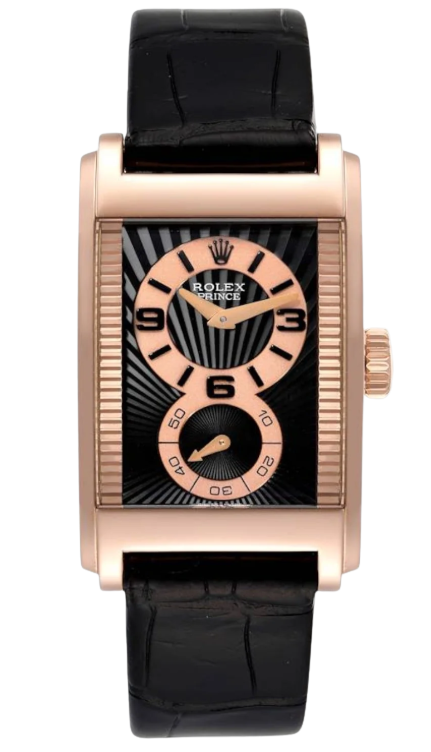
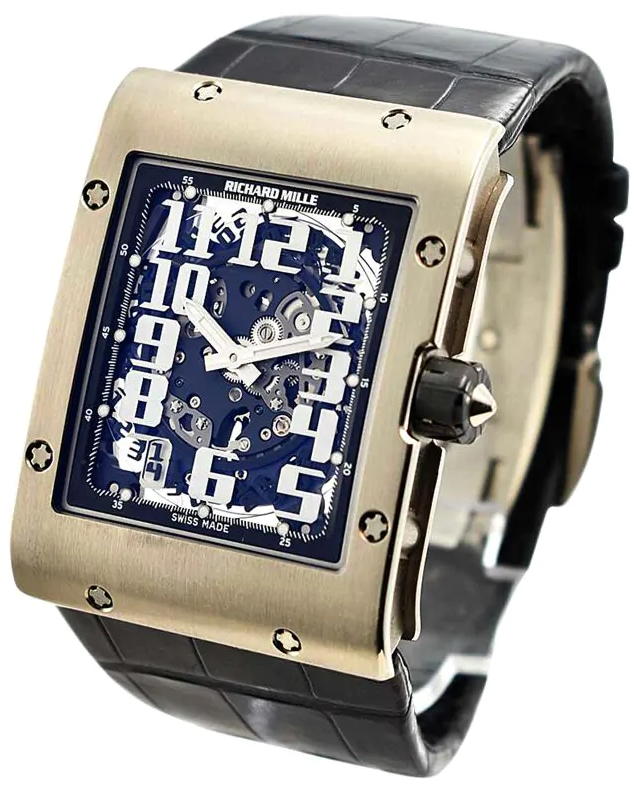
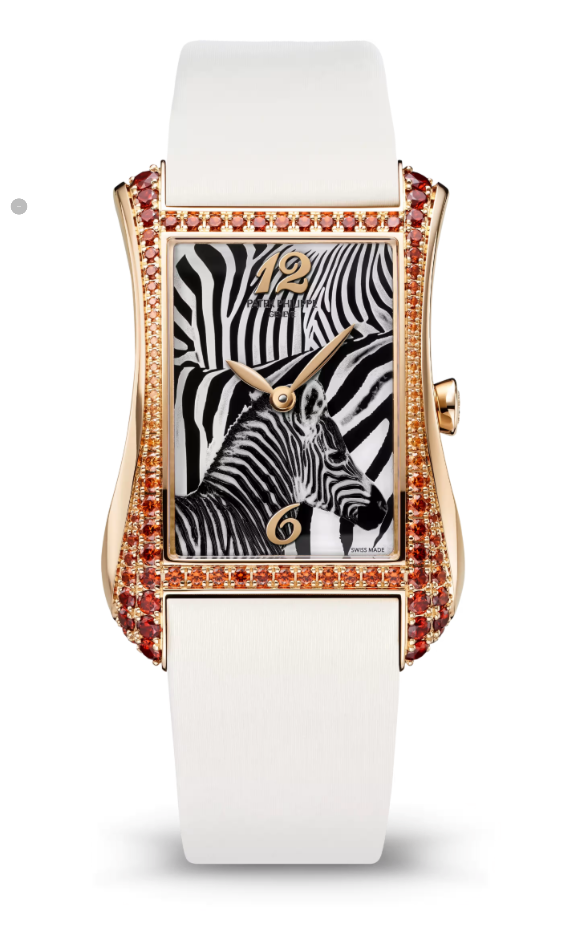
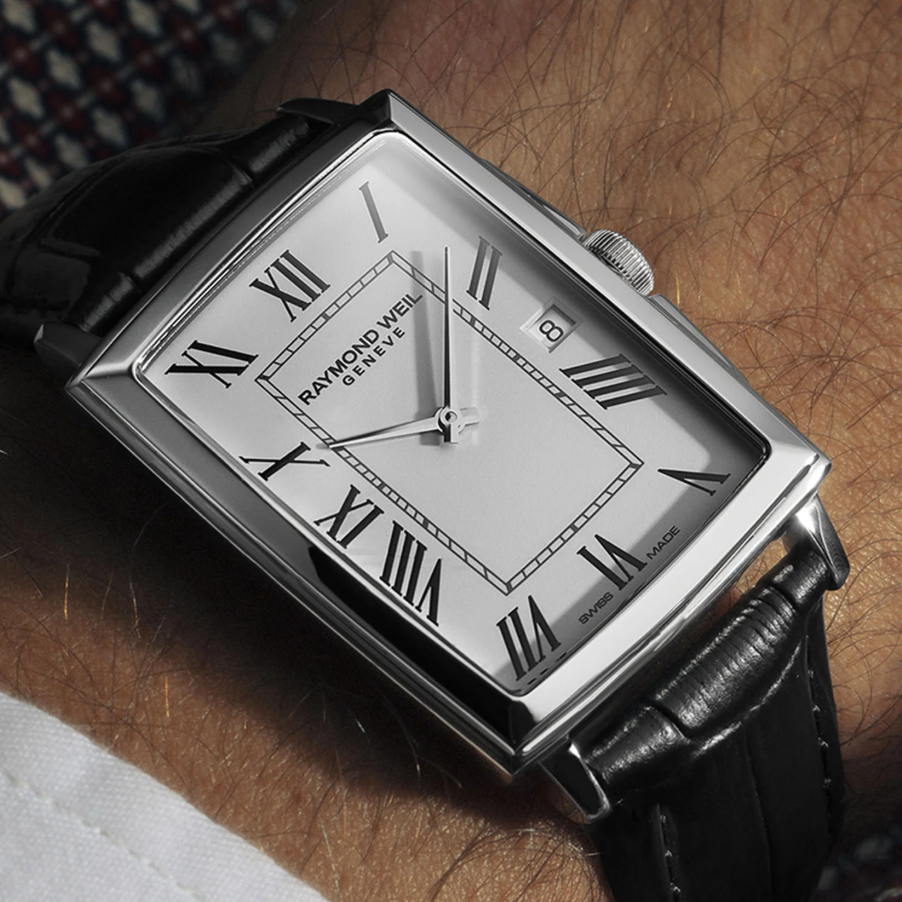
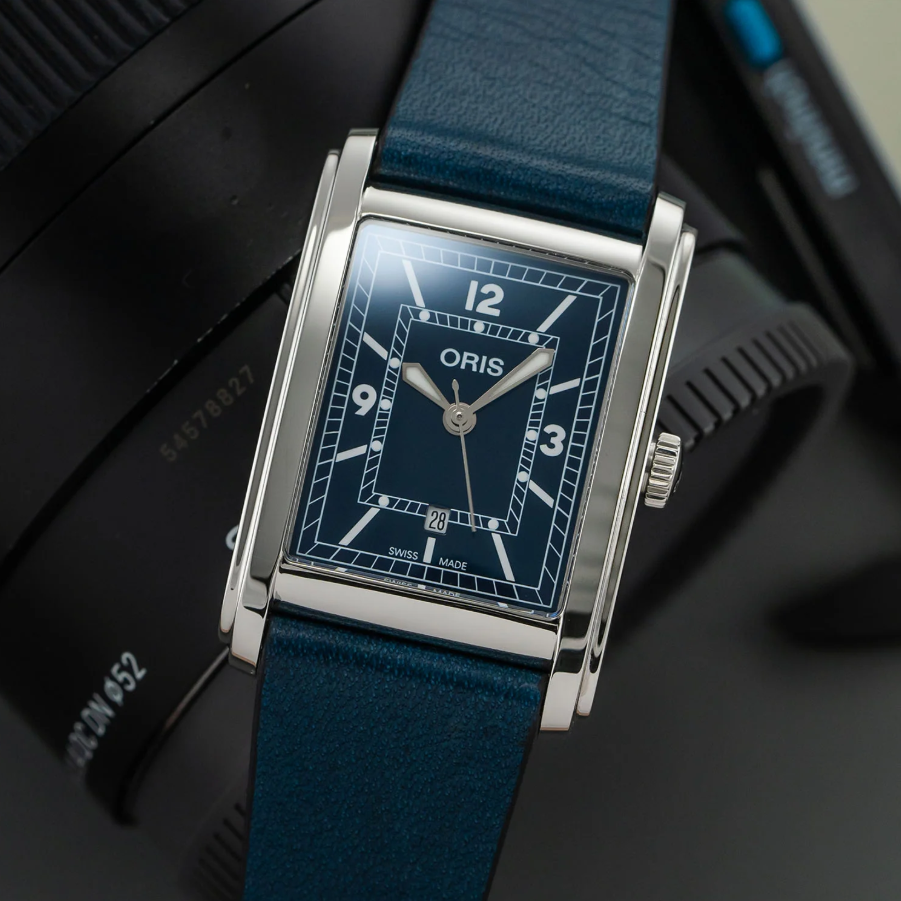
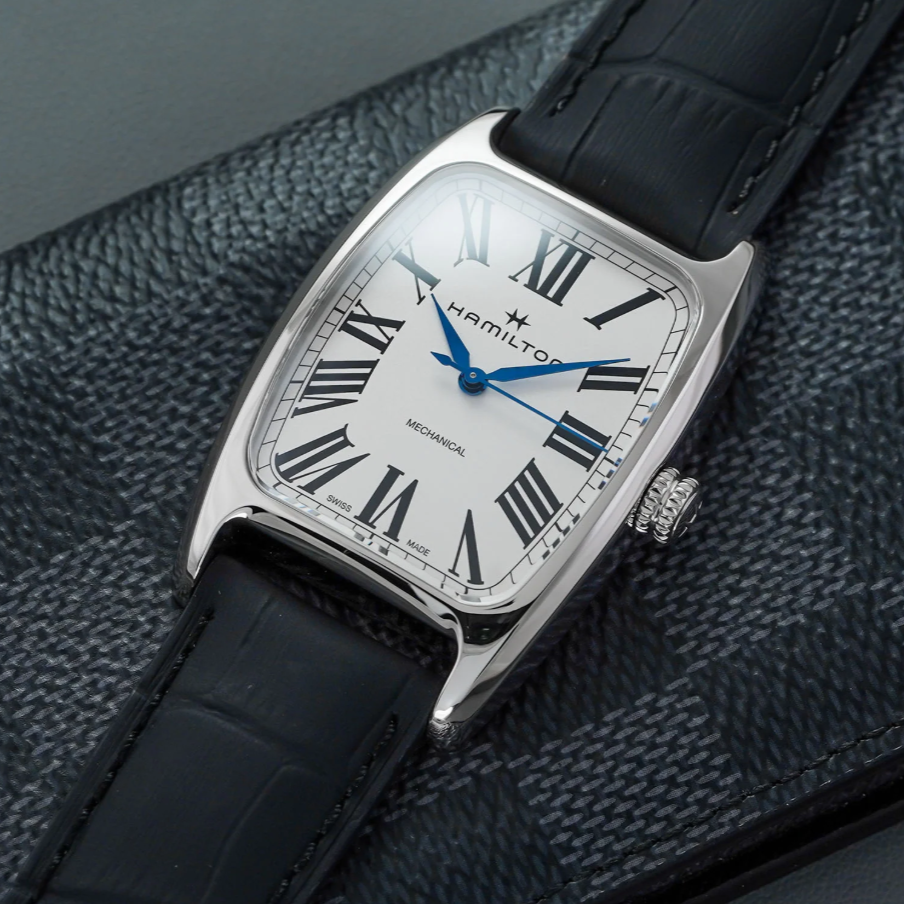
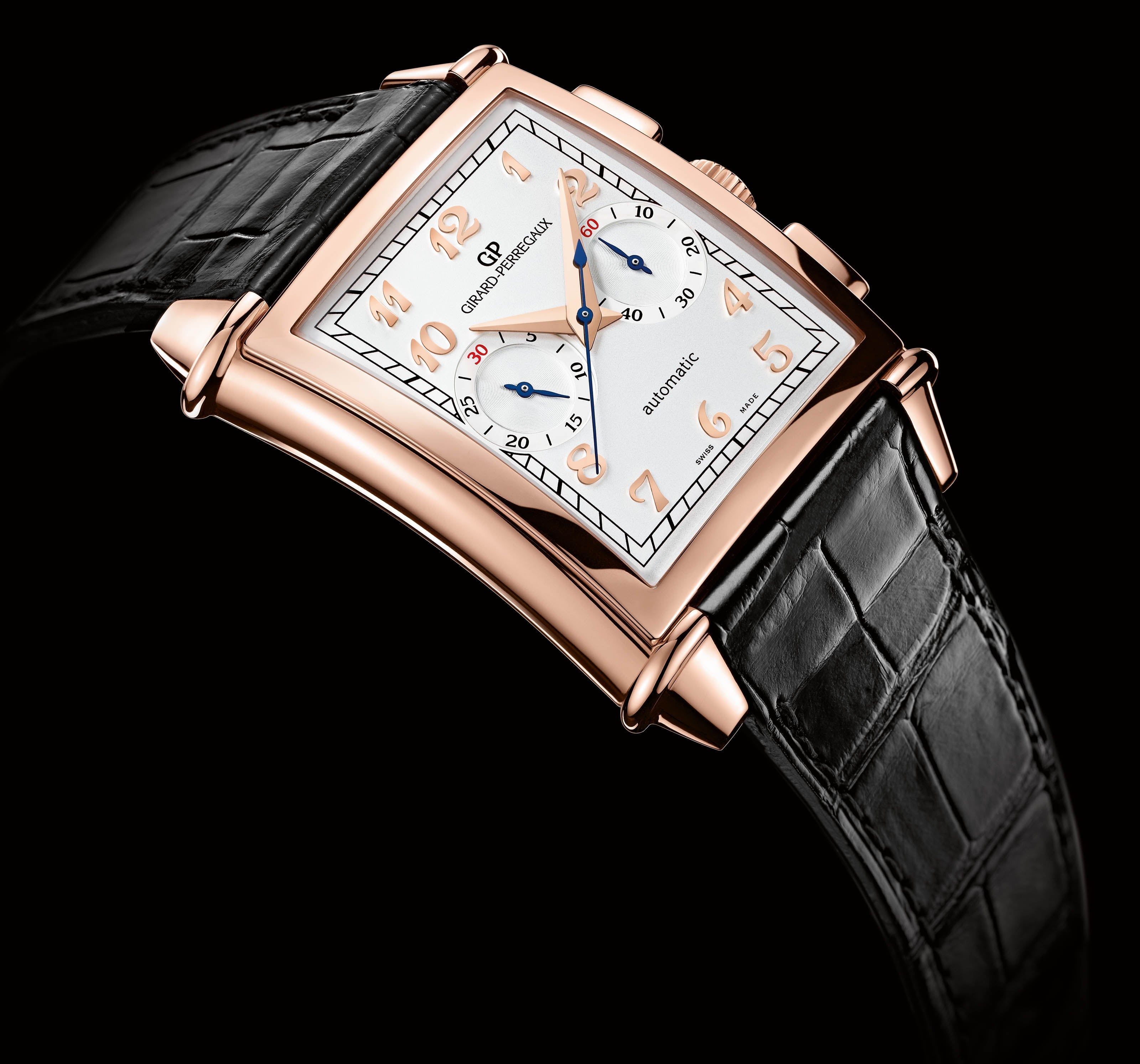
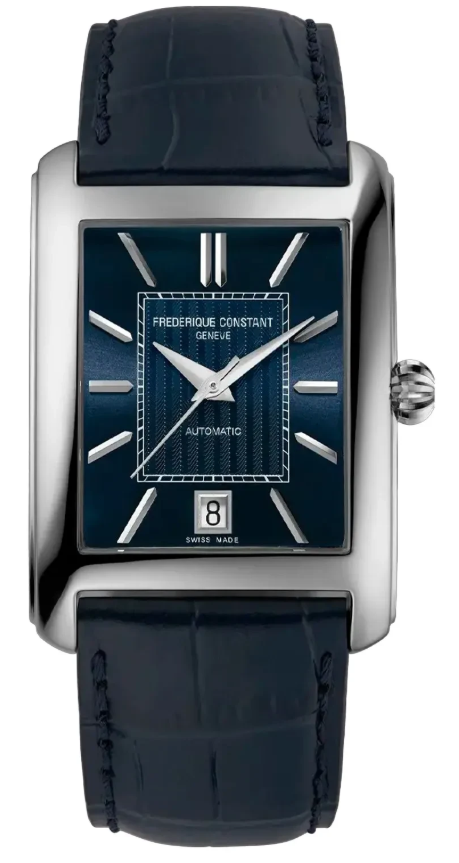
The oblong category encompasses several distinct styles. A rectangular oblong watch has straight sides and 90-degree corners. A tonneau oblong watch has curved sides that bow outward, creating a softer barrel shape. A cushion oblong watch has rounded corners on a rectangular base. An oval oblong watch has no straight edges at all. Each has its own proportional character, but all share the fundamental quality that gives oblong watches their distinctive wrist presence: the elongated form tracks the natural geometry of the arm rather than sitting on top of it as a circle.
Oblong watches account for a small minority of total watch production, which is precisely why wearing one communicates something specific. In a market where over 98% of watches are round, choosing an oblong case is a deliberate act.

The History of the Oblong Watch
The oblong watch emerged in the early 20th century as watchmakers began exploring alternatives to the round pocket watch convention. The Art Deco movement of the 1910s through 1930s was the defining period: geometric precision, clean lines, and a rejection of Victorian ornament produced the design language that still defines the finest oblong watches today.
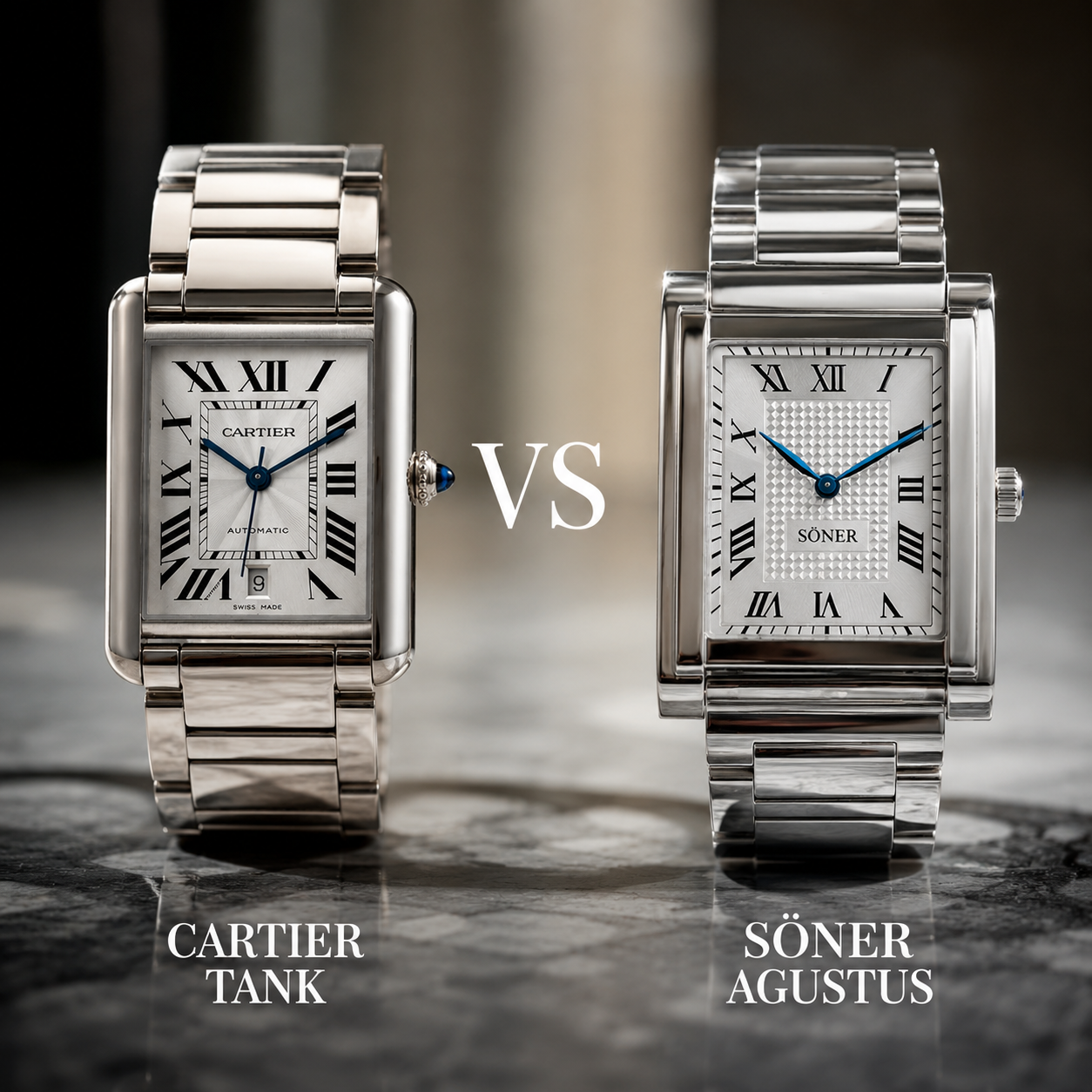
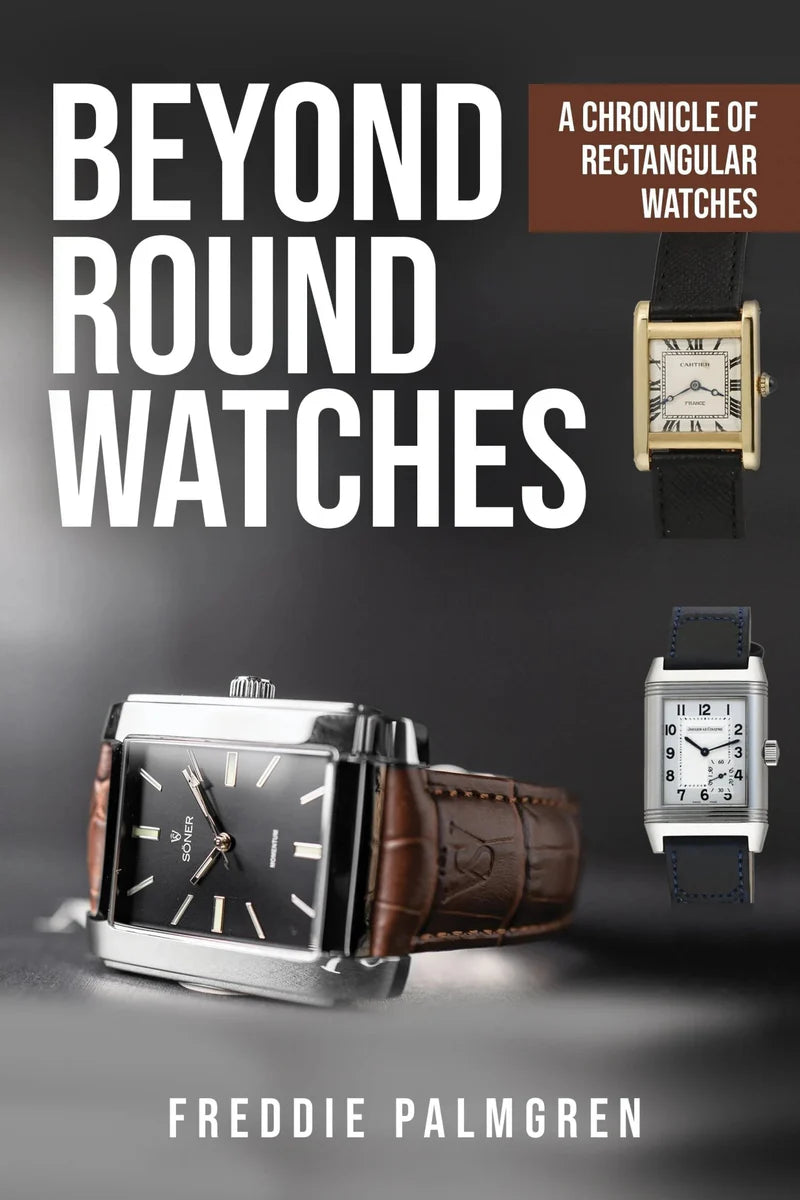
Louis Cartier created the Tank in 1917, inspired by the aerial profile of Renault FT military tanks. The parallel side rails of the case echoed the tracks of the vehicle. The rectangular case was not an aesthetic choice for its own sake — it was the correct answer to a specific design problem. It has not needed fundamental revision in over a century.
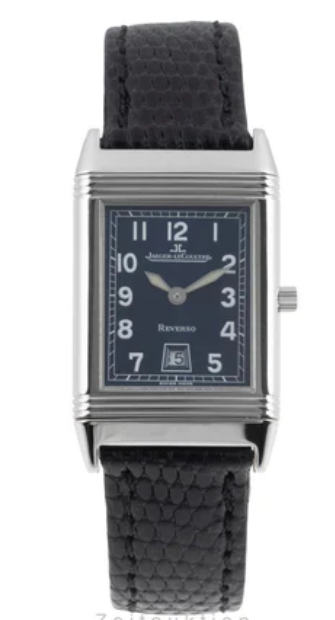
Jaeger-LeCoultre introduced the Reverso in 1931, initially for polo players who needed to protect the watch crystal during play. The reversible oblong case became one of the most ingenious designs in watchmaking history. Patek Philippe's Gondolo, tracing to the early 1900s, brought the oblong form to the highest tier of Swiss horology. Together these three watches established the oblong case as the dress watch shape of choice for the 20th century's most discerning wearers.

Types of Oblong Watch
Rectangular (Tank Style)
Straight sides, 90-degree corners, elongated case. The cleanest and most formal oblong shape. The Cartier Tank is the defining example. Slides under a shirt cuff cleanly and reads as architecturally precise.
Tonneau
Curved bowing sides with straight top and bottom. More organic than rectangular, more formal than cushion. The Cartier Tortue is the classic reference. Sits more naturally on the wrist than a strict rectangle.
Cushion Case
Rounded corners on a rectangular base. Bridges vintage and contemporary aesthetics. Common in 1970s watch design, currently experiencing a revival. More approachable than a strict rectangle.
Reverso Style
The rectangular case with a distinctive stepped and bevelled lug architecture derived from the JLC Reverso. The most Art Deco of all oblong forms. Proportions refined over nine decades without revision.

Why Choose an Oblong Watch
The wrist fit is better. The wrist is flat and elongated. An oblong case follows that geometry, sitting flush along the arm. A round case sits on the wrist as a self-contained object. The difference is visible and felt.
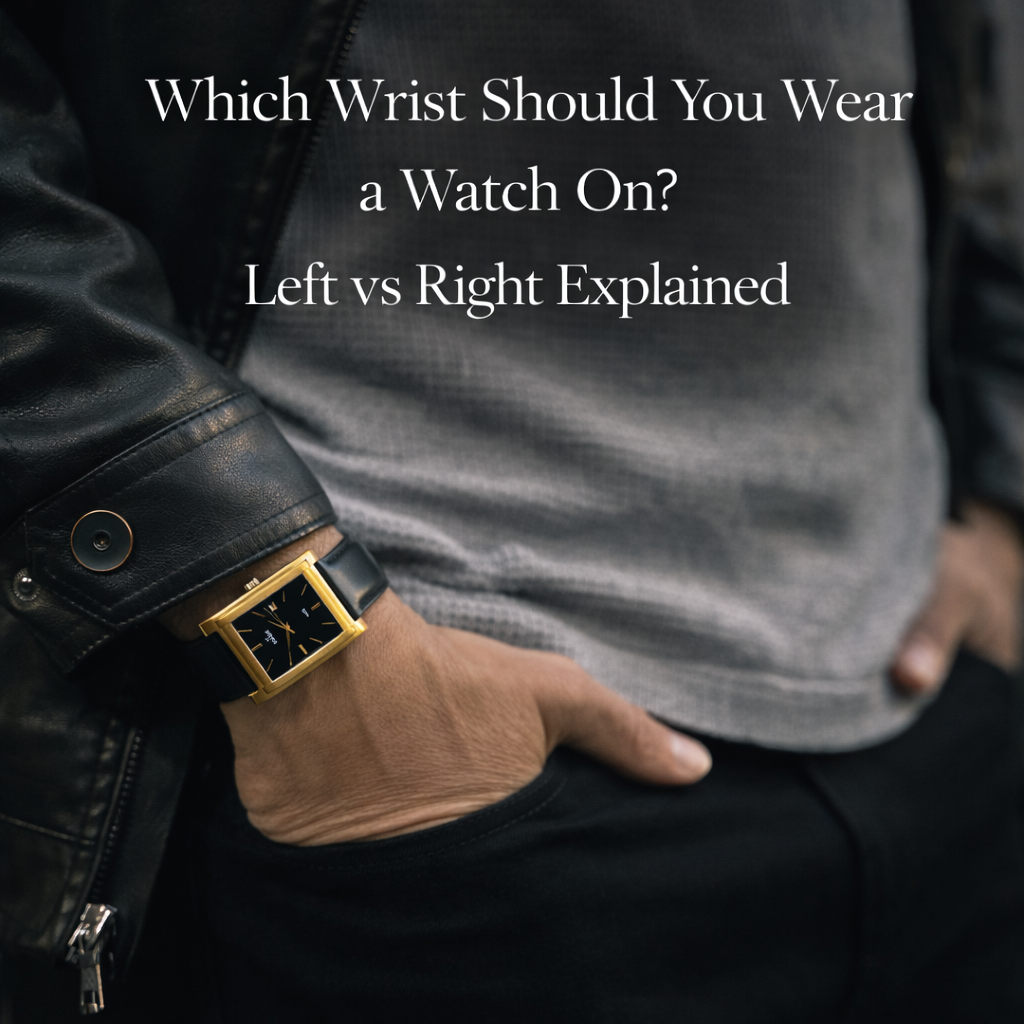
Shirt cuff clearance. A slim oblong watch slides under a shirt cuff without creating a visible bump. This is why the rectangular dress watch became the formal watch of choice for over a century. Round sports watches of equivalent case size cannot achieve the same under-cuff profile.
Genuine distinctiveness. Under 2% of watches sold are non-round. An oblong watch is immediately noticeable as a deliberate choice. It communicates design awareness in a way a round watch cannot, regardless of price.
Design heritage. The oblong case has over a century of association with the most culturally significant watches ever made. Wearing one connects you to that tradition without requiring explanation.
Dial design. The elongated case provides more useful dial space than a round case of equivalent width. Complications, date windows, and subsidiary dials find more natural positions within the oblong geometry.

How to Choose an Oblong Watch
| Factor | What to Look For | Why It Matters |
|---|---|---|
| Case width | 26mm to 36mm for most wrists | Oblong cases appear larger than their stated width due to lug-to-lug length |
| Lug-to-lug | Should not overhang your wrist width | The vertical dimension determines how the watch sits on the arm |
| Thickness | Under 10mm for dress contexts | Slim profile is essential for cuff clearance and wrist integration |
| Crystal | Sapphire with AR coating | Flat oblong crystals show scratches and reflections more than round ones |
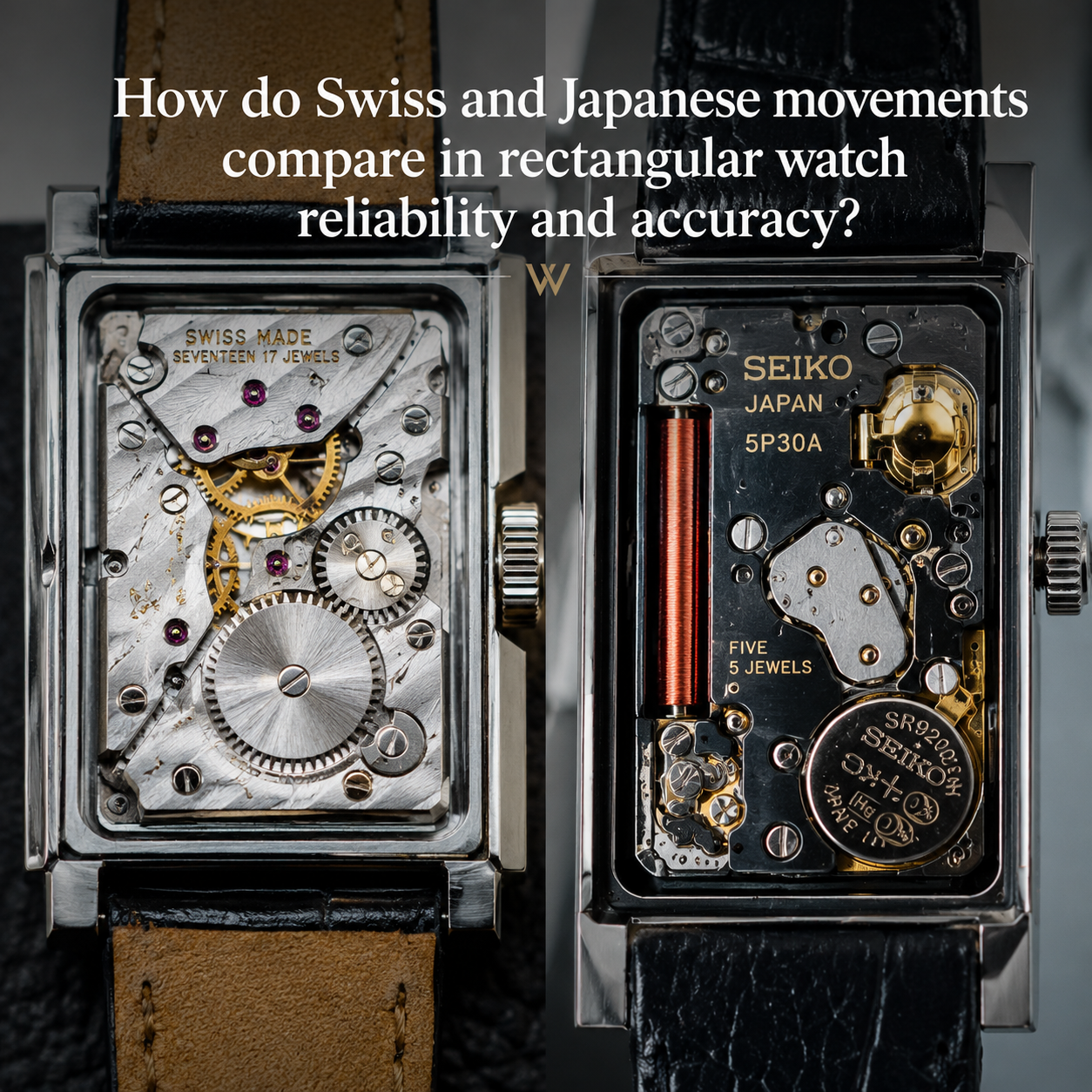
| Movement | Swiss or Japanese quartz or automatic | Oblong movements are harder to produce, quality varies more than in round cases |
| Strap | Leather for formal, steel for everyday | Leather is the traditional pairing for oblong dress watches |
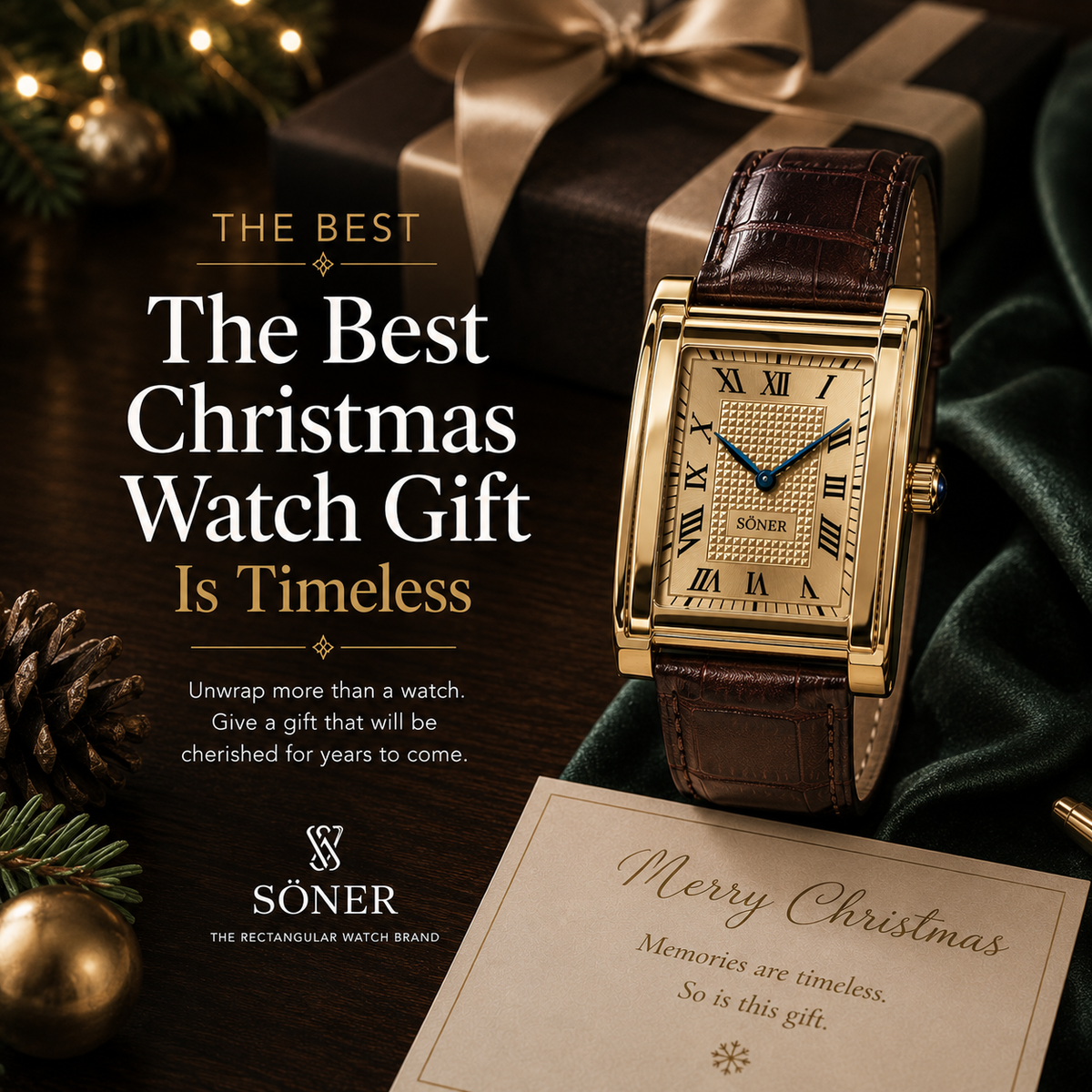
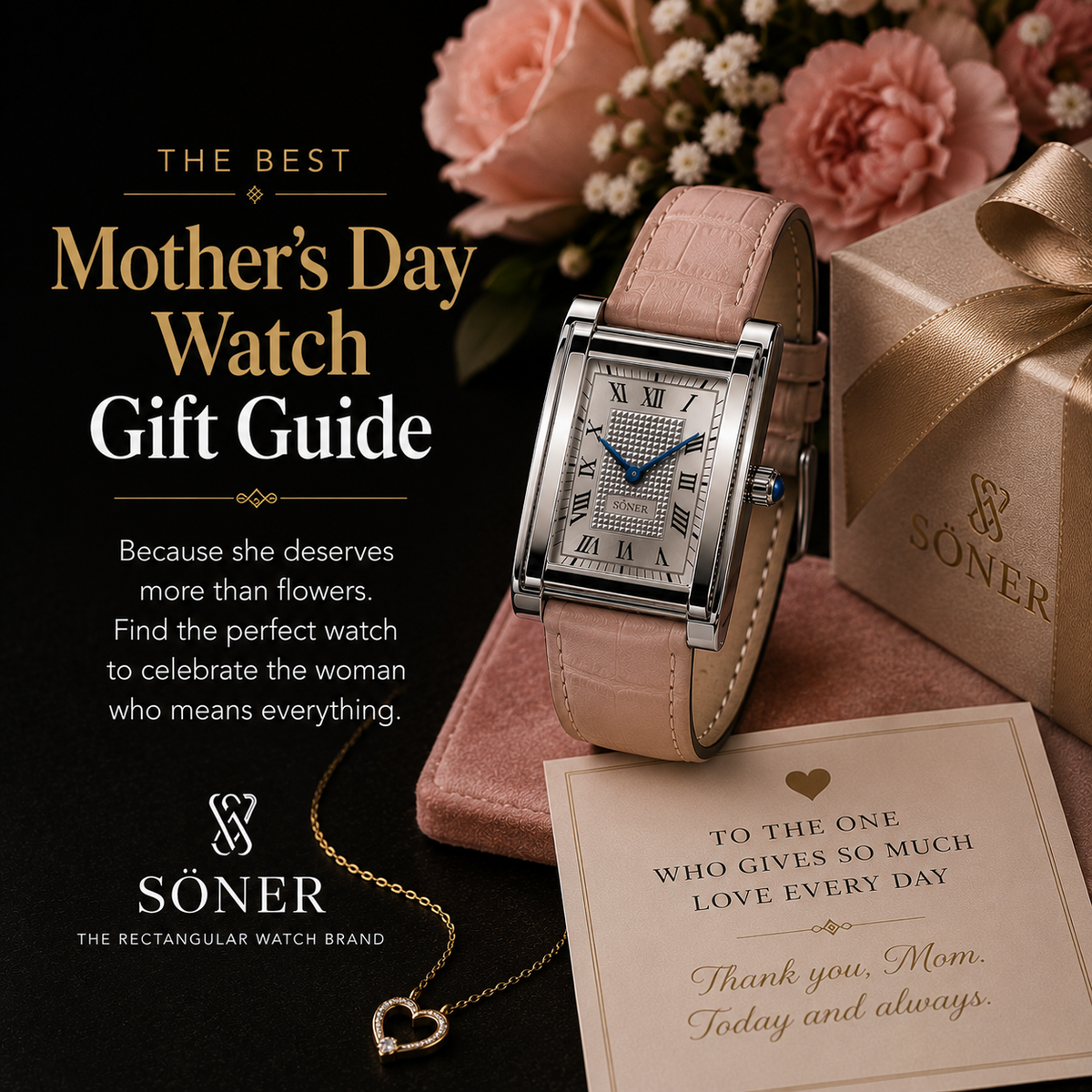
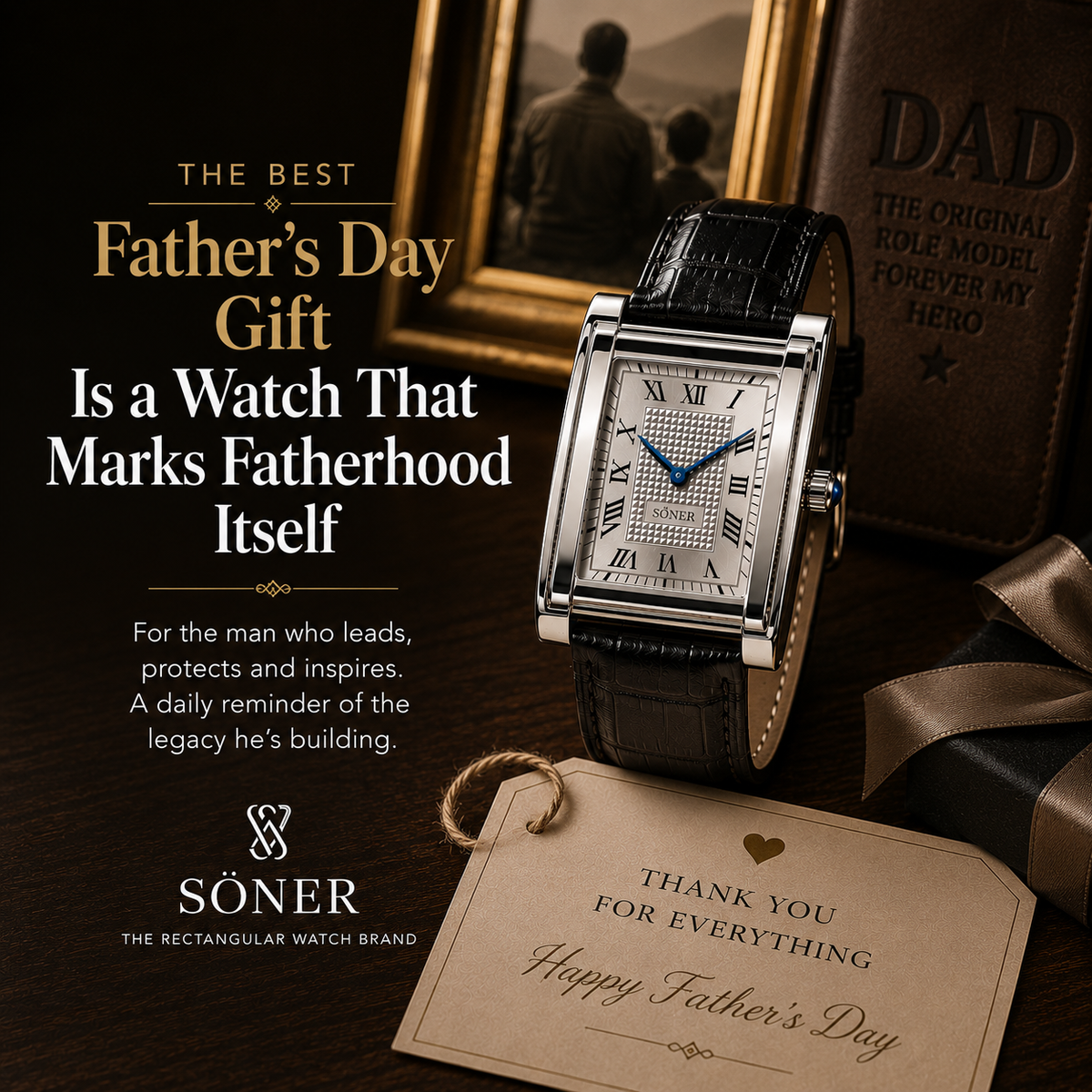
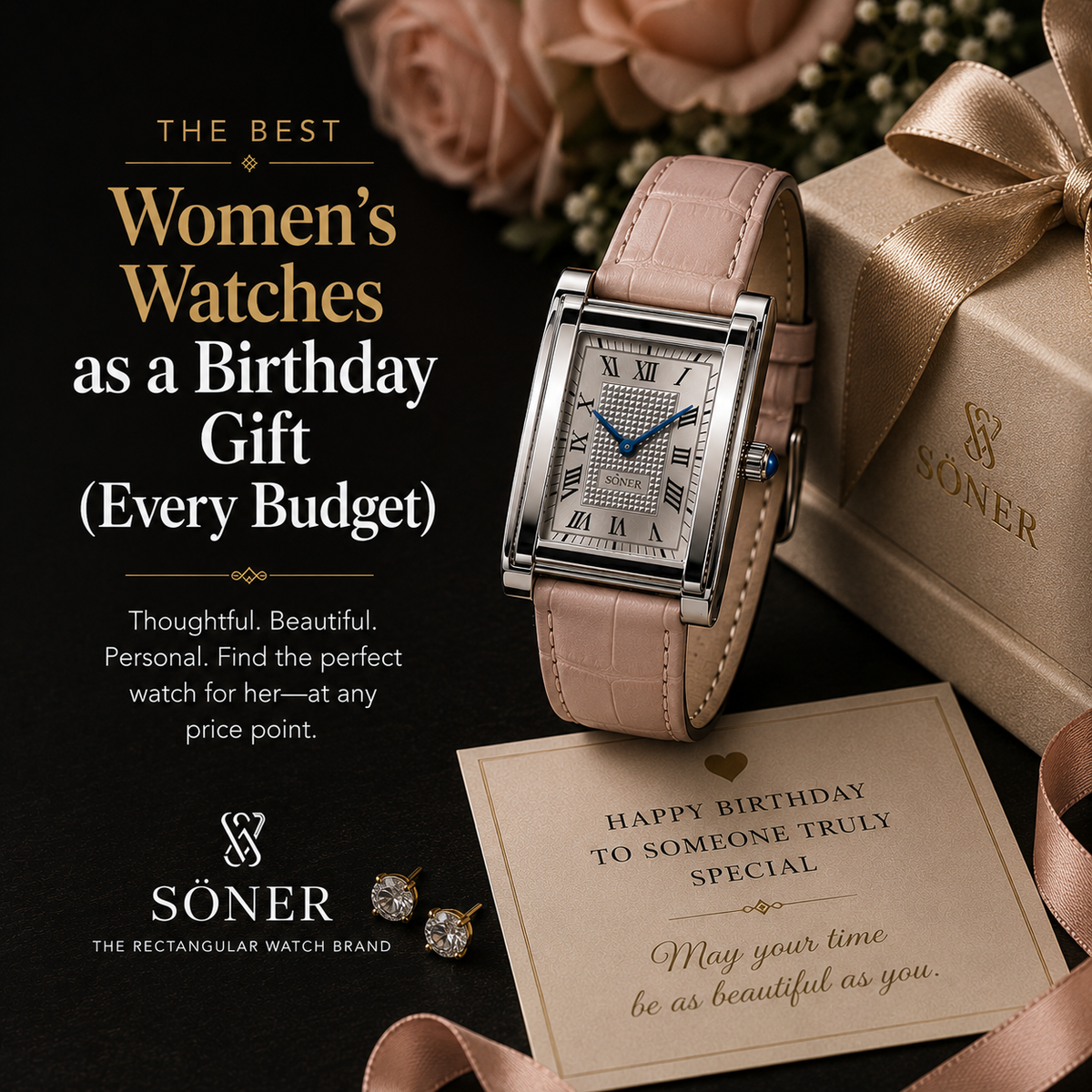
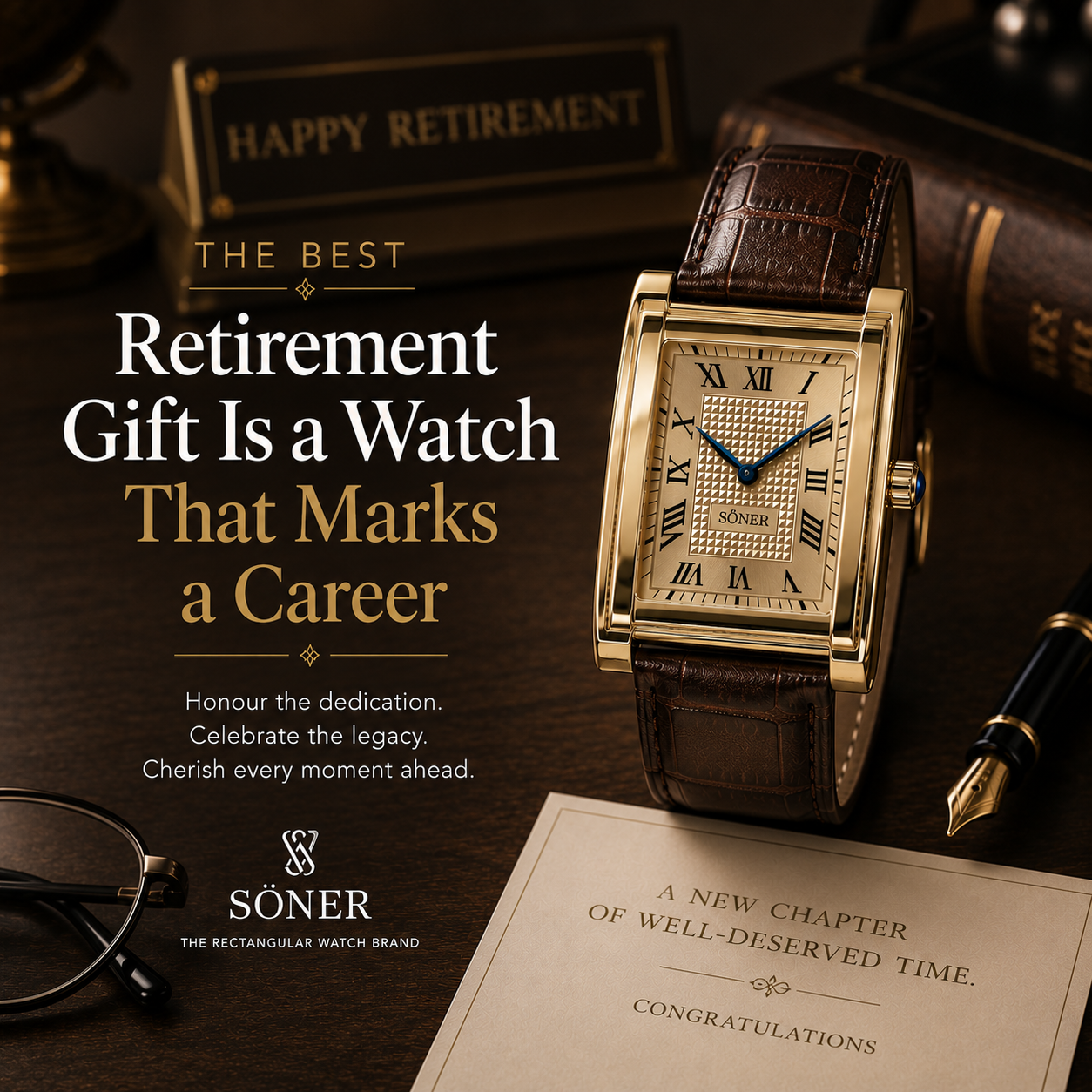
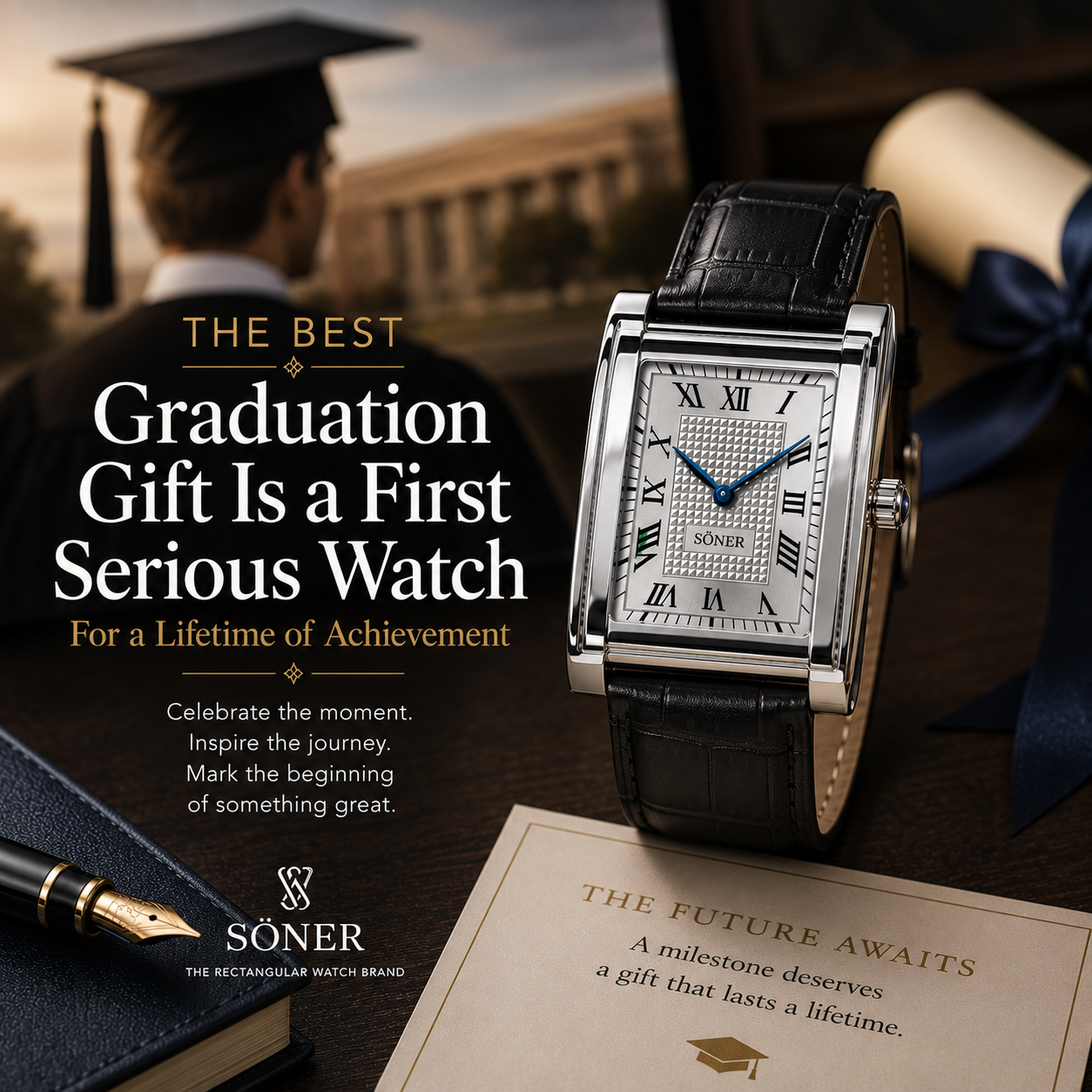
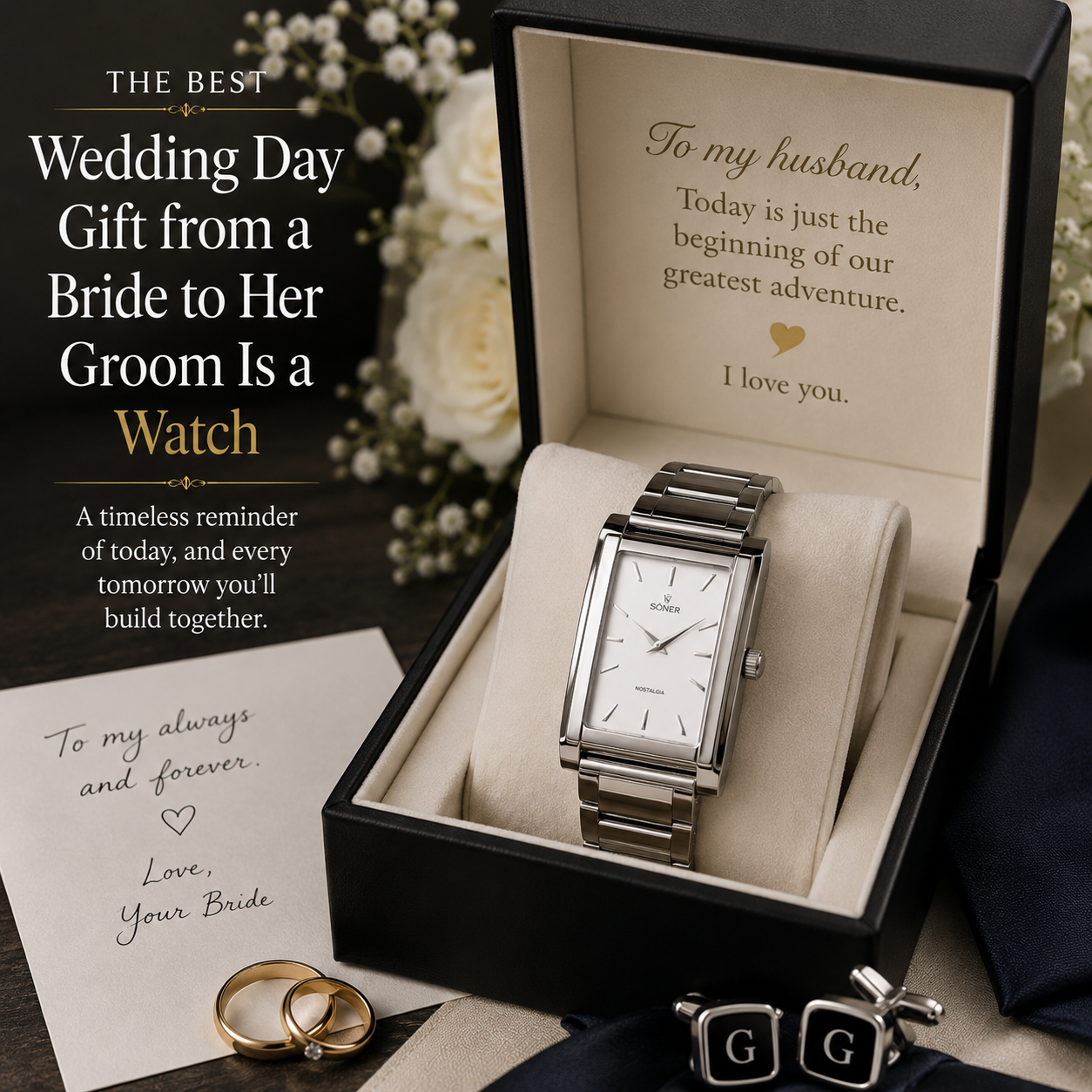
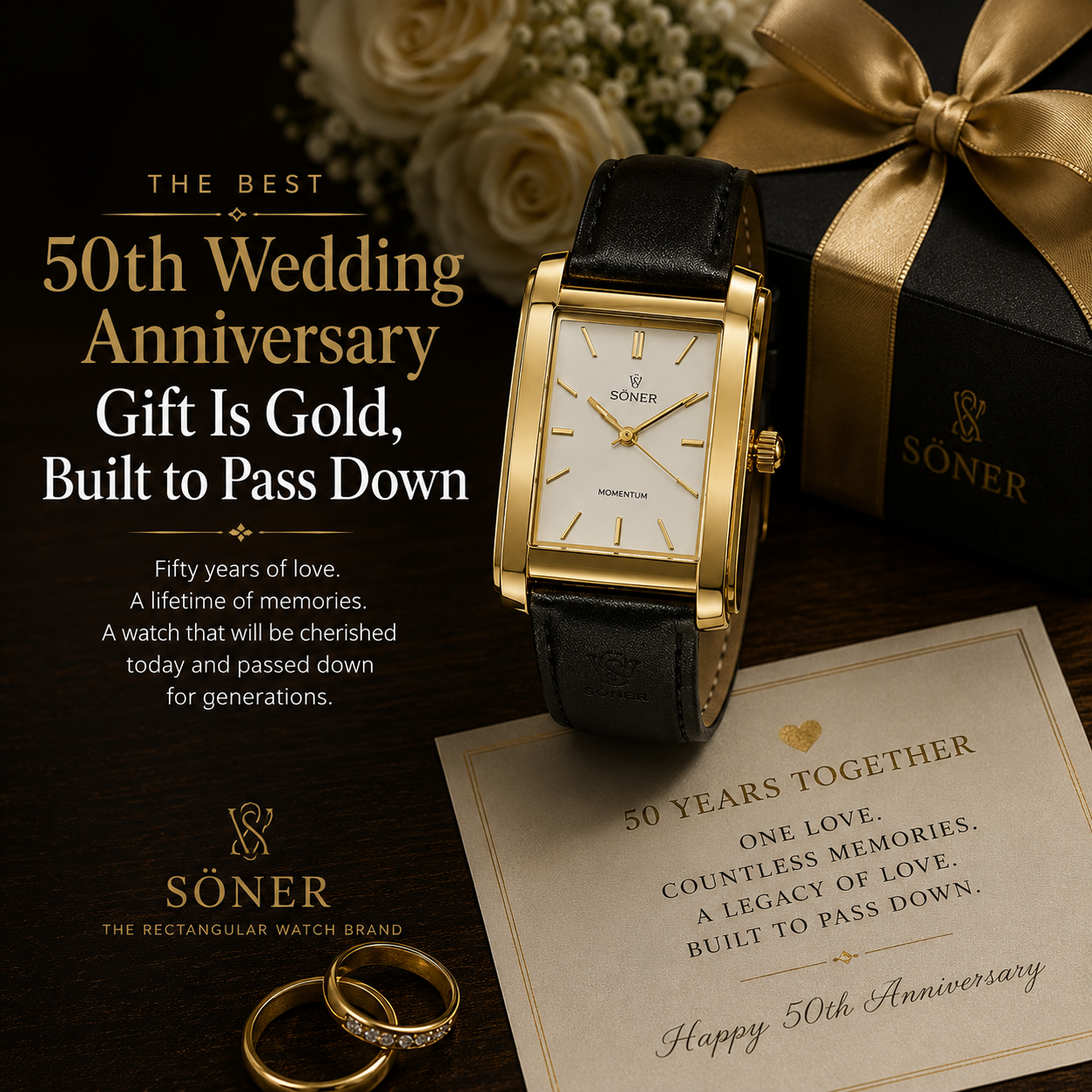
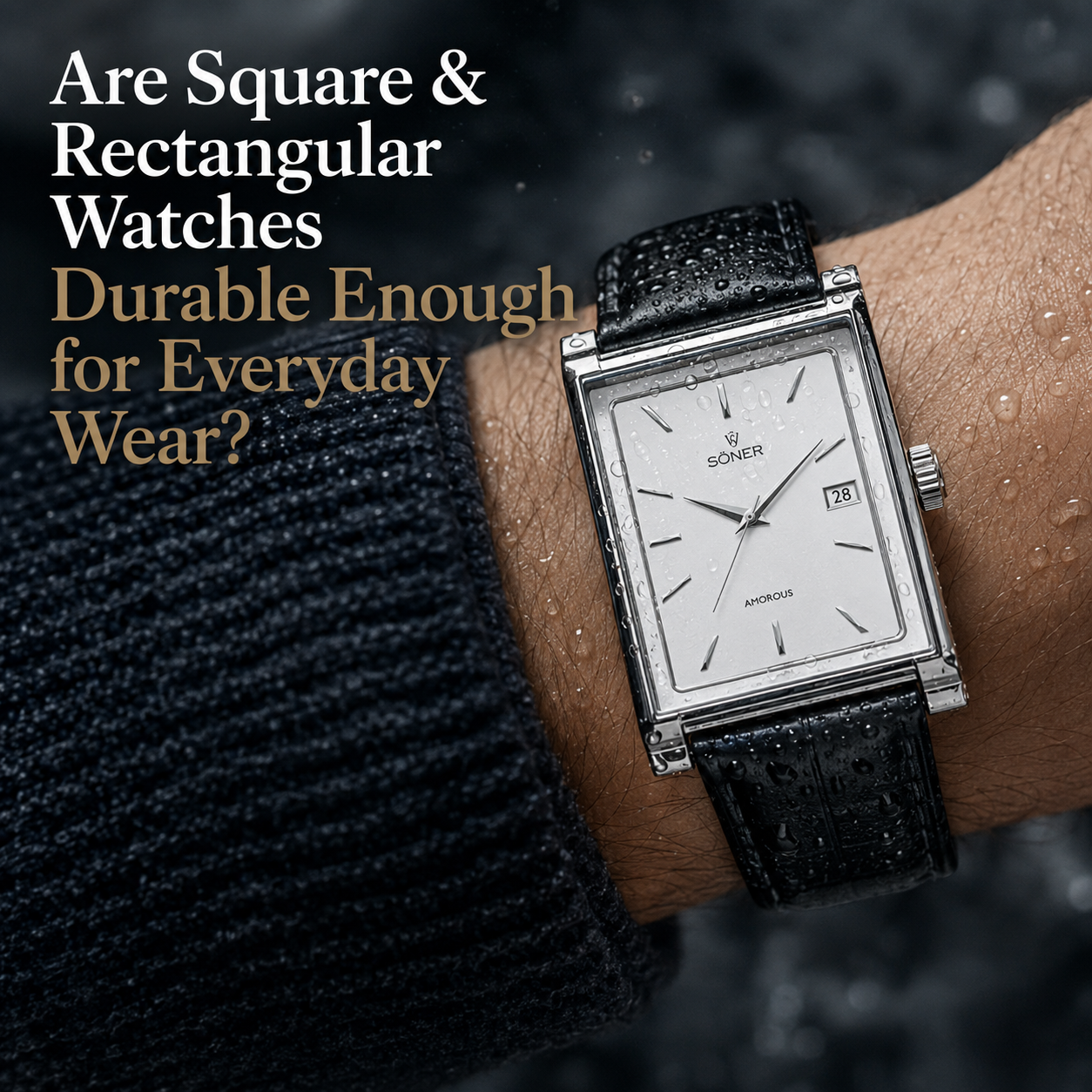
The brand built exclusively for oblong watches: Söner Watches is the only watch brand in the world dedicated exclusively to oblong rectangular watches. Every collection, Nostalgia, Amorous, Momentum, and Legacy, is rectangular. Swiss and Japanese movements, 800HV hardened steel, sapphire crystal, 10-year warranty. From $385.
How to Style an Oblong Watch
Formal and Business
- Slim oblong case (under 10mm) on dark leather strap
- Slides under shirt cuff without distorting the sleeve
- White or navy dial reads as most formal
- Steel or gold-tone case both work depending on shirt and suit colour
- Let the watch do the work: keep other accessories minimal
Smart Casual and Weekend
- Same case on a steel bracelet or mesh strap for a more contemporary read
- Coloured dials (green, blue, red) add character in casual contexts
- A slightly larger oblong case (35x45mm) suits casual wear well
- NATO or canvas strap adds texture while keeping the oblong geometry
- Neutral clothing lets the distinctive case shape speak for itself

The Best Oblong Watches to Buy in 2026
The strongest oblong watches at every price point:
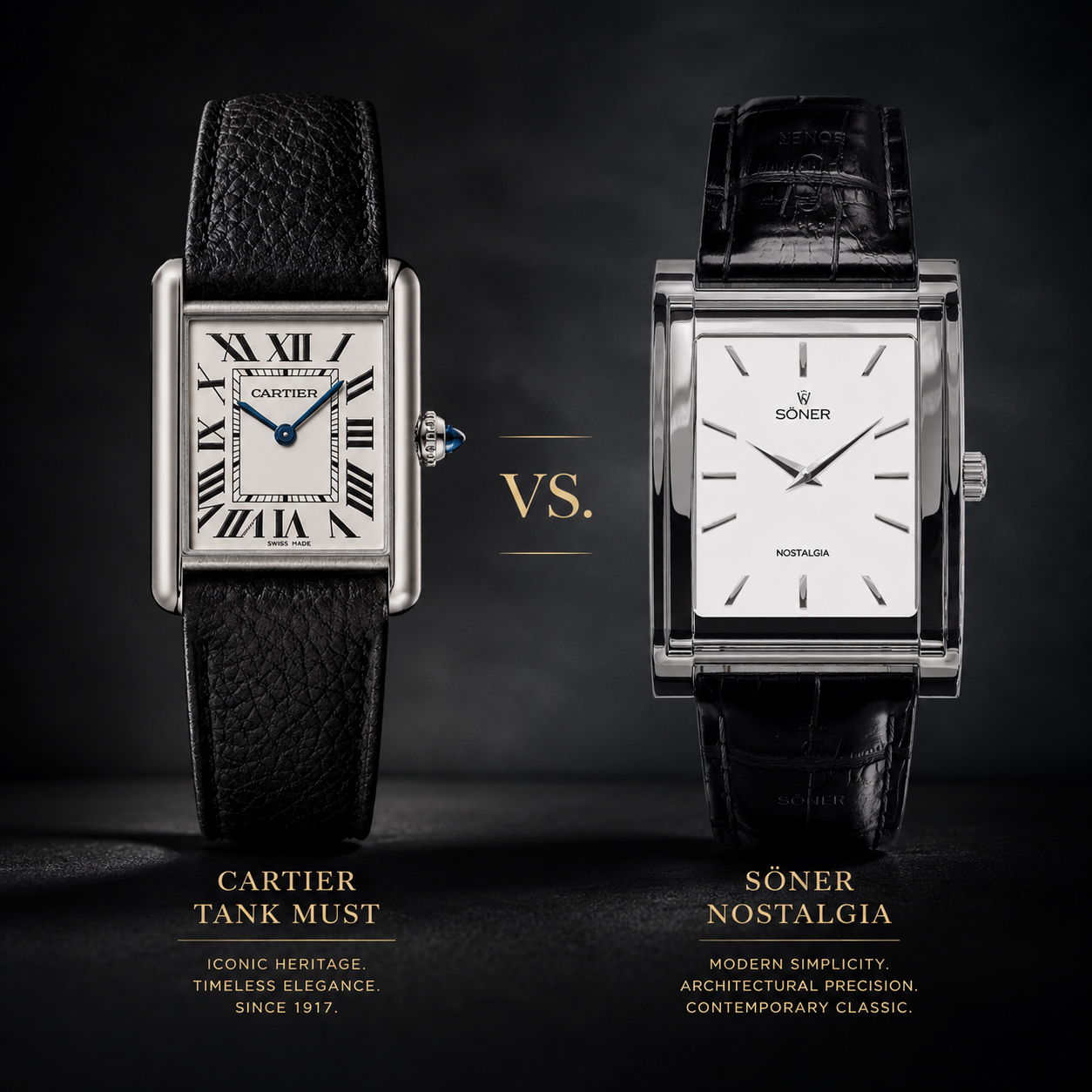
Under $700 (Swiss movement): Söner Nostalgia at $520 delivers Swiss ETA 901.001 quartz, 11-year battery, 800HV hardened steel, sapphire AR crystal, 5 ATM, 7mm slim profile in a 28x40mm rectangular case. The strongest oblong dress watch under $1,000 on specifications alone.
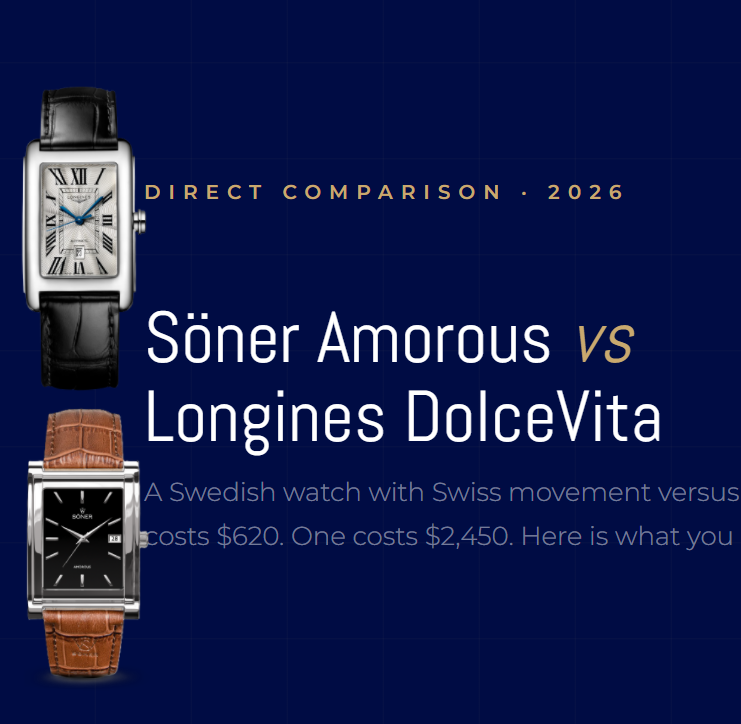
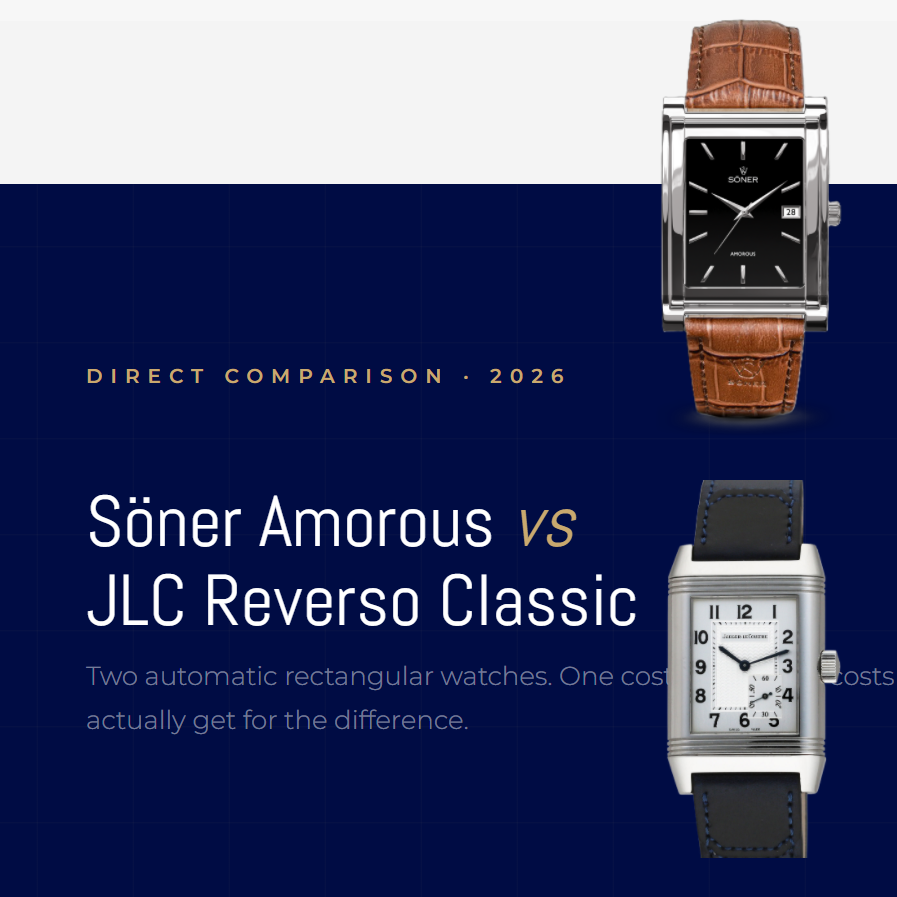
Under $700 (Swiss automatic): Söner Amorous at $620 uses a Swiss Sellita SW100A automatic with 25 jewels, 28,800 vph, 42-hour power reserve in the same 28x40mm rectangular case at 10mm. The only Swiss automatic oblong watch at this price point with these specifications.
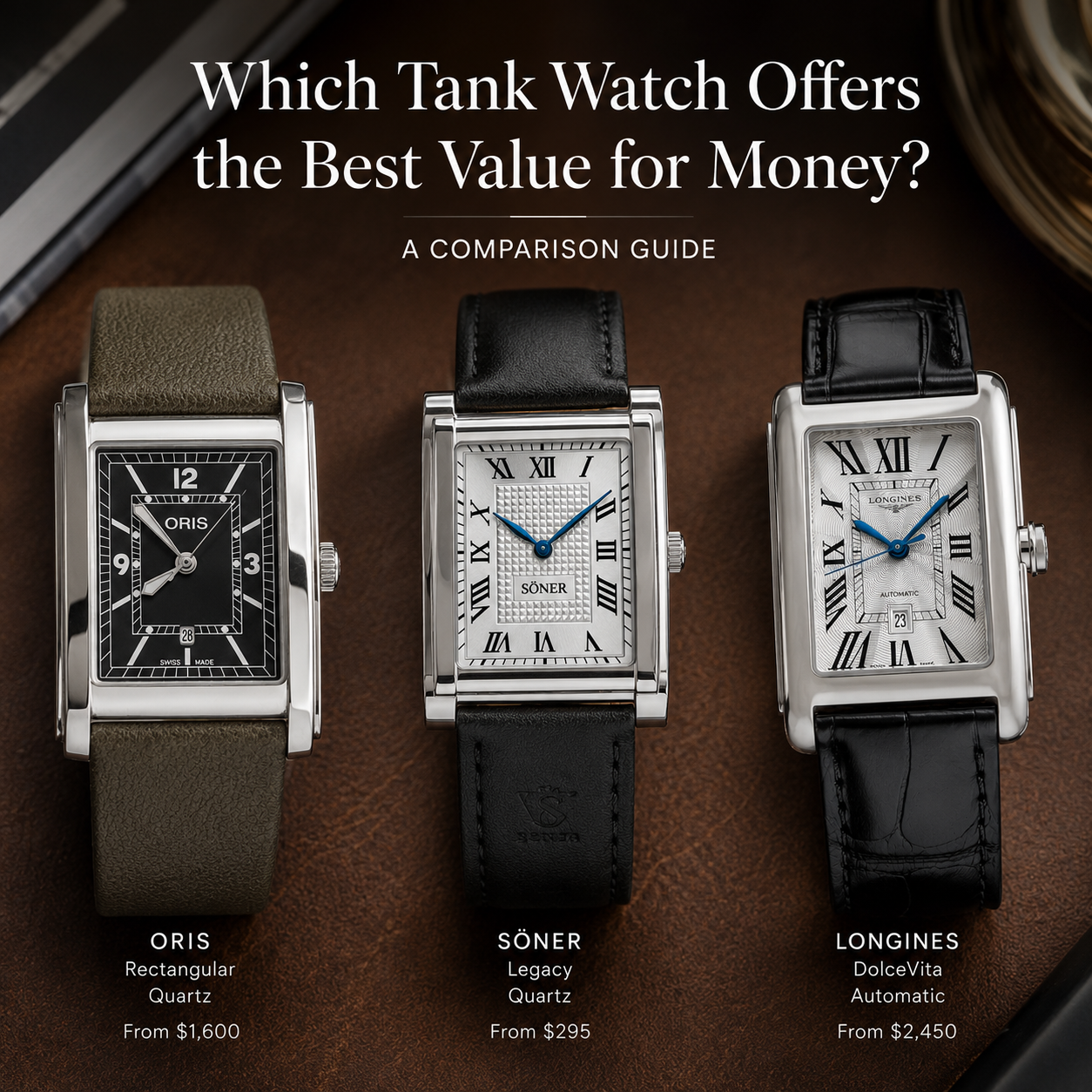
$1,500 to $3,000: Longines DolceVita in quartz or automatic. Swiss manufacture heritage, sapphire crystal, elegant proportions, and 27.7x43.8mm case. Strong mid-range oblong watch with genuine Swiss watchmaking background.
$3,000 to $5,000: Cartier Tank Must. The original oblong watch in its most accessible form. Quartz Cal. 690, sapphire crystal, the design that defined the category. At $3,200 in steel it is the benchmark against which every oblong dress watch is measured.
Above $7,000: Jaeger-LeCoultre Reverso. The most accomplished oblong case design ever produced. In-house or in-house-derived movements, reversible engravable case, Art Deco proportions unchanged since 1931. The finest oblong watch available at any price.
Frequently Asked Questions
What is an oblong watch?
An oblong watch is any watch with a case that is longer than it is wide. The term covers rectangular, tonneau, cushion, and oval case shapes. The Cartier Tank, Jaeger-LeCoultre Reverso, and Patek Philippe Gondolo are all oblong watches. The oblong case has been the dominant dress watch shape since the Art Deco era.
Are oblong watches and rectangular watches the same?
Rectangular watches are a type of oblong watch. Oblong is the broader term covering any case that is longer than wide — rectangular (straight sides), tonneau (curved sides), cushion (rounded corners), and oval (no straight edges) are all oblong shapes. In common usage the terms are often used interchangeably, particularly for rectangular dress watches.
Why do oblong watches suit formal wear better than round watches?
The slim profile typical of oblong dress watches slides under a shirt cuff without creating a visible bump or distorting the sleeve. The elongated case follows the natural geometry of the wrist and arm rather than sitting on top of it. The rectangular form also carries over a century of association with formal dress, from the Cartier Tank to the JLC Reverso.
What is the most famous oblong watch?
The Cartier Tank (1917) is the most historically significant oblong watch and has been in continuous production for over a century. The Jaeger-LeCoultre Reverso (1931) is its closest rival for design authority. Together they define the oblong dress watch tradition.
What is the best oblong watch to buy?
At the accessible tier, the Söner Nostalgia at $520 delivers the strongest combination of Swiss movement, 800HV hardened steel, sapphire crystal, and oblong rectangular proportions available under $1,000. At the heritage tier, the Cartier Tank Must at $3,200 is the benchmark. At the finest level, the JLC Reverso is the definitive oblong watch at any price.
Söner is the world's only watch brand dedicated exclusively to oblong rectangular watches. Swiss and Japanese movements, 800HV hardened steel, sapphire crystal with AR coating, 10-year international warranty. From $385.
Browse the CollectionSÖNER rectangular watches
Free worldwide shipping · 10-year warranty · 30-day returns
Our pick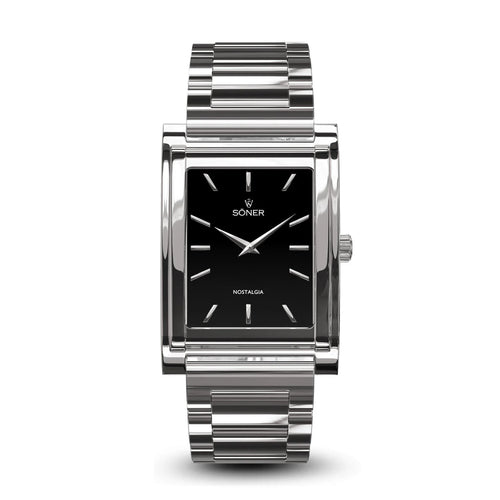 Nostalgia Stockholm11-year battery$580 USD
View watch
Nostalgia Stockholm11-year battery$580 USD
View watch
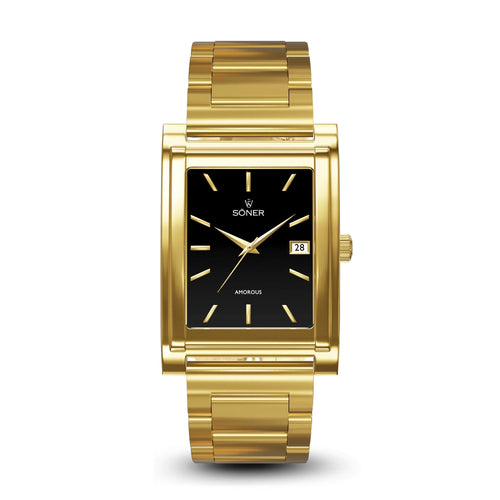 Amorous MilanoAutomatic$785 USD
View watch
Amorous MilanoAutomatic$785 USD
View watch
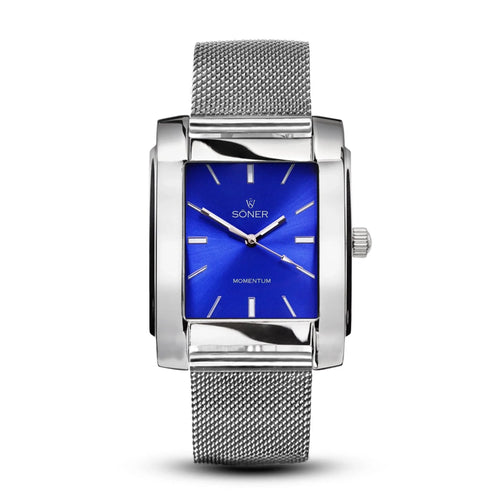 Momentum BacardiAutomatic$585 USD
View watch
Momentum BacardiAutomatic$585 USD
View watch
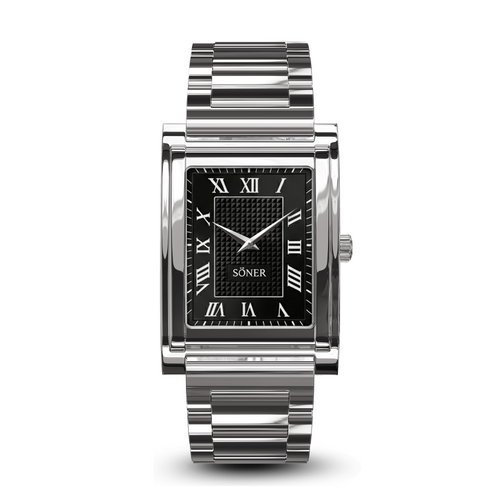 Nostalgia Caesar11-year battery$765 USD
View watch
Nostalgia Caesar11-year battery$765 USD
View watch
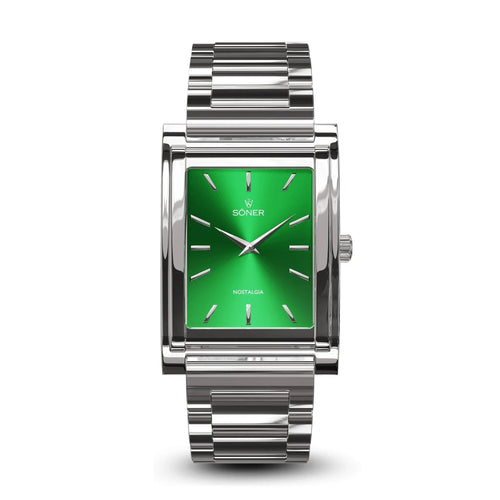 Nostalgia New York11-year battery$580 USD
View watch
Nostalgia New York11-year battery$580 USD
View watch
View all watches
 Nostalgia Stockholm11-year battery$580 USD
View watch
Nostalgia Stockholm11-year battery$580 USD
View watch
 Amorous MilanoAutomatic$785 USD
View watch
Amorous MilanoAutomatic$785 USD
View watch
 Momentum BacardiAutomatic$585 USD
View watch
Momentum BacardiAutomatic$585 USD
View watch
 Nostalgia Caesar11-year battery$765 USD
View watch
Nostalgia Caesar11-year battery$765 USD
View watch
 Nostalgia New York11-year battery$580 USD
View watch
Nostalgia New York11-year battery$580 USD
View watch