

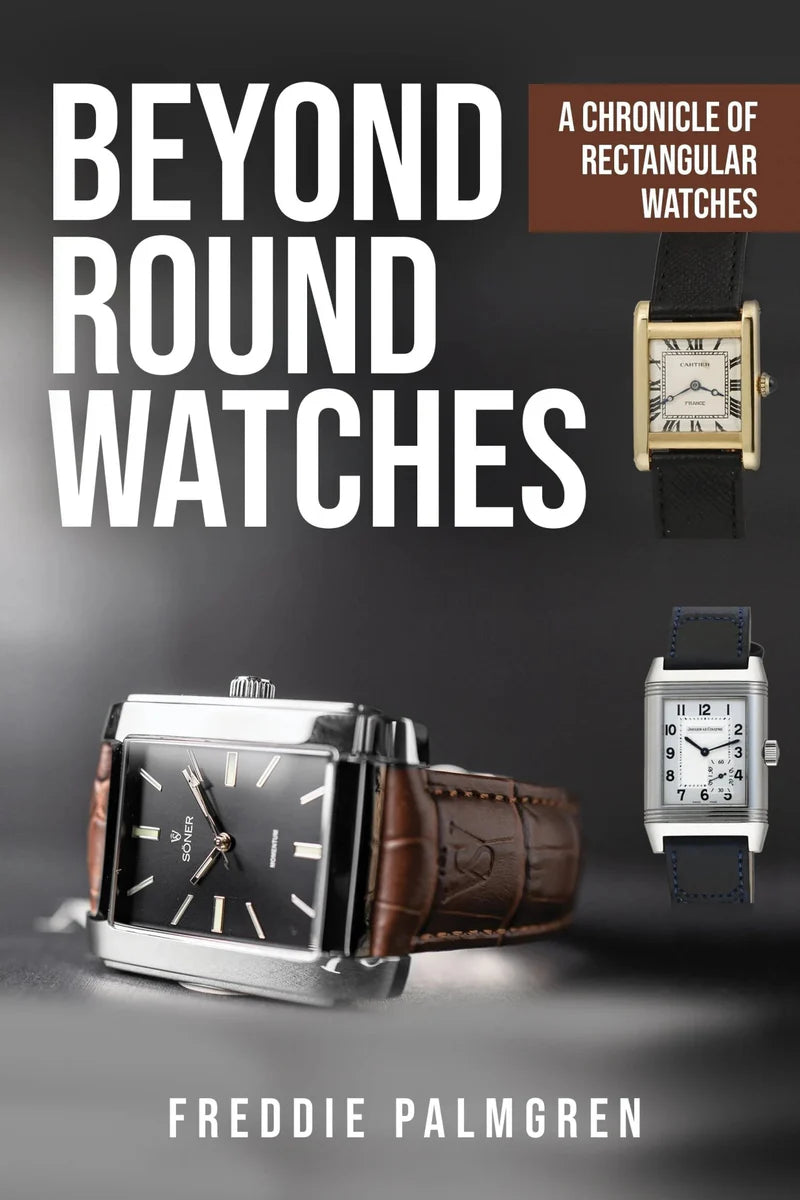


 Published on
Table of Contents
Quick Answer: Which brands pioneered rectangular watchmaking?
The brands that defined rectangular watchmaking are Cartier (Tank, 1917), Jaeger-LeCoultre (Reverso, 1931), Patek Philippe (Reference 2441 and 2442), Audemars Piguet (Heure Sautante and Full Calendar), Rolex (Prince and Cellini), Omega (Marine, 1932), Longines (Caliber 9.47N, 1925), and Gruen (Curvex, 1935). Together these brands established the rectangular case as one of the most technically and aesthetically significant formats in watch history during the golden age of horology in the early to mid-20th century.
Round cases have dominated watchmaking for a simple reason: the internal mechanisms of a watch - the interlocking gears, springs, and escapement components - are inherently circular. That circular geometry translated naturally into round cases, round dials, and hands arranged around a central axis. The round watch was not a design choice. It was the path of least resistance.
The brands covered in this article chose a different path. During the first half of the 20th century, a group of watchmakers embraced the rectangular case - not because it was easier, but because it was more interesting. Fitting a precise mechanical movement into a non-round case required more engineering ingenuity, more careful finishing, and more considered design. The results were some of the most important watches ever made.
This is the story of the pioneers who built the rectangular watch tradition.

Sketch of the Santos de Cartier, 1911. © Cartier SA
Rectangular watches reached the height of their popularity during the early to mid-20th century - the golden age of watchmaking. Brands including Jaeger-LeCoultre, Cartier, Vacheron Constantin, Rolex, Omega, and Patek Philippe all embraced the geometric format, producing timepieces that combined artistry with technical innovation. These watches adorned the wrists of style icons and trendsetters, cementing their status as coveted accessories.
The popularity of the rectangular watch waned through the second half of the 20th century as round designs reasserted their dominance. But the format never disappeared entirely - and today, it is experiencing its most sustained resurgence in decades. A century later, the pendulum has swung back. The pioneering work of the brands below is the reason rectangular watchmaking has a tradition worth returning to.
Cartier
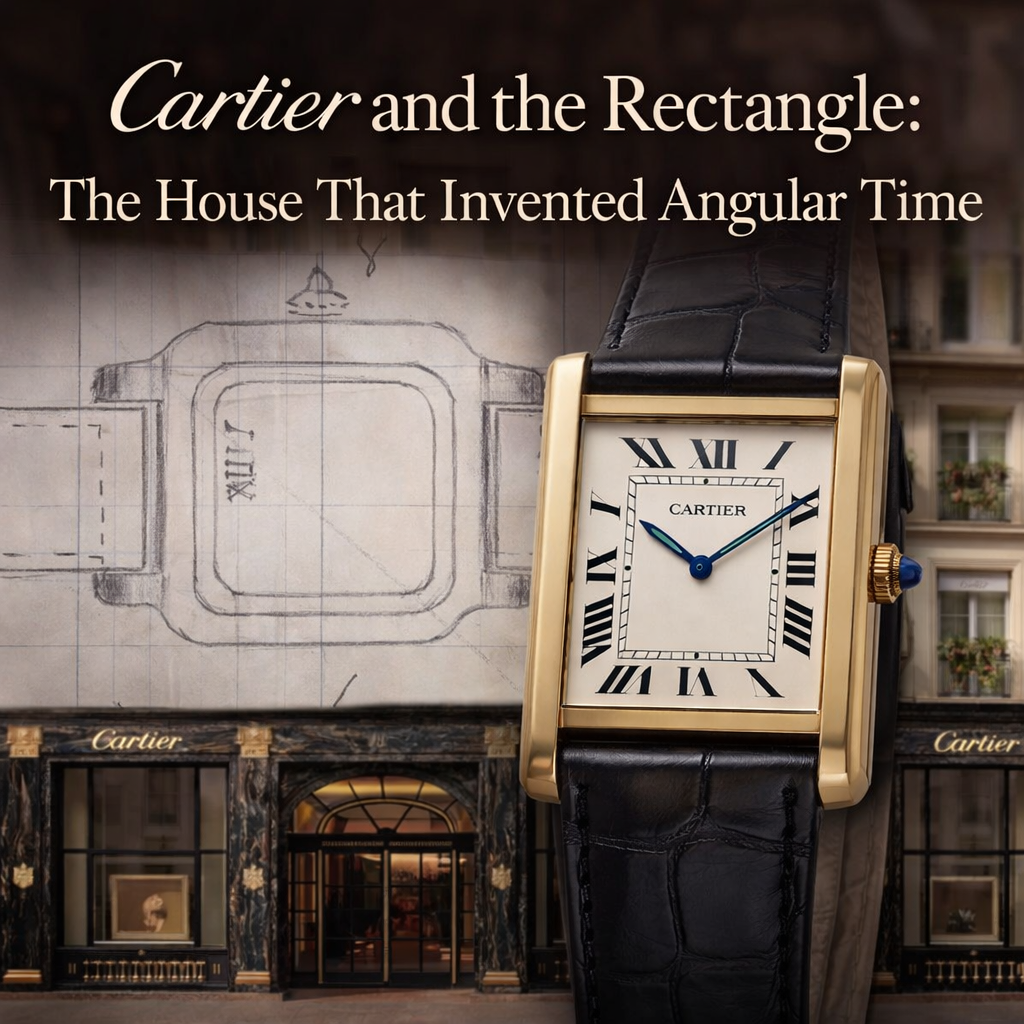
Cartier emerged as the defining force in rectangular watchmaking at the start of the 20th century. While the Santos de Cartier (1904) is recognised as one of the earliest purpose-built wristwatches, it is the Tank that gave rectangular watchmaking its name - and its permanent cultural authority.
Cartier - The Tank (1917)
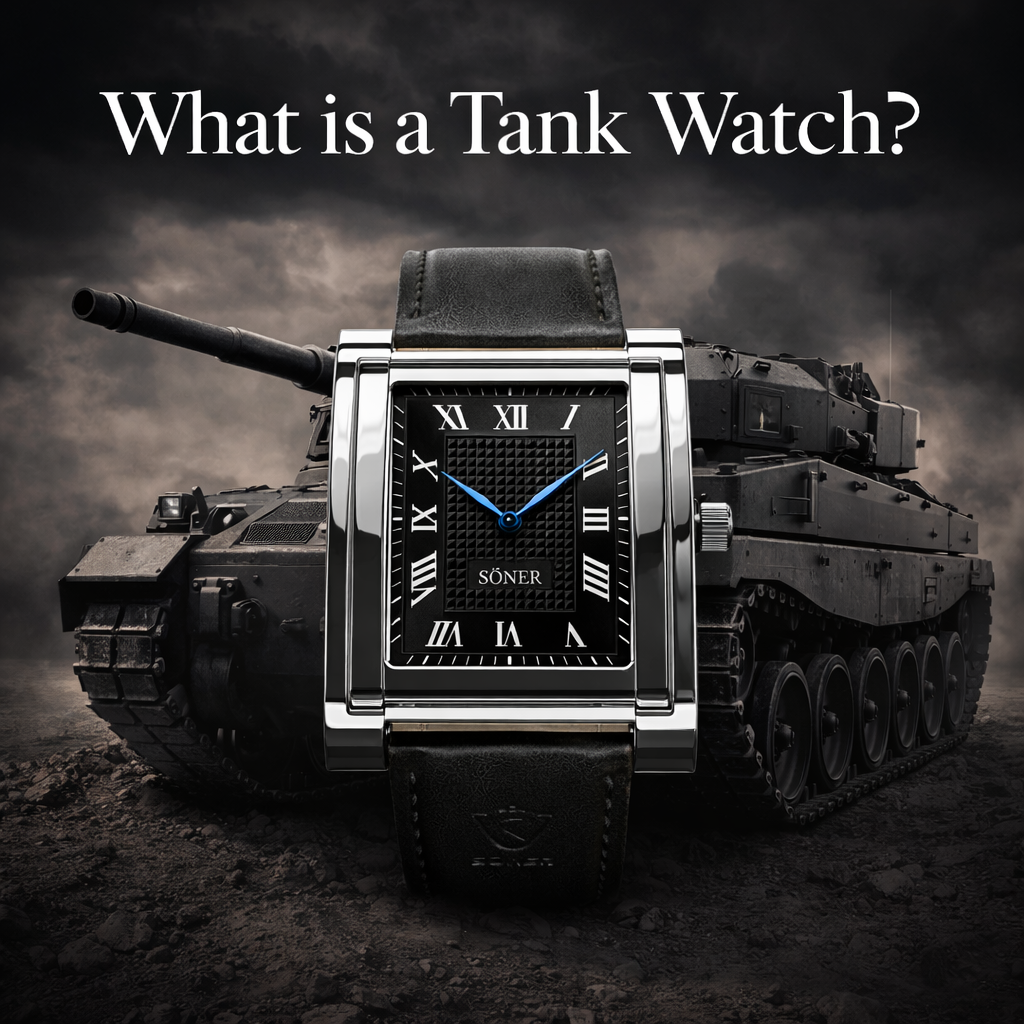
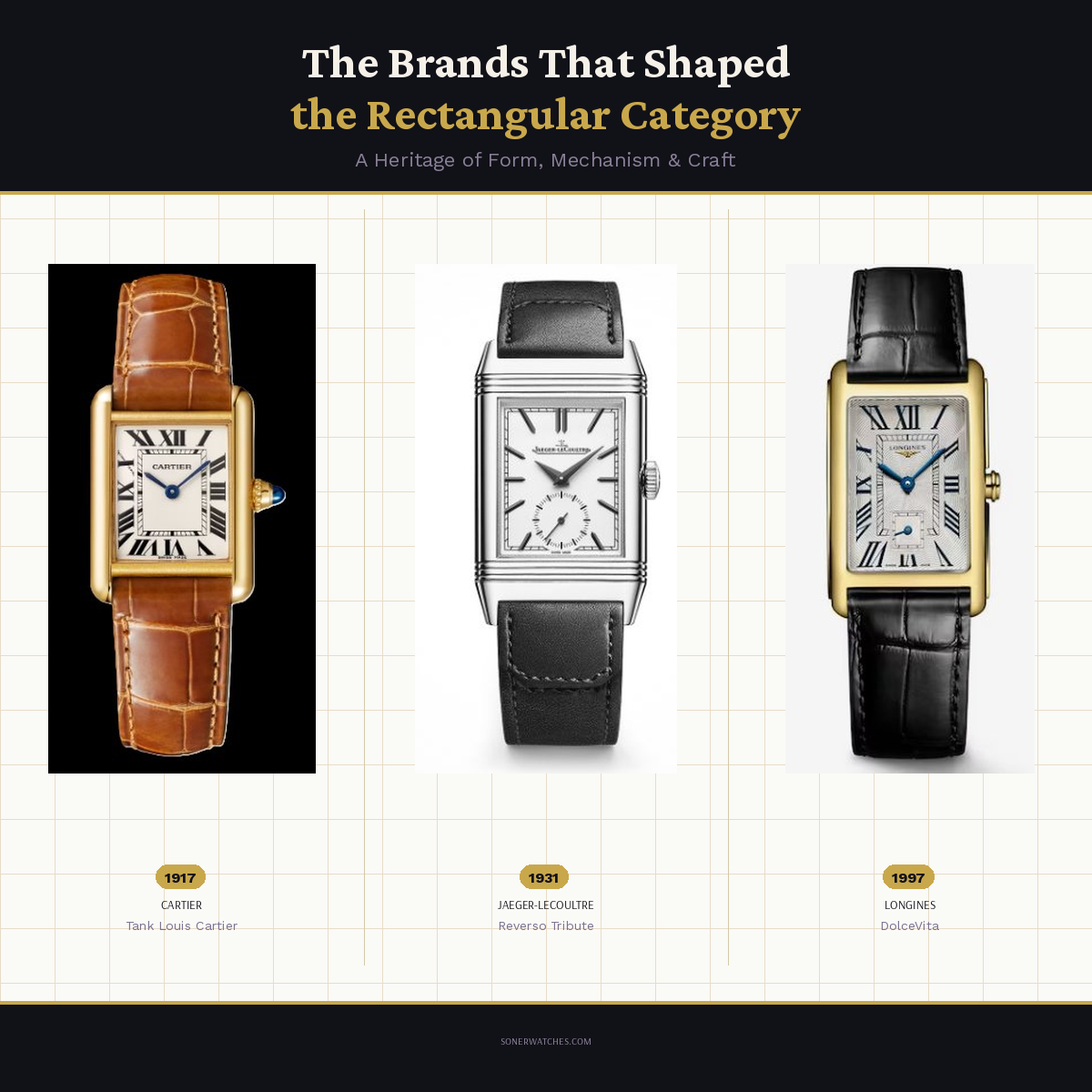
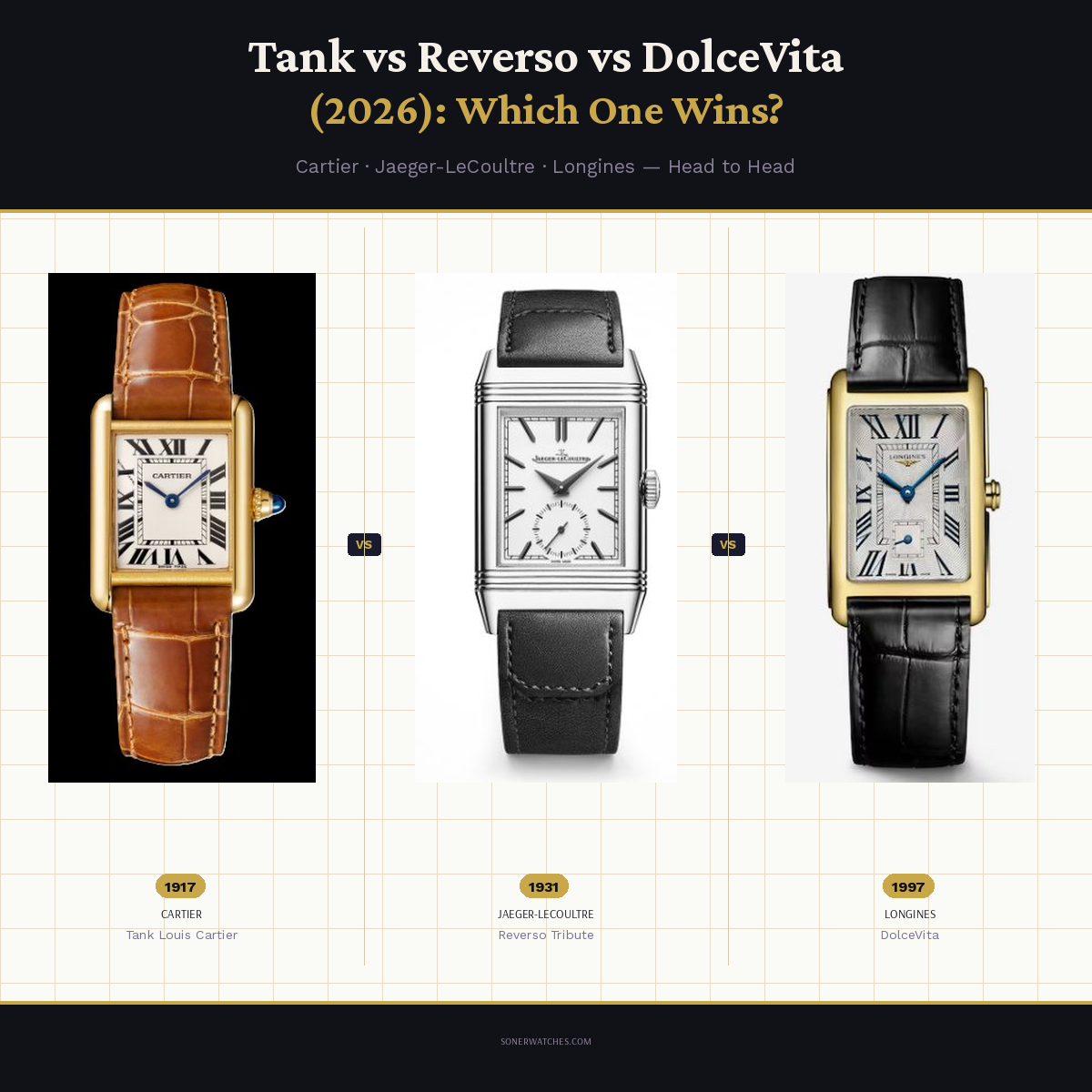
The Cartier Tank was introduced in 1917, drawing inspiration from the profile of Renault FT-17 tanks on the Western Front during World War I. Its rectangular case with clean lines, parallel side bars echoing tank tracks, Roman numeral dial, and sapphire cabochon crown represented a complete rejection of the decorative conventions of the period in favour of architectural precision.
The Tank was first gifted to General John Pershing of the American Expeditionary Force. It did not reach public sale until 1919. The word "tank" subsequently became a generic term in watchmaking for a rectangular case style - a linguistic adoption that confirms the Tank's position as the founding reference of the entire category.

Vintage Cartier Tank. © Cartier SA
The Tank has been worn by Jackie Kennedy, Princess Diana, Andy Warhol, Yves Saint Laurent, and hundreds of other cultural figures across a century of production. It established the rectangular case as the dress watch of choice for those with a specific understanding of design - an understanding that elegance comes from precision, not decoration.
For the full story of the Tank's history and cultural significance, see our article on the history and legacy of the Cartier Tank.
Jaeger-LeCoultre
Jaeger-LeCoultre has registered over 1,242 movements and 400 patents across nearly two centuries of watchmaking. Its contribution to rectangular watchmaking spans two landmark models: the Duoplan of 1925 and the Reverso of 1931.
Jaeger-LeCoultre - The Duoplan (1925)
The Duoplan was introduced during a period when fashion demanded extremely small wristwatches - a trend that posed fundamental problems for movement reliability. Smaller movements mean smaller balance wheels, and smaller balance wheels mean less precise timekeeping.
Jaeger-LeCoultre's solution was the dual-level movement that gave the Duoplan its name. By arranging the movement components across two planes rather than one, the watchmakers retained a large-diameter balance wheel within a compact case. Technical precision was preserved within a smaller footprint. The Duoplan is a direct precursor to the Reverso, and its engineering logic informed everything that followed.
Jaeger-LeCoultre - The Reverso (1931)
The Reverso's origin is one of the most specific in watchmaking history. In 1930, businessman César de Trey was in British India, where colonial army officers complained that their wristwatch crystals were breaking during polo matches. De Trey brought the problem to Jaeger-LeCoultre's Jacques-David LeCoultre and Edmond Jaeger, who had already demonstrated expertise in compact rectangular movements through the Duoplan.
French designer René-Alfred Chauvot crafted the solution: a rectangular case that could slide within its frame and flip completely over, presenting a solid metal back to protect the crystal during play. The design was patented on March 4, 1931, under French patent No. 712868. The Art Deco decorative language - baton hands, dart indexes, Arabic numerals, three decorative gadroons at top and bottom - was not applied as ornamentation but integrated into the functional structure of the case.

Jaeger-LeCoultre Reverso. © Matthew Bain
The Reverso's success was driven by engineering ingenuity rather than material luxury or decorative embellishment. It is a quintessential Art Deco product - form serving function, beauty emerging from problem-solving. The watch has been in continuous production since 1931 and remains the most technically sophisticated rectangular watch available today.
Patek Philippe
Patek Philippe's contribution to rectangular watchmaking is less celebrated than Cartier's or JLC's but no less significant. The brand produced several rectangular references during the mid-20th century that pushed the format into territory it had not previously explored.
Patek Philippe - The Eiffel Tower (Reference 2441, 1948)
The Patek Philippe Reference 2441, introduced in 1948, takes its nickname from the design of its lugs, which bear a striking visual resemblance to the lattice structure of the Eiffel Tower. It features a rectangular case - a deliberate departure from the round formats that dominated Patek's output - housing a manual-winding movement with a clean dial using Arabic numerals, baton hour markers, and slim hands.

Patek Philippe Eiffel Tower (Ref. 2441). © Matthew Bain
The 2441 is highly valued among Patek Philippe collectors for its rarity and the specificity of its design detail. As a rectangular reference from a brand whose identity is almost entirely centred on round cases, it represents Patek's acknowledgment that the rectangular format could achieve the same level of horological excellence as any of its round watches.
Patek Philippe - The Banana (Reference 2442)
The Patek Philippe Reference 2442, introduced in the 1940s and known as "The Banana," takes the rectangular case concept further than almost any watch of its era. The curved, elongated case - designed to follow the contour of the wrist - gives the watch its nickname and its distinctive character. Crafted in yellow or pink gold with gracefully flared lugs and a clean dial with dauphine hands, the 2442 is simultaneously elegant and unconventional.

Patek Philippe Banana (Ref. 2442). © Matthew Bain
Powered by a manually wound mechanical movement, the 2442 has become a rare collector's item cherished for both its unique design and its historical significance within the Patek Philippe lineup. It demonstrates that the rectangular case is not a single format but a family of possibilities - from the strict geometry of the Tank to the fluid curves of the Banana.
Audemars Piguet
Founded in 1875, Audemars Piguet has consistently pushed the technical boundaries of watchmaking. Its rectangular contributions from the early 20th century are among the most technically ambitious watches of their era.
Audemars Piguet - Heure Sautante (1921)
In 1921, Audemars Piguet introduced wristwatches featuring digital jumping hours - a display format that showed the hour as a numeral that jumped instantaneously at each hour change rather than moving continuously via hands. This was a significant departure from conventional time display.
Early versions used a disc of numerals, which proved difficult to read in low light. A subsequent version featured windows cut into the metallic front of the case - a design solution delivered to American retailer Metric Watch in 1926. This version was housed in a rectangular white-gold case containing the hand-wound Caliber GHSM, measuring 22.5mm in diameter and just 2.8mm thick.

AP Jumping Hours. © Christie's / Bridgeman Images
Audemars Piguet - Full Calendar (1921)
Also from 1921, the Audemars Piguet Full Calendar in rectangular white-gold case demonstrated the format's suitability for complex complications. The hand-wound Caliber base (GHSM 17/12), acquired from LeCoultre, drove three hands indicating day, date, and month, alongside a moon-phase display at 6 o'clock. The moon-phase disk carried precisely 59 teeth, with two moons symmetrically positioned opposite each other.
Two inset buttons within the flanks of the rectangular case allowed manual adjustment of the calendar at month-end - a practical engineering solution to the complications of the format. The dial bears the signature of retailer E. Gübelin Lucerne, as was customary for Audemars Piguet of the era.
Rolex
Rolex built its global reputation on round tool watches - the Oyster, the Submariner, the Datejust. But Rolex also produced two significant rectangular collections that demonstrate the brand's understanding that the rectangular case belongs at the highest level of watchmaking.
Rolex - The Prince (1920s)
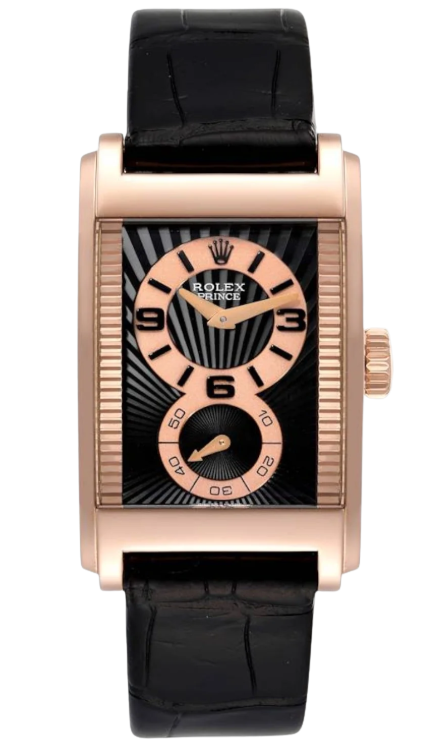
Introduced in the 1920s during a period of design experimentation, the Rolex Prince featured a distinctive rectangular case providing space for complications unusual in round watches of the era. The most characteristic design element is a prominent subsidiary seconds sub-dial at 6 o'clock, creating a two-register dial layout that reads as architecturally considered rather than merely functional.

Rolex Prince. © Matthew Bain
The Prince became a favourite among professionals including doctors, pilots, and executives who valued its precision and reliability. It was discontinued in the mid-20th century but its legacy endures: vintage Rolex Prince references are now highly sought after by collectors for their historical significance and the rarity of finding Rolex quality in a rectangular Art Deco case.
Rolex - The Cellini (1960s onwards)
Named after Renaissance artist Benvenuto Cellini, the Cellini collection emerged in the 1960s as Rolex's dress watch line - and the natural continuation of the Prince's rectangular legacy. The King Midas, designed by Gerald Genta (also responsible for the Audemars Piguet Royal Oak and Patek Philippe Nautilus), was a bold all-gold rectangular watch produced in the 1960s and 1970s. The Cellini Prince followed with a transparent caseback allowing the movement to be viewed - one of the very few Rolex references to feature this.

Rolex Cellini King Midas. © Matthew Bain
The Cellini collection has since been discontinued, but its rectangular references remain among the most collectible non-round Rolex references produced. For more detail on Rolex's rectangular output, see our complete guide to rectangular Rolex watches.
Omega
Founded in 1848, Omega has consistently been at the forefront of watchmaking precision - official timekeeper of the Olympic Games since 1932, and the watch that went to the moon with the Apollo missions. Its rectangular contribution is the Marine of 1932: the first true dive watch ever made, and it was rectangular.
Omega Marine (1932)
The Omega Marine was introduced in 1932 as a direct solution to the problem of waterproofing - a challenge the entire watch industry was grappling with following Rolex's introduction of the Oyster in 1926. Engineer Alix's patent for the Marine used a double-case construction: a rectangular inner case housing the movement, dial, and hands, fitted into a matching outer case that created a watertight seal without infringing on Rolex's screw-down crown patents.

Omega Marine. © Christie's / Bridgeman Images
In 1936, the Marine was submerged to 73 metres in Lake Geneva. In May 1937, the Swiss Laboratory for Horology in Neuchâtel certified it capable of withstanding pressure equivalent to 135 metres of depth. These tests established the Marine as the first watch in history to be formally certified as suitable for diving. The fact that the world's first true dive watch was rectangular is not a footnote. It is a significant piece of the rectangular case's history that is rarely acknowledged.
Longines
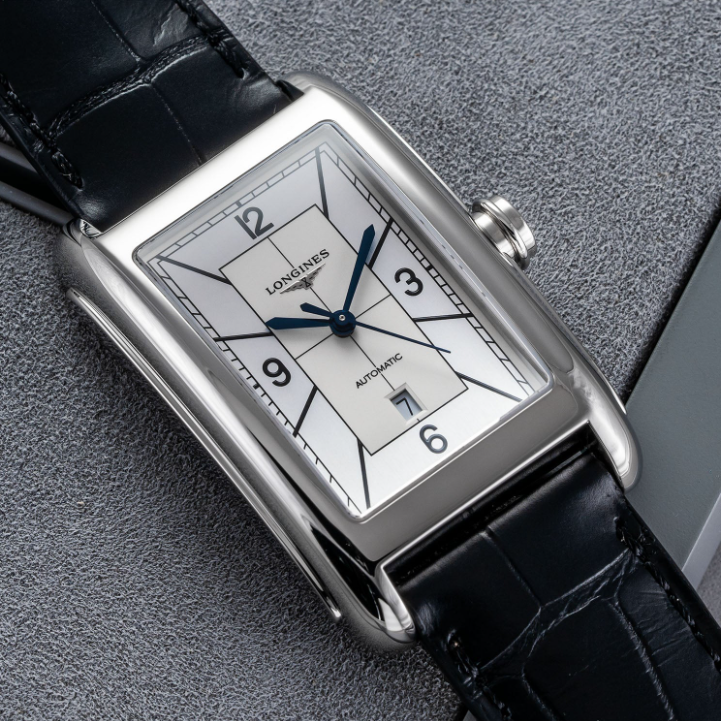
Founded in 1832 in the Swiss village of Saint-Imier, Longines registered its winged hourglass trademark in 1880 - making it the oldest registered trademark in the watchmaking industry. Its rectangular watchmaking history began earlier than most and was more systematically developed than almost any other brand of the era.

Early rectangular watches. © Longines Francillon SA
Longines unveiled its first rectangular movement in 1914 with the Cal. 7.43. The Cal. 8.47 followed in 1916 with both rectangular and oval designs. The brand's first rectangular men's watch arrived in 1925 with the Cal. 9.47N. In 1939, Longines filed a patent for a water-resistant rectangular case - prefiguring the waterproofing innovations that would define the second half of the 20th century. The systematic development of rectangular watchmaking across three decades demonstrates a commitment that no other brand of the era matched in consistency.
Longines Caliber 9.47N (1925)
The Longines Caliber 9.47N, introduced in 1925, marked the brand's formal entry into rectangular men's watchmaking. Measuring 20 x 28mm with a height of 4.1mm and carrying 15 jewels, the movement was designed for compact sophistication without sacrificing precision. Its standout feature was a small seconds sub-dial - one of the first rectangular watches in history to include this complication. The combination of technical precision, compact engineering, and considered dial design established a template that Longines would develop for decades.

Longines watch with cal. 9.47N, 1925. © Longines Francillon SA
Gruen
The Gruen Watch Company was established in 1894 by German immigrant Dietrich Gruen. Known for precision and design innovation, Gruen's contribution to rectangular watchmaking is the Curvex - a watch that solved a fundamental ergonomic problem with engineering elegance.
The Gruen Curvex (1935)
Introduced in 1935, the Gruen Curvex featured a revolutionary curved movement - a mechanical calibre that followed the contour of the wrist rather than lying flat against it. The result was a rectangular watch that sat on the body more naturally than any flat-cased equivalent, combining the visual appeal of the geometric case with a wearing comfort that flat movements could not replicate.

Gruen Curvex. © Christie's / Bridgeman Images
The Curvex remained Gruen's flagship product through the mid-20th century and is highly sought after by collectors today for its pioneering design and historical significance. It represents an approach to rectangular watchmaking that prioritised the wearing experience as much as the visual statement - a philosophy that remains valid nearly a century later.
The Legacy of Rectangular Watchmaking Pioneering
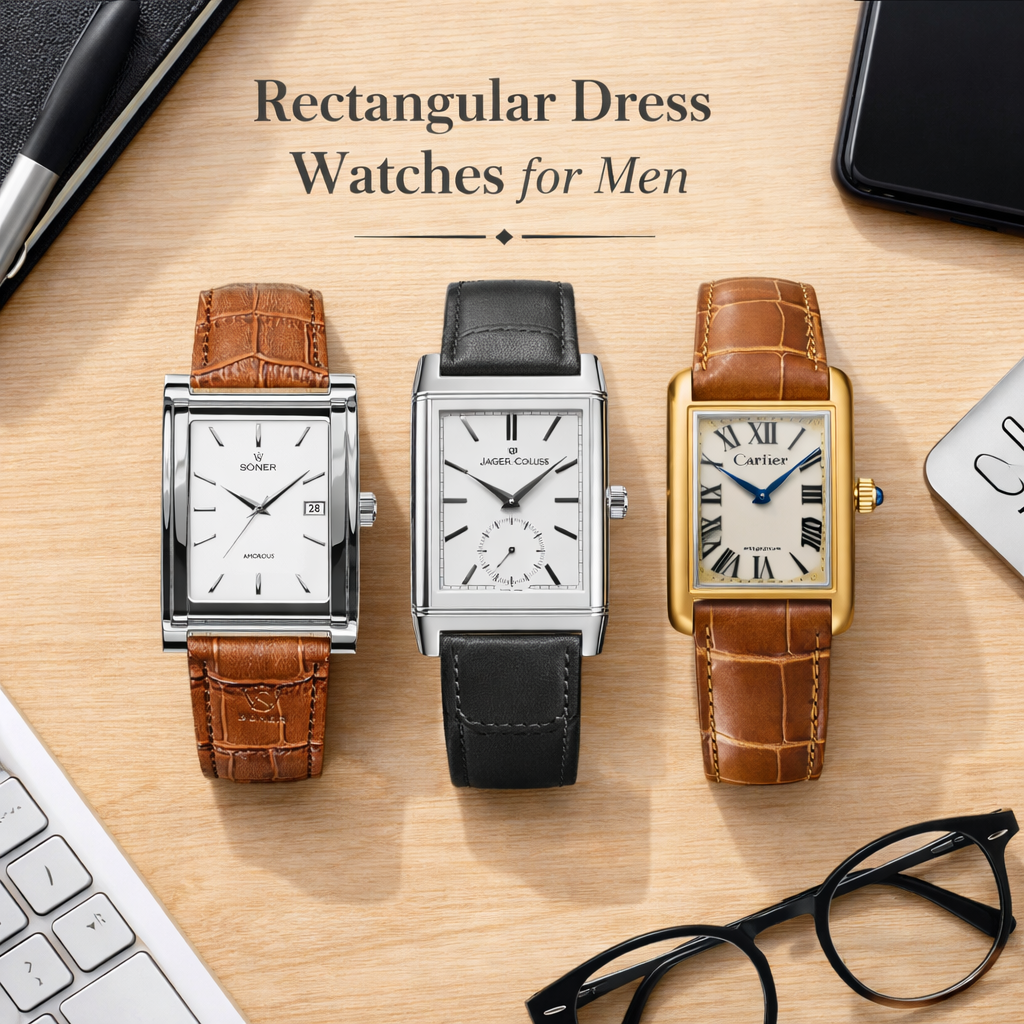
The brands covered in this article collectively established something that no single company could have done alone: a tradition. The Cartier Tank provided the cultural foundation. The JLC Reverso added engineering depth. Patek Philippe, Audemars Piguet, Rolex, Omega, Longines, and Gruen extended the format into complications, sport, and ergonomic innovation that proved the rectangular case was not a decorative choice but a versatile and technically serious format.
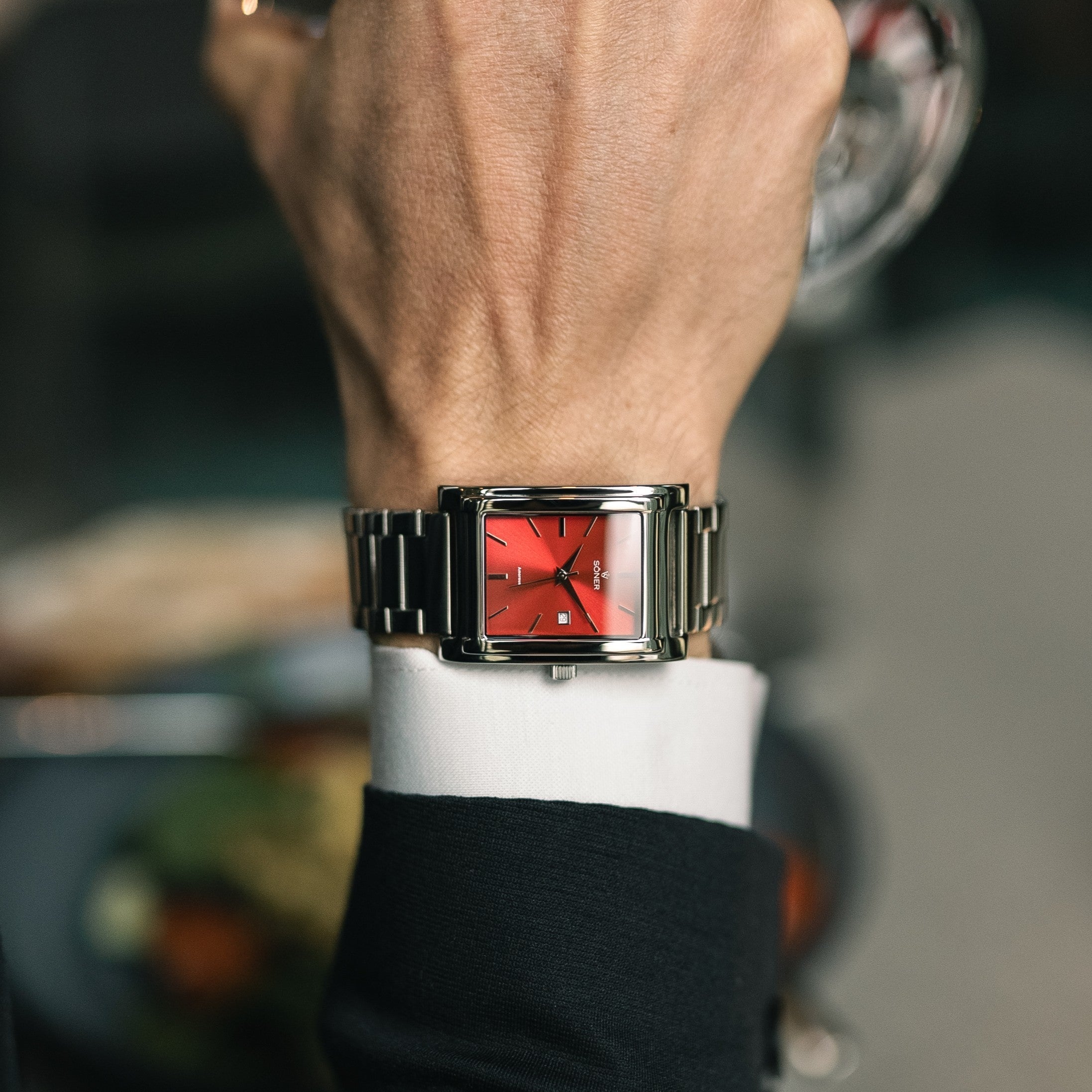
That tradition is what Söner Watches continues today. As the only brand in the world dedicated exclusively to rectangular watches, every decision we make - case proportions, dial layout, movement selection, strap design - is made in direct continuation of the work these pioneers began. Not as imitation. As conviction that the rectangular case is still the most interesting shape in watchmaking.
For the full chronological history of rectangular watch development, see our complete history of rectangular watches. To explore the current Söner collection, see our rectangular watch collection.
Frequently Asked Questions
Which brand made the first rectangular watch?
The Cartier Santos (1904) is generally recognised as one of the earliest purpose-built wristwatches and featured a square case. The Cartier Tank (1917) is considered the founding reference of rectangular watchmaking as a distinct tradition. The Tank introduced the design language - case geometry, dial layout, decorative elements - that defined the category for the century that followed.
Why did rectangular watches fall out of fashion?
The quartz crisis of the 1970s disrupted the entire mechanical watch industry, and rectangular cases - which require more complex manufacture than round ones - were disproportionately affected. As the industry recovered, it did so primarily through round sports watches, which suited the quartz and then mechanical revival of the 1990s and 2000s. Rectangular watches were never abandoned entirely but retreated to a specialist position. The current resurgence reflects a broader shift toward dress watches, vintage design, and watches with genuine design heritage.
What is the most technically significant rectangular watch in history?
The Jaeger-LeCoultre Reverso makes the strongest claim. Its reversible case mechanism - patented in 1931 and still in production today - represents an engineering solution to a specific problem that has never been bettered. The Omega Marine (1932) is a close second as the world's first certified dive watch, demonstrating that the rectangular format was capable of extreme functional performance as well as elegance.
Are rectangular watches from these heritage brands still available today?
The Cartier Tank and JLC Reverso are both in active production across multiple references. The TAG Heuer Monaco continues in production. The Rolex Cellini and Patek Philippe rectangular references have largely been discontinued, making vintage examples the primary route to ownership. For current rectangular watches at accessible price points, see the Söner rectangular watch collection.