




 Published on
Table of Contents
Some watches don't just tell time - they define it. In a market where round cases account for roughly 85 to 90 percent of all watches produced, a handful of rectangular models have managed something extraordinary: they became icons not despite their shape, but because of it. These are the watches that proved the rectangular case wasn't a compromise or a curiosity, but a design language capable of producing objects of lasting cultural and aesthetic significance.
This is not a ranking. It is a record of the models that shaped the category, influenced generations of designers, and continue to set the standard for what a rectangular watch can be. If you're building an understanding of the rectangular watch world, these are the references you need to know. Start with the complete rectangular watch guide to establish your foundation, then return here to understand the models that made the category what it is.
The Cartier Tank: The Watch That Started Everything
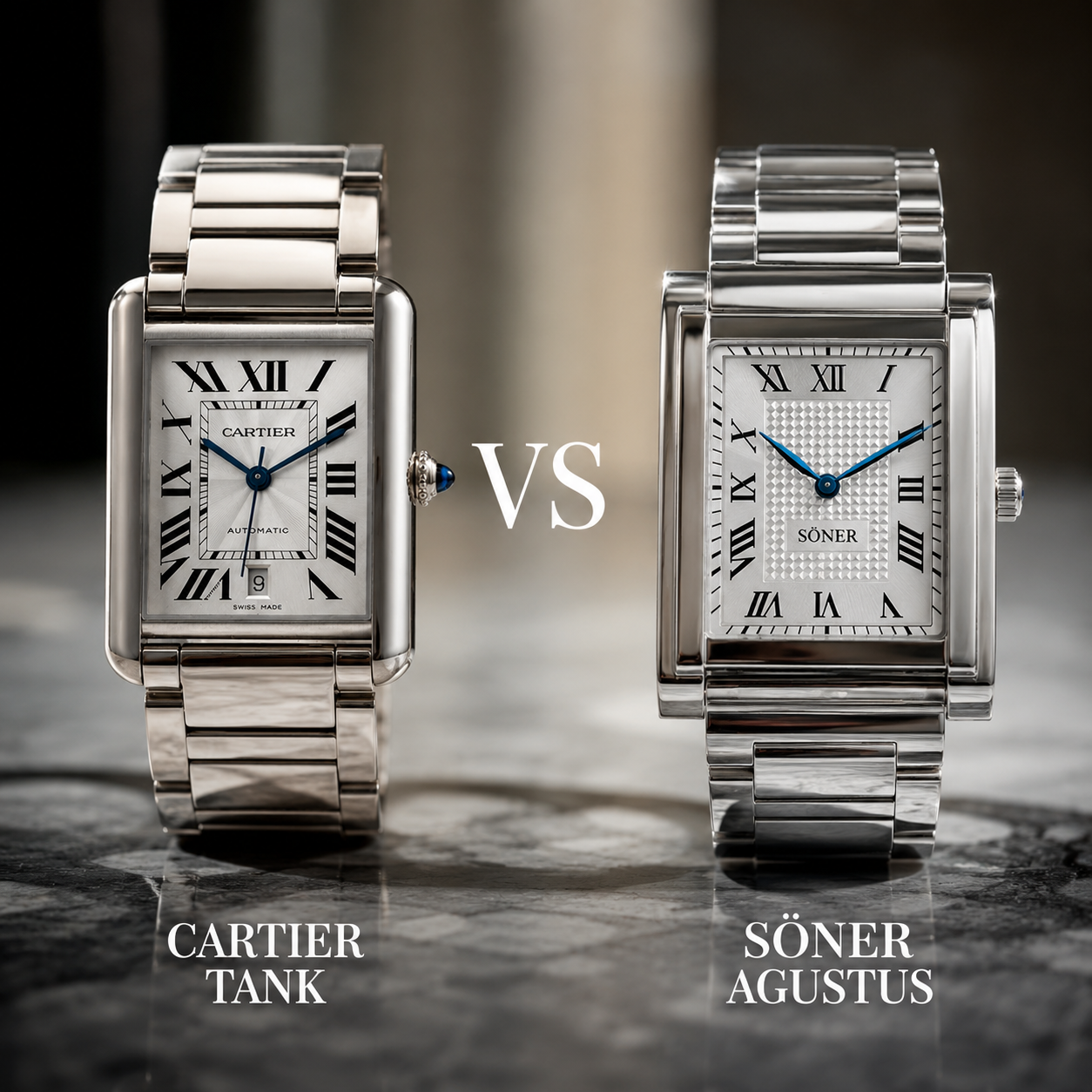
No discussion of rectangular watches begins anywhere other than the Cartier Tank. Introduced in 1917 and inspired, according to legend, by the aerial view of Allied tanks crossing the Western Front, the Tank did not merely launch a product. It launched a visual argument that has never been successfully refuted.
Louis Cartier's design solved the fundamental challenge of the rectangular watch with an elegance that has proved impossible to improve upon: the bracelet was integrated directly into the case via vertical side bars called brancards, creating a continuous line from wrist to dial. The watch did not sit on the wrist so much as flow across it. The dial was pure architecture, a white rectangle with Roman numerals and blued steel hands, with nothing extraneous.
The Tank became the watch of the twentieth century's defining figures. Andy Warhol wore one. So did Jacqueline Kennedy Onassis, Princess Diana, and Yves Saint Laurent. Muhammad Ali received one as a gift and never took it off. The Tank is not merely a watch that famous people wore. It is a watch that famous people chose specifically because it communicated something that a round watch could not.
What the Tank established was the idea that a rectangular watch could be a complete artistic statement, that the geometry of the case was not a limitation to be worked around but a virtue to be celebrated. Every rectangular watch made since 1917 exists in some relationship to the Tank, whether that relationship is reverence, reaction, or reinvention. Its role in the historical development of the entire rectangular watch category cannot be overstated.
The Tank family today encompasses multiple references, including the Tank Louis Cartier, the Tank Americaine, the Tank Francaise, and the Tank Solo. Each is a variation on the original argument, none of which has required a fundamental revision of Louis Cartier's original idea. That is the definition of an icon.
The Jaeger-LeCoultre Reverso: Engineering as Ideology
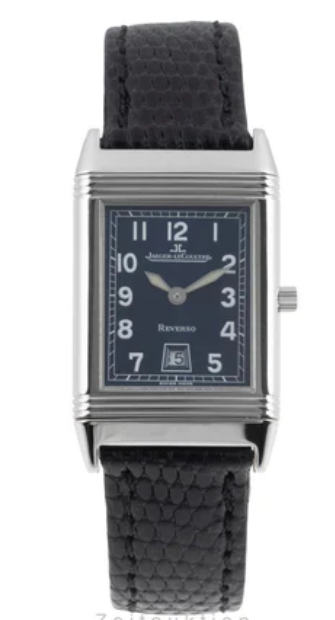
If the Tank is the emotional center of the rectangular watch category, the Reverso is its intellectual one. Introduced in 1931, the Reverso began as a solution to a practical problem: polo players in British India needed a watch that could survive the impacts of the sport without damaging the crystal. Jaeger-LeCoultre's solution was to put the entire movement in a case that could physically rotate within its carrier, hiding the dial against the wrist during play.
The mechanism that achieved this, a sliding chassis within a fixed carrier, is one of the most elegant pieces of engineering in watchmaking history. But the Reverso's lasting significance goes beyond its defining feature. The flipping mechanism forced Jaeger-LeCoultre to design a rectangular case of exceptional precision, because the tolerances required for the slide mechanism left no room for geometric imprecision. The Reverso is a rectangular watch that is rectangular because it had to be, and the purity of that necessity is visible in every line of the finished object.
The reverse of the case, the surface that faces the wrist when flipped, became a canvas. Reverso cases have been engraved, enameled, set with miniature paintings, and decorated with personal dedications. The rectangular case turned out to be an ideal format for this kind of personalization, its flat surfaces offering a dignity and scale that a round caseback cannot match.
The Reverso's modern visibility among collectors and in the broader luxury market reflects the watch's extraordinary ability to remain relevant across nine decades without fundamental revision. The proportions Jaeger-LeCoultre established in 1931 are still the proportions that make the watch work today.
The Rolex Prince: The Watch Collector's Rectangular Reference
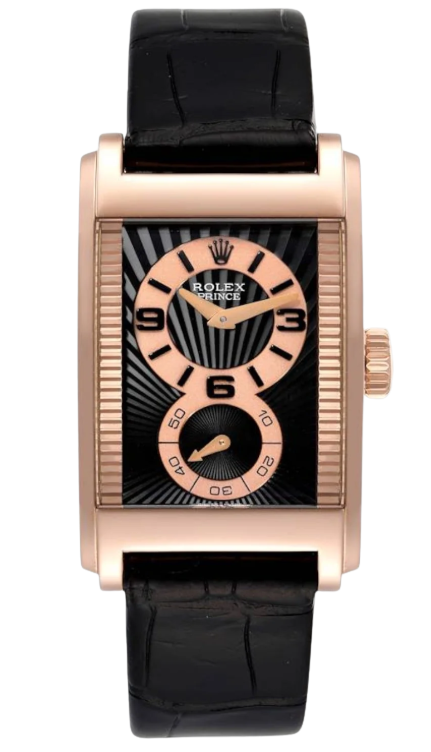
The Rolex Prince, produced primarily between 1928 and 1945, occupies a different position in the rectangular canon than the Tank or the Reverso. It was not a design object in the same self-conscious sense. It was a watchmaker's watch, a technical achievement that happened to be housed in a rectangular case.
The Prince's defining feature was its two-register dial, which separated the hours and minutes into a large upper aperture and the running seconds into a smaller lower one. This arrangement gave the dial a mechanical clarity and visual precision that suited the rectangular format perfectly. The elongated case provided exactly the vertical space needed to stack two dial registers without crowding, and the result was a watch that looked like what it was: a precision instrument of the highest order.
Rolex positioned the Prince as a doctor's watch, partly because its running seconds register made it easy to count a patient's pulse, and partly because the association with medical precision reinforced the watch's identity as a technical rather than decorative object. The Prince is now among the most sought-after vintage rectangular watches, its current market positioning at auction reflecting both its rarity and its status among serious collectors as the defining horological rectangular watch of the interwar period.
The Baume and Mercier Hampton: Democratic Elegance
Not every iconic rectangular watch is a masterpiece of engineering or a cultural artifact worn by heads of state. The Baume and Mercier Hampton, introduced in 1994, made the argument that rectangular watch design could be accessible, that the vocabulary of the great rectangular references could be translated into a watch that more people could actually own and wear.
The Hampton's proportions are carefully judged: tall enough to read as deliberately architectural, narrow enough to slide under a cuff without difficulty. The finishing is clean without being severe. The case is stainless steel by default, with gold options available, but the design does not require precious metal to make its point.
The Hampton's contribution to the category is proof that iconic status does not require rarity or extreme price. A well-proportioned rectangular watch, produced with genuine care, at a price that rewards rather than punishes the buyer, is itself a statement of values.
The Patek Philippe Gondolo: The Aristocrat of the Category
The Gondolo name traces to the Gondolo and Labouriau retailer in Rio de Janeiro, for whom Patek Philippe produced rectangular pocket watches in the early twentieth century. The name was revived in 1993 for a wristwatch collection that made a specific argument: that the rectangular case, at its highest expression, is the most aristocratic form in watchmaking.
Patek Philippe brings to the Gondolo everything it brings to its round watches, including hand-finished movements, exceptional dial execution, and case proportions refined over decades of iteration, and applies it to a case shape that immediately distinguishes the wearer from the round-watch majority. The result is a watch that communicates membership in a very specific community: people who know watchmaking well enough to choose the harder path and have the resources to do it properly.
The Gondolo is not the most famous rectangular watch, but it may be the finest argument for what the category can achieve when manufacturing excellence meets genuine design conviction.
The Cartier Santos: When Square Challenged Round
Strictly speaking, the Santos is not rectangular. It is square, or at least closer to square than to the elongated rectangles of the Tank and Reverso families. But its role in the story of non-round watches is significant enough to warrant its place here.
The Santos, created by Louis Cartier for the aviator Alberto Santos-Dumont around 1904, was among the first wristwatches made for a man. Santos-Dumont needed to be able to check the time during flight without taking his hands off the controls, and Cartier's solution was a watch worn on the wrist rather than carried in a pocket. The square case with exposed screws on the bezel became one of the most recognizable watch designs in history.
The Santos matters to the rectangular story because it demonstrated, a decade before the Tank, that a geometric case shape could carry meaning that a round case could not. The exposed screws were functional, holding the bezel to the case, but they were also legible as a statement of purpose, as visible evidence that this was a tool designed for a specific task. The Santos established the idea that non-round watches could wear their intentions on their faces.
What These Watches Share
Looking across these references, the Tank, the Reverso, the Prince, the Hampton, the Gondolo, and the Santos, a common set of qualities becomes visible.
Each of them solved a genuine problem. The Tank addressed the formal elegance problem that round watches could not resolve. The Reverso addressed the physical durability problem of active wear. The Prince addressed the legibility problem of precision timekeeping. The Santos addressed the hands-free problem of early aviation. The rectangular case, in each instance, was chosen because it was the right answer to a real question, not because designers were trying to be different for its own sake.
Each of them established proportions that have proved resistant to improvement. The dimensions of the original Tank, the slide geometry of the original Reverso, the two-register layout of the Prince, these have been iterated on, scaled, and reissued across decades without fundamental revision because they were correct from the beginning. That is what makes a watch iconic rather than merely interesting.
And each of them demonstrated that the penalties of the rectangular case, the manufacturing complexity, the movement constraints, the higher production costs, are not arguments against the form but part of its identity. A watch that accepts difficulty in the pursuit of a specific kind of excellence communicates something that an easy watch cannot.
Summary
The icons of the rectangular watch category did not survive a century of market pressure by accident. The Tank, the Reverso, the Prince, the Hampton, the Gondolo, and the Santos each made a specific argument in favor of the rectangular case, solved a genuine problem with it, and established proportions and design logic that time has not improved upon. Together they form the foundation of a category that rewards the wearer who takes the time to understand it.
The rectangular watch is not a niche. It is a tradition with more than a century of proven excellence behind it, and these are the watches that built it. Understanding where they came from, how they have influenced the market that exists today, and where the category is headed requires looking beyond the individual references to the broader story of the form itself.
The complete rectangular watch guide is the place to begin that study. The historical development of these references gives the context that makes them fully legible across the decades. And for anyone deciding where to enter the category today, understanding their current market positioning alongside the modern visibility of the rectangular watch in contemporary collecting and fashion is the clearest guide to making the right choice.
Related Articles:
Complete rectangular watch guide Historical development Modern visibility Current market positioningSÖNER rectangular watches
Free worldwide shipping · 10-year warranty · 30-day returns
Our pick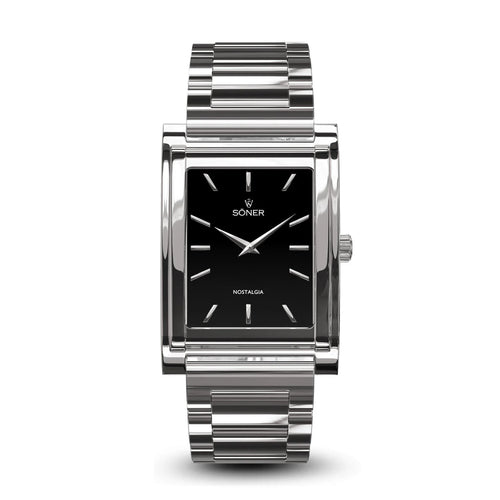 Nostalgia Stockholm11-year battery$580 USD
View watch
Nostalgia Stockholm11-year battery$580 USD
View watch
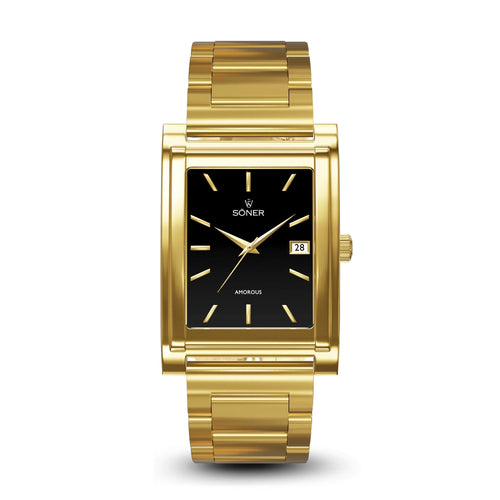 Amorous MilanoAutomatic$785 USD
View watch
Amorous MilanoAutomatic$785 USD
View watch
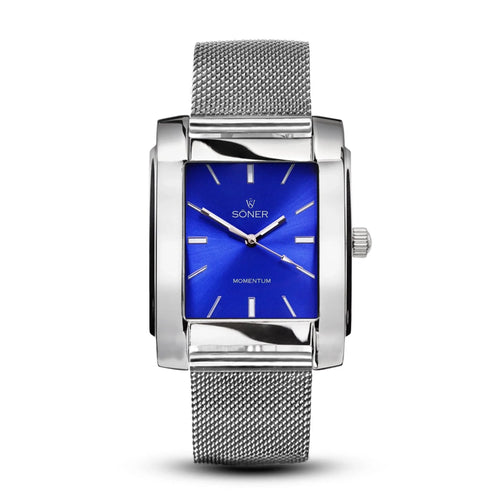 Momentum BacardiAutomatic$585 USD
View watch
Momentum BacardiAutomatic$585 USD
View watch
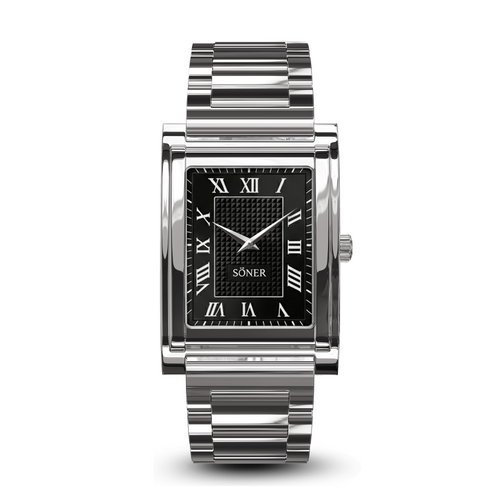 Nostalgia Caesar11-year battery$765 USD
View watch
Nostalgia Caesar11-year battery$765 USD
View watch
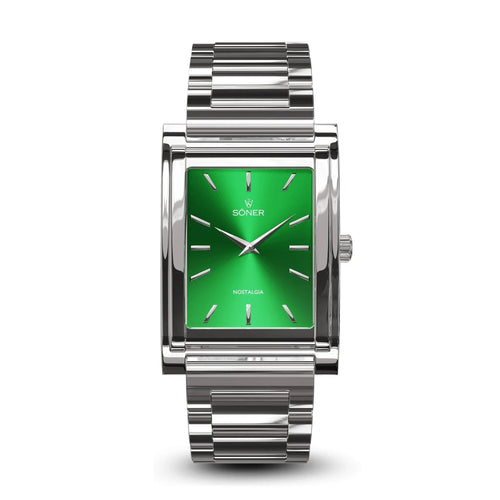 Nostalgia New York11-year battery$580 USD
View watch
Nostalgia New York11-year battery$580 USD
View watch
View all watches
 Nostalgia Stockholm11-year battery$580 USD
View watch
Nostalgia Stockholm11-year battery$580 USD
View watch
 Amorous MilanoAutomatic$785 USD
View watch
Amorous MilanoAutomatic$785 USD
View watch
 Momentum BacardiAutomatic$585 USD
View watch
Momentum BacardiAutomatic$585 USD
View watch
 Nostalgia Caesar11-year battery$765 USD
View watch
Nostalgia Caesar11-year battery$765 USD
View watch
 Nostalgia New York11-year battery$580 USD
View watch
Nostalgia New York11-year battery$580 USD
View watch