



 Published on
Table of Contents
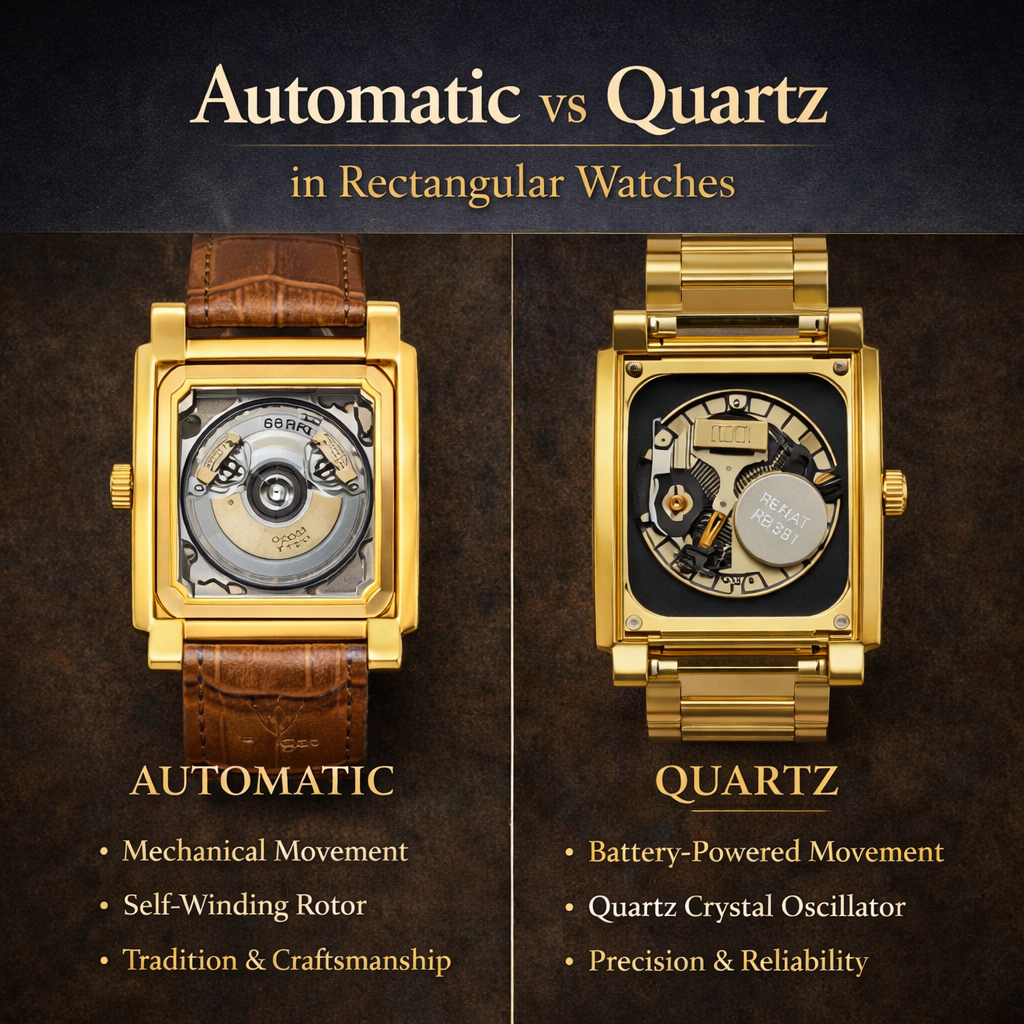
In most watch categories, the debate between automatic vs quartz is relatively straightforward. Automatic movements offer mechanical interest, tradition, and the satisfaction of a self-winding calibre. Quartz movements offer superior accuracy, lower maintenance, and significantly lower cost. The buyer weighs those trade-offs against their preferences and budget and makes a choice.
In rectangular watches, the debate is more interesting and more consequential. The geometry of the rectangular case introduces constraints and complications that change the terms of the comparison in ways that do not apply to round watches. Movement type affects not just accuracy and maintenance but case thickness, wrist presence, available price points, and the long-term repairability of the watch. Understanding how each movement type interacts specifically with rectangular case geometry is essential knowledge for any serious buyer in this category.
The Definitive Guide to Rectangular Watches covers movement choice in the broader context of the full buying decision, alongside proportions, materials, history, and price. This article goes deeper into the specific mechanical and practical implications of each choice.
Why Movement Type Matters More in Rectangular Cases
In a round watch, the movement sits concentrically within the case. The case is sized to accommodate the movement diameter, and the relationship between movement size and case size is well understood and well standardized. Adding a rotor for automatic winding adds a known amount to the movement height, and the case can be designed around that total height. The geometry is cooperative.
In a rectangular case, the geometry is not cooperative. The movement must fit a non-round space. The options for accommodating a rotor are more limited. The corner spaces that a rotor might sweep through in a round case are dead zones in a rectangular one. The available height above and below the movement plate is constrained by the desire for overall case thinness, which is almost always a design priority for rectangular watches.
The result is that every movement type involves a different set of compromises in a rectangular case, and those compromises are more significant than in a round case of equivalent quality.
Quartz Movements in Rectangular Cases
How Quartz Works in a Rectangular Context
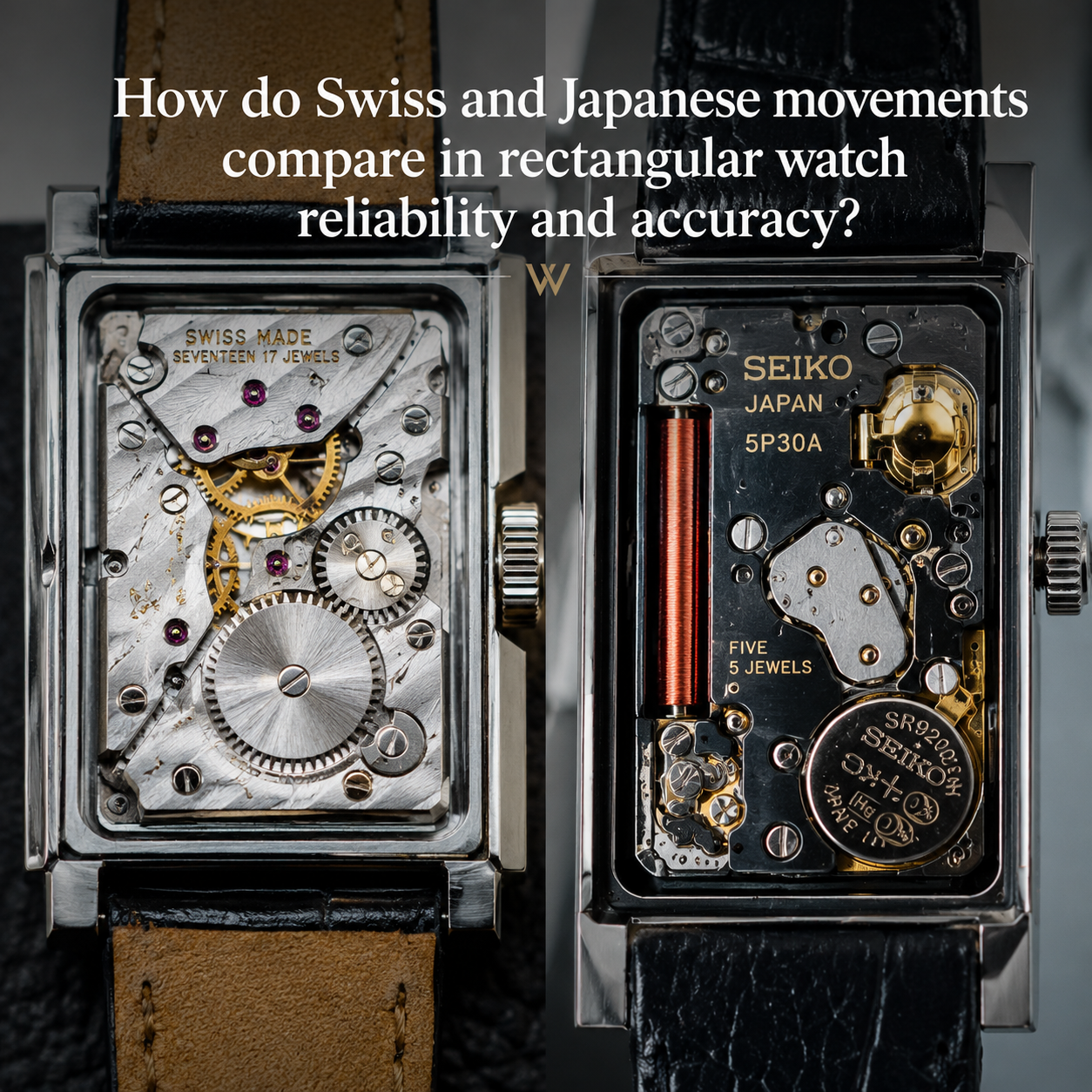
A quartz movement uses the precise oscillation frequency of a quartz crystal, typically 32,768 times per second, to regulate timekeeping. The quartz oscillator is driven by a battery and controls a stepping motor that advances the hands. The system requires no mainspring, no gear train in the traditional sense, and no rotor. It is mechanically much simpler than an automatic movement.
This simplicity is a significant advantage in a rectangular case. A quartz calibre can be designed as a flat, thin module that is shaped precisely to the available footprint within the case. Because there is no rotor and no need for the gear train depth of a mechanical movement, quartz calibres can be extraordinarily thin. Some rectangular quartz movements measure less than 2mm in total height, allowing the finished watch to achieve a total case thickness of 4mm to 6mm, which is essentially impossible with an automatic movement at the same quality level.
The quartz oscillator itself occupies minimal space and can be positioned anywhere within the movement plate. The battery can similarly be placed wherever the available footprint permits. This spatial flexibility allows movement designers to create quartz calibres that fill a rectangular footprint efficiently, without the dead corner space that round movements produce in rectangular cases.
The Thinness Advantage
The single most significant advantage of quartz in a rectangular case is thinness. This matters more in the rectangular category than in almost any other because thinness is central to what makes a great rectangular dress watch great.
A rectangular case that disappears under a shirt cuff, that rests flat against the wrist without creating a visible profile from the side, that carries itself with the understated elegance of a well-cut garment rather than the assertive bulk of a sports watch: all of these qualities depend on thinness, and thinness depends on the movement inside.
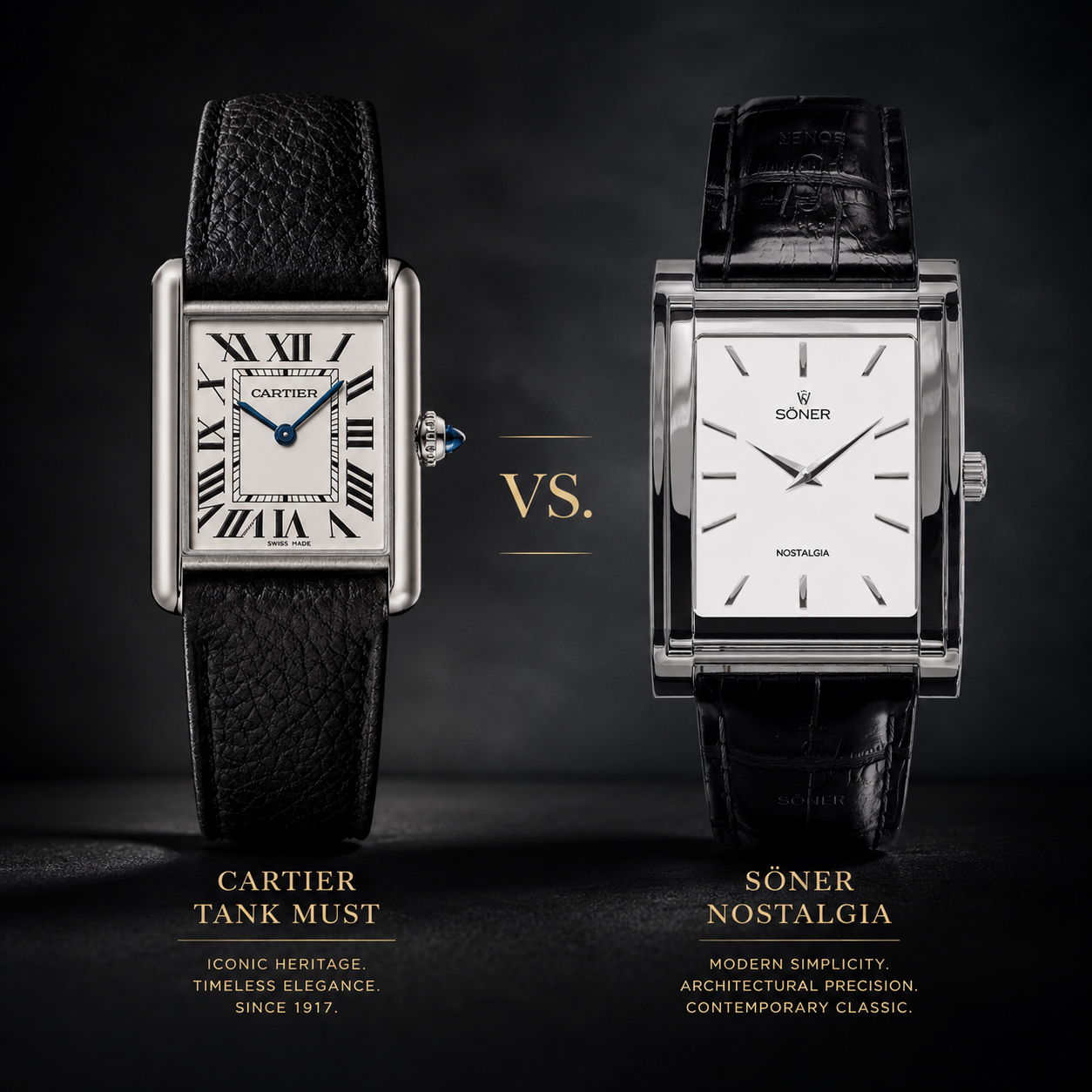
Some of the most celebrated rectangular watches in history have been quartz powered. The Cartier Tank Must, which represents the Tank at its most accessible and perhaps its most culturally influential, uses a quartz movement. The result is a case that achieves 6.6mm of total thickness, a number that no automatic movement of equivalent case footprint can approach without enormous engineering investment.
Accuracy and Reliability
A quality quartz movement is accurate to within approximately plus or minus 15 seconds per year under normal conditions. A high-precision quartz calibre can achieve even better performance. By comparison, a mechanical movement, automatic or manual, is typically accurate to within plus or minus 3 to 5 seconds per day, which translates to approximately 18 to 30 seconds per month.
In absolute terms, quartz is significantly more accurate. For a watch worn as an everyday timekeeping instrument, this difference is practically meaningful. For a watch worn primarily as an aesthetic object on formal occasions, it is largely irrelevant.
Quartz movements are also more reliable in the short to medium term. They have fewer moving parts, lower sensitivity to position and temperature, and no dependence on regular winding. A quartz rectangular watch will keep better time with less attention than an automatic one.
Battery and Maintenance
The primary maintenance requirement of a quartz movement is battery replacement, typically every two to three years depending on the calibre and dial configuration. Battery replacement is a minor service that most watchmakers can perform quickly and inexpensively.
The longer-term maintenance picture is more complex. Quartz movements, particularly inexpensive ones, are sometimes treated as disposable. When the movement fails, the cost of repair may exceed the cost of replacement. For high-quality quartz calibres from the major Swiss manufacturers, repair and servicing are available and cost-effective. For proprietary quartz modules in fashion watches, long-term parts availability is less certain.
For rectangular dress watches from established brands, quartz movements are a practical and sustainable long-term choice. The movements are well-supported, the service intervals are long, and the overall cost of ownership is lower than for an equivalent automatic.
| Movement Type | Routine Maintenance | Service Interval | Long-Term Durability |
|---|---|---|---|
| Quartz | Battery replacement | Every 2–3 years | Dependent on parts availability |
| Manual Wind | Full mechanical service | Every 5–7 years | Indefinite with proper servicing |
| Automatic | Full mechanical service | Every 5–7 years | Indefinite with proper servicing |
Which Rectangular Movement Requires Less Maintenance?
Quartz movements require only battery replacement every few years, while mechanical movements require full servicing approximately every five to seven years. Mechanical watches, however, can be maintained indefinitely through component replacement.
Manual-Wind Movements in Rectangular Cases
Before addressing automatic movements specifically, it is worth giving manual-wind mechanical calibres their own consideration, because they occupy an important position in the rectangular watch category.
A manual-wind movement is a mechanical calibre without a self-winding rotor. It must be wound by hand, typically daily or every other day, by turning the crown. The absence of the rotor is the critical difference from an automatic. The rotor in an automatic movement adds height to the movement stack and takes up space that could otherwise be used for thinner plates or additional complications.
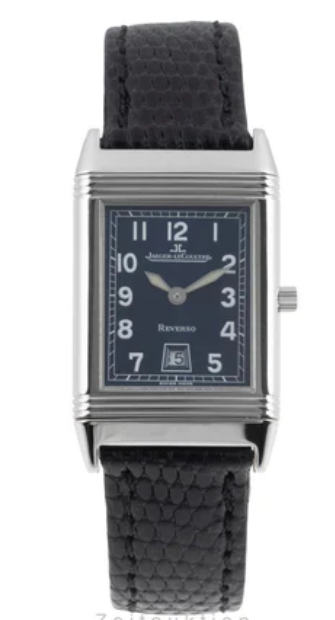
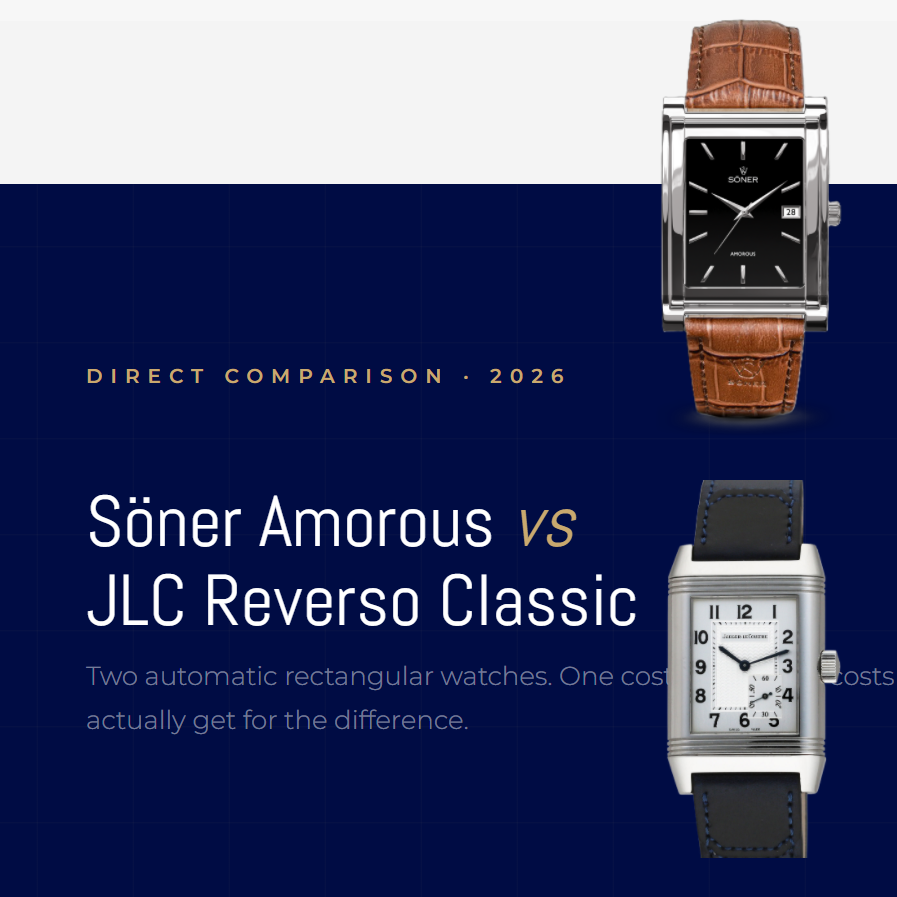
Without the rotor, a manual-wind movement can achieve significantly lower total height than an automatic calibre of equivalent quality. The Jaeger-LeCoultre Calibre 822, used in the Reverso, is a manual-wind rectangular calibre that achieves a total height of approximately 2.94mm, allowing the Reverso to reach a case thickness in the 7mm to 9mm range depending on the specific model. An equivalent automatic movement in the same case footprint would be several millimeters thicker.
For buyers who want a mechanical movement in a rectangular case but prioritize thinness, manual-wind is almost always the better answer than automatic. The trade-off is the winding ritual: the watch must be wound by hand every day or two. Many enthusiasts find this ritual appealing rather than burdensome. It creates a daily engagement with the watch that automatic winding eliminates.
Automatic Movements in Rectangular Cases
The Engineering Challenge
Fitting a self-winding mechanical movement into a rectangular case is one of the most demanding engineering challenges in commercial watchmaking. The self-winding rotor, the weighted semicircle that swings with wrist movement to wind the mainspring, presents specific problems in a non-round case.
In a round case, the rotor sweeps a circular arc that corresponds naturally to the circular case interior. The rotor can be sized to nearly fill the case diameter, maximizing its weight and therefore its winding efficiency. In a rectangular case, the rotor must either be reduced in diameter to fit within the shorter axis of the case, or shaped to fit the rectangular footprint.
A reduced-diameter rotor has less mass and therefore less winding efficiency. A watch with a small rotor may require more active wrist movement to maintain a full power reserve than an equivalent round watch with a full-diameter rotor. For wearers who are relatively sedentary, this can result in the watch running down during periods of inactivity.
Some manufacturers have addressed this by designing sector rotors, shaped not as a full semicircle but as a sector that fits the available space more efficiently. Others have used micro-rotor systems, where a very small but very dense rotor (typically made from platinum or tungsten for maximum mass) is integrated within the movement plate rather than sitting above it. The micro-rotor approach allows for significantly thinner total movement height while maintaining acceptable winding efficiency, but it is expensive to execute well.
Thickness Implications
The self-winding rotor typically adds between 1.5mm and 3mm to the total height of a movement stack compared to the manual-wind equivalent. In a rectangular case where the total thickness target might be 8mm to 10mm, those millimeters matter significantly.
The practical result is that automatic rectangular watches are almost always thicker than their quartz or manual-wind equivalents. At mid-range price points, an automatic rectangular watch will typically be between 9mm and 13mm thick. At high-end price points, where manufacturers invest heavily in movement miniaturization, 7mm to 9mm is achievable. Below 7mm in an automatic rectangular watch is extremely rare and represents genuine haute horlogerie engineering.
The relationship between movement type and overall case thickness, and what that means for how the watch wears on the wrist, is covered in full in the article on thickness and wrist presence in the rectangular watch size guide.
| Movement Type | Typical Thickness Range | Rectangular Case Impact | Engineering Trade-Off |
|---|---|---|---|
| Quartz | 4–6mm total case possible | Ultra-thin dress proportions achievable | Lower mechanical complexity |
| Manual Wind | 6–8mm typical | Balanced thinness with mechanical integrity | Requires daily winding |
| Automatic | 8–13mm typical | Greater wrist presence | Rotor height increases case thickness |
Why Are Automatic Rectangular Watches Thicker?
Automatic rectangular watches require additional vertical space for the self-winding rotor. In a non-round case, integrating rotor clearance while maintaining structural rigidity increases overall thickness compared to quartz and manual-wind designs.
The Case for Automatic in Rectangular
Despite the engineering challenges and thickness implications, automatic movements in rectangular cases have genuine advantages that make them the right choice for many buyers.
The primary advantage is ownership experience. A self-winding mechanical watch requires no daily winding ritual and no battery replacement. It simply runs as long as it is worn regularly, and stops when left unworn for more than the power reserve duration (typically 38 to 72 hours depending on the calibre). This combination of mechanical soul and practical convenience is what made the automatic movement revolutionary when it appeared in the mid-20th century, and it remains compelling.
The secondary advantage is horological significance. An automatic rectangular calibre is a genuinely rare and difficult object. The brands that produce them well have invested substantially in their development. Owning one is an acknowledgment of that investment, and it gives the watch a level of mechanical credibility that quartz cannot provide regardless of its practical advantages.
The third advantage is long-term repairability. A quality mechanical automatic movement, properly serviced every five to seven years, can function indefinitely. The parts are machined metal components that can be replaced individually as they wear. A watch with a mechanical movement can theoretically be kept running forever. A quartz movement, particularly a proprietary one, is only as serviceable as the parts available for it.
For buyers who want a rectangular watch primarily as a collector piece, as a long-term investment in a mechanical object, or as a daily driver that they will own for decades, automatic is the more defensible choice despite its cost and thickness premium.
The Movement Architecture Question
The specific engineering decisions involved in fitting automatic movements into rectangular cases, including rotor geometry, micro-rotor systems, and the trade-offs between winding efficiency and thinness, are examined in detail in the article on movement architecture in rectangular watch engineering.
Comparing the Three Options
| Characteristic | Quartz | Manual Wind | Automatic |
|---|---|---|---|
| Minimum realistic thickness | 4mm to 6mm | 6mm to 8mm | 8mm to 10mm |
| High-end thin achievable | Under 4mm | 6mm to 7mm | 7mm to 8mm (at high cost) |
| Accuracy | Very high | Moderate | Moderate |
| Maintenance interval | 2 to 3 years (battery) | 5 to 7 years (service) | 5 to 7 years (service) |
| Daily interaction required | None | Winding every 1 to 2 days | None if worn regularly |
| Collector appeal | Lower | High | Highest |
| Repairability | Moderate | Excellent | Excellent |
| Entry price point | Lower | Medium | Higher |
| Rotor present | No | No | Yes |
Price and Value by Movement Type
Movement type is one of the primary drivers of price in rectangular watches, but the relationship is not as simple as automatic equals expensive and quartz equals affordable.
At the entry level, quartz rectangular watches from established brands offer better case quality, finishing, and overall value than automatic watches at the same price. The movement savings free up budget for better materials and more refined case work. A well-finished quartz rectangular watch at 500 to 800 euros is a more satisfying object than a poorly executed automatic at the same price.
At the mid-range, from approximately 1,500 to 5,000 euros, the choice becomes more genuinely competitive. Quality automatic rectangular calibres from respected manufacturers are available at this level. The movement architecture is better resolved, the rotor efficiency is adequate, and the total thickness, while greater than an equivalent quartz, is not a practical problem for most wearers.
At the high end, above 5,000 euros and especially above 15,000 euros, the most interesting engineering in rectangular watchmaking is exclusively automatic or manual-wind. The brands investing in ultra-thin automatic rectangular calibres, in micro-rotor systems, in purpose-built rectangular movements of genuine horological ambition, are all working in the mechanical domain. Quartz does not appear at this level because the buyers at this level are there specifically for mechanical craft.
The implications for how case material choices interact with movement type and price are covered in the article on case thickness constraints in rectangular watch materials.
Which Should You Choose?
The honest answer is that the right movement type depends entirely on your priorities, and those priorities are personal.
Choose quartz if thinness is your primary aesthetic priority, if you want the lowest possible total cost of ownership, if you wear the watch occasionally rather than daily, or if you are drawn to the rectangular case primarily for its design rather than its mechanical content. Quartz is not a compromise in the rectangular dress watch category. It is frequently the most appropriate choice, and it is the choice that some of the most celebrated rectangular watches ever made have embraced without apology.
Choose manual-wind if you want a mechanical movement and thinness, if you appreciate the daily winding ritual as a form of engagement with the watch, or if you are drawn to the specific design heritage of movements like the Jaeger-LeCoultre Calibre 822. Manual-wind is the least discussed option in the rectangular category but arguably the most coherent: it combines mechanical soul with the thinness that the category demands.
Choose automatic if you want mechanical self-winding convenience and are willing to accept additional thickness and cost in exchange, if you are buying the watch as a long-term collector piece with horological significance, or if you are drawn to the engineering achievement of a self-winding rectangular calibre. Automatic is the most demanding choice to execute well, and the best automatic rectangular watches are genuinely exceptional objects precisely because they solved a very hard problem elegantly.
| Movement Type | Service Events (10 yrs) | Typical Cost Range | Ownership Profile |
|---|---|---|---|
| Quartz | 3–4 battery changes | Low cumulative cost | Cost-efficient, predictable |
| Manual Wind | 1–2 full services | Moderate to high | Long-term mechanical investment |
| Automatic | 1–2 full services | Moderate to high | Collector-oriented ownership |
Is Quartz or Automatic Cheaper Over 10 Years?
Quartz watches generally cost less to maintain over a decade due to inexpensive battery replacements. Mechanical watches require full servicing at longer intervals, resulting in higher cumulative ownership costs but greater long-term repairability.
Summary
Movement type in a rectangular watch is not a secondary specification. It is a fundamental design decision that affects thickness, wrist presence, ownership experience, price, and long-term value in ways that are specific to the rectangular case geometry. Quartz enables extraordinary thinness and practical convenience. Manual-wind combines mechanical integrity with achievable slimness. Automatic offers self-winding convenience and horological credibility at the cost of thickness and price.
None of these options is categorically superior. Each is the right answer for a different buyer with different priorities. The key is understanding what each choice actually involves in the specific context of a rectangular case, rather than applying the general watch market assumption that automatic is always better.
For the full context of how movement choice fits into every other dimension of the rectangular watch buying decision, the Definitive Guide to Rectangular Watches is where the complete picture comes together.
Related Articles:
- Definitive Guide to Rectangular Watches - The complete category reference
- Engineering Challenges of Rectangular Watch Cases - movement architecture explained
- Rectangular Watch Materials Explained - case thickness constraints by material
- Rectangular Watch Size Guide - thickness and wrist presence analyzed
SÖNER rectangular watches
Free worldwide shipping · 10-year warranty · 30-day returns
Our pick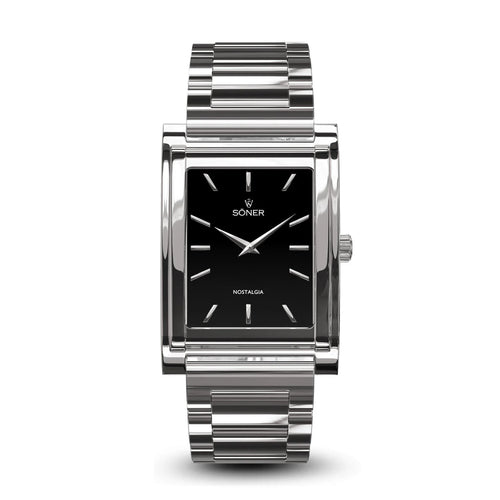 Nostalgia Stockholm11-year battery$580 USD
View watch
Nostalgia Stockholm11-year battery$580 USD
View watch
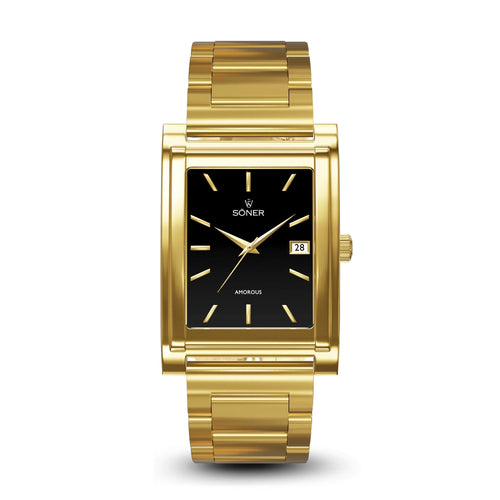 Amorous MilanoAutomatic$785 USD
View watch
Amorous MilanoAutomatic$785 USD
View watch
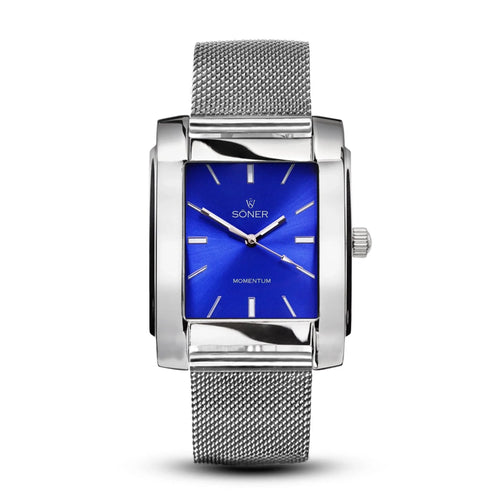 Momentum BacardiAutomatic$585 USD
View watch
Momentum BacardiAutomatic$585 USD
View watch
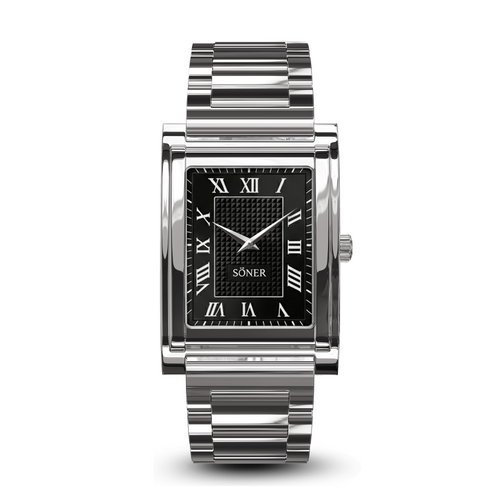 Nostalgia Caesar11-year battery$765 USD
View watch
Nostalgia Caesar11-year battery$765 USD
View watch
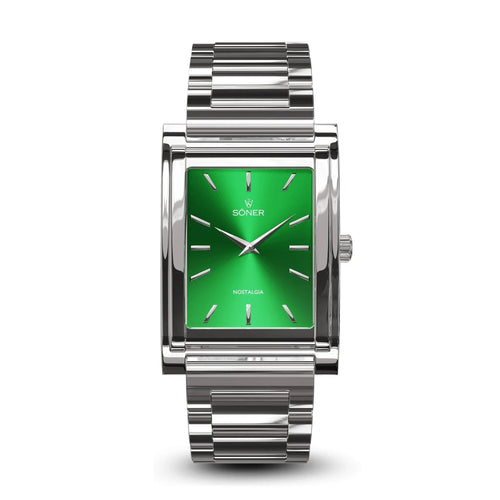 Nostalgia New York11-year battery$580 USD
View watch
Nostalgia New York11-year battery$580 USD
View watch
View all watches
 Nostalgia Stockholm11-year battery$580 USD
View watch
Nostalgia Stockholm11-year battery$580 USD
View watch
 Amorous MilanoAutomatic$785 USD
View watch
Amorous MilanoAutomatic$785 USD
View watch
 Momentum BacardiAutomatic$585 USD
View watch
Momentum BacardiAutomatic$585 USD
View watch
 Nostalgia Caesar11-year battery$765 USD
View watch
Nostalgia Caesar11-year battery$765 USD
View watch
 Nostalgia New York11-year battery$580 USD
View watch
Nostalgia New York11-year battery$580 USD
View watch