



 Published on
Table of Contents
Since the dawn of civilisation, humans have been fascinated by the concept of time. The daily cycle of day and night, the changing seasons, and the movements of celestial bodies have all shaped our understanding of it. Over millennia, various cultures devised ingenious methods to measure and track time, leading to the sophisticated devices we rely on today.
This journey through the history of timekeeping reveals humanity's relentless curiosity and creativity. From the earliest sundials to the ultra-precise atomic clocks of the modern era, each innovation brought us closer to mastering the measurement of time.
Ancient Timekeeping: Sundials and Water Clocks
Sundials: The First Timekeepers
One of the earliest known timekeeping devices was the sundial, originating in Ancient Egypt around 1500 BCE. These instruments consisted of a gnomon - a vertical rod - that cast a shadow onto a marked surface. By observing the shadow's position, people could estimate the time of day.
The Greeks and Romans refined sundial designs, incorporating mathematical and astronomical principles. Greek scholars including Anaximander studied the sun's movement, producing more accurate sundials in horizontal, vertical, and equatorial orientations suited to different locations and purposes.
By the Middle Ages, sundials were common in monasteries and public squares, serving both agricultural and religious needs. Their designs ranged from basic stone carvings to elaborate metal and wooden structures.
Water Clocks: Measuring Time with Flow
While sundials relied on sunlight, water clocks - clepsydras - provided a way to track time at night or indoors. The earliest evidence comes from Ancient Egypt and Mesopotamia in the 16th century BCE. These devices used a steady drip of water from a container to mark the passage of time.
The Greeks and Chinese advanced water clock technology significantly. Plato reportedly designed an intricate clepsydra with interconnected vessels for greater precision. In Han Dynasty China (25-220 CE), astronomer Zhang Heng created the water-driven celestial globe - a mechanical marvel that tracked celestial movements and predicted eclipses.
Medieval Timekeeping: The Birth of Mechanical Clocks
The Middle Ages marked a turning point with the invention of mechanical clocks in 13th-century Europe. These early clocks, installed in monasteries and cathedrals, used weights, gears, and escapements to regulate movement. Two notable surviving examples are the Salisbury Cathedral Clock from the 14th century - one of the oldest mechanical clocks still in existence, striking hours with a bell - and the Wells Cathedral Clock (1392), which featured an astronomical dial showing moon phases and planetary positions.
These massive public clocks symbolised both religious and societal order, helping communities synchronise daily activities in ways that had not previously been possible.
The Pendulum Clock: A Revolution in Precision
In 1656, Dutch scientist Christiaan Huygens invented the pendulum clock - a breakthrough in accuracy. By using a swinging pendulum to regulate motion, these clocks lost only seconds per day, a vast improvement over all earlier mechanisms. The pendulum clock enabled precise longitude calculations at sea, standardised timekeeping for scientific experiments and industrial processes, and laid the groundwork for the marine chronometers and mechanical watches that followed.
Huygens' invention is the direct ancestor of the modern mechanical watch. The same principle - a regulated oscillator controlling the release of stored energy - governs every mechanical movement produced today.
The Industrial Revolution: Timekeeping for the Masses
The 18th and 19th centuries transformed watchmaking through mass production. Interchangeable parts lowered costs and increased consistency. New materials including steel and its alloys improved durability. Precision engineering produced reliable chronometers and pocket watches of a quality previously available only to the wealthiest individuals.
For the first time, ordinary people could afford personal timepieces. The democratisation of timekeeping changed how societies organised work, travel, and daily life - railway timetables, factory shifts, and scheduled commerce all depended on a population that could reliably tell the time.
The Wristwatch: From Battlefield to Everyday Accessory
The wristwatch emerged as a practical tool for soldiers during World War I. Pocket watches were impractical in the trenches - a wristwatch enabled quick, hands-free time checks during coordination and artillery timing. Returning veterans normalised the format in civilian life, and by the late 1920s the wristwatch had largely replaced the pocket watch for daily male wear.
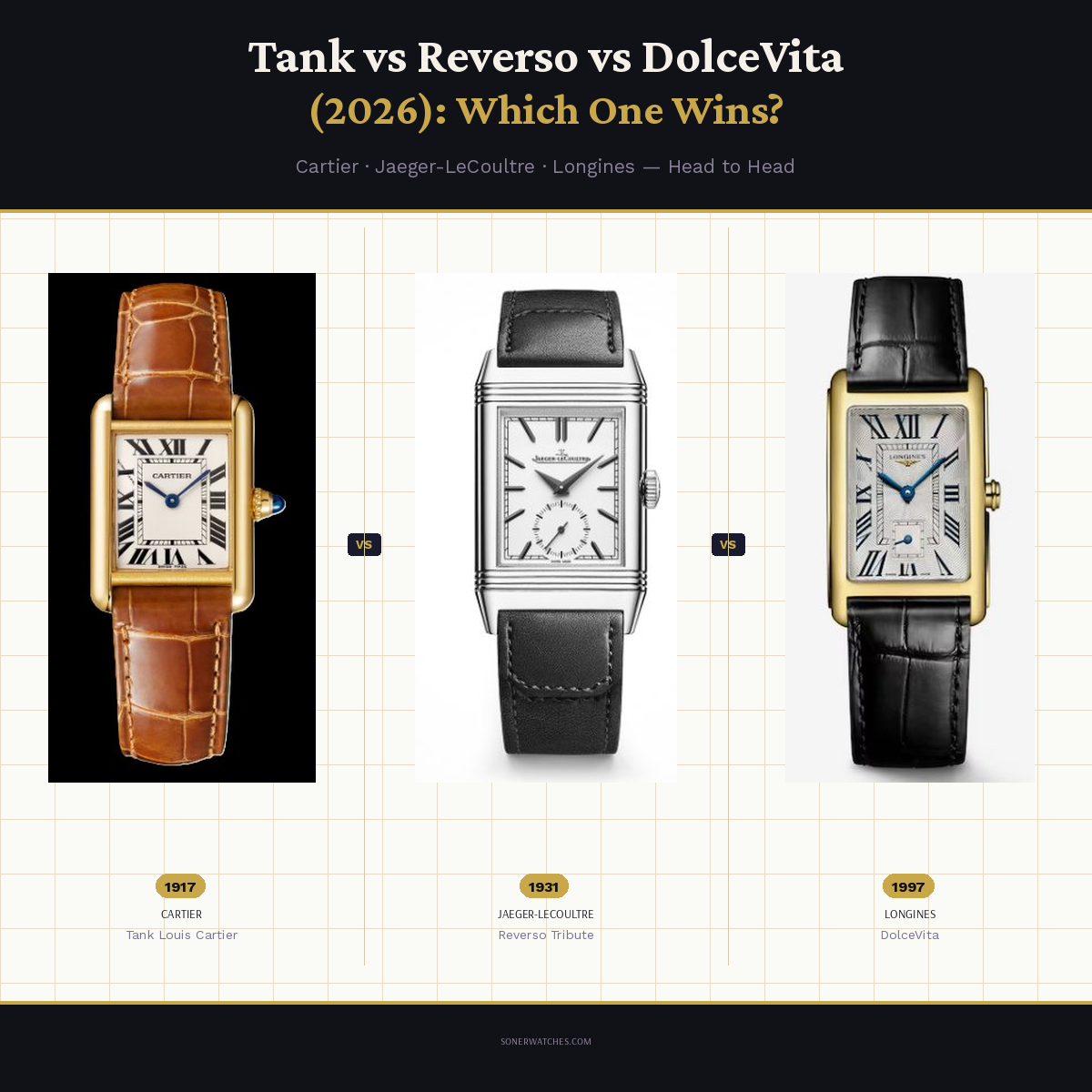
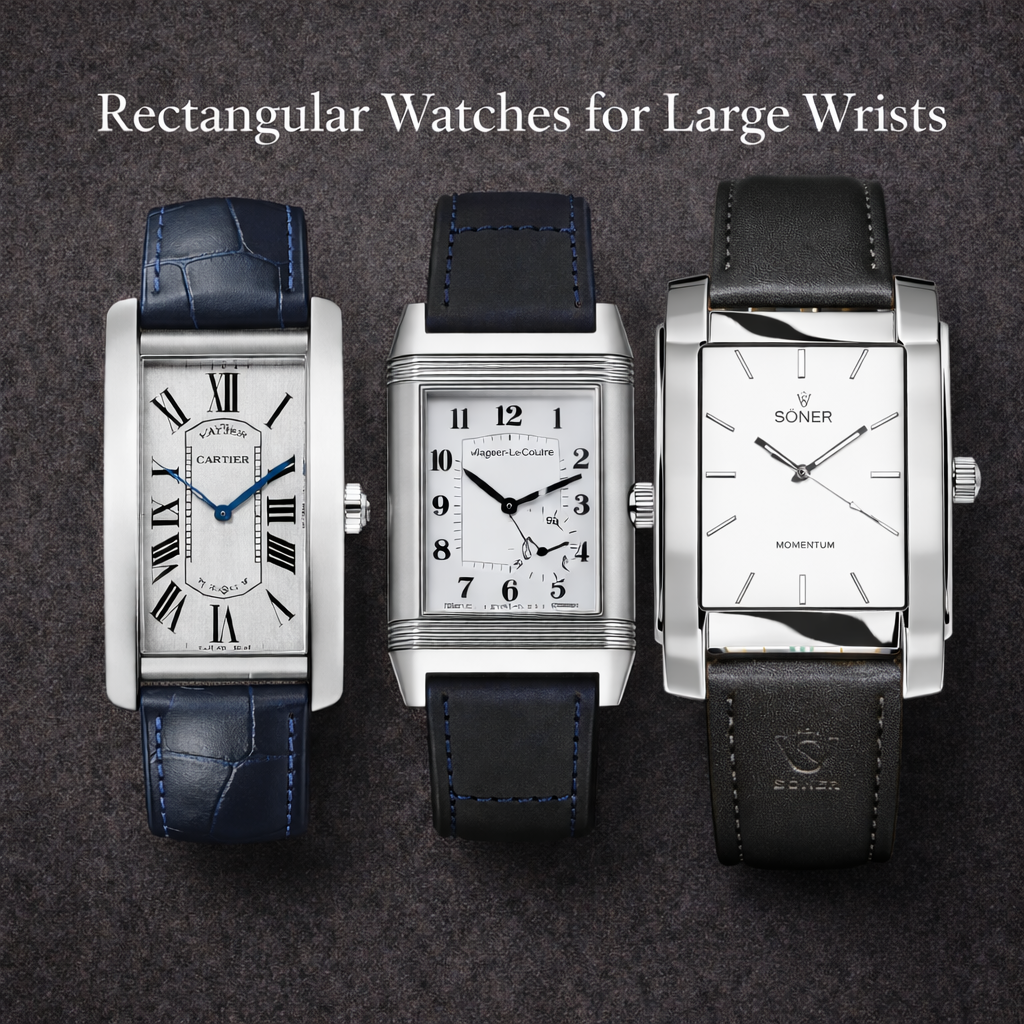
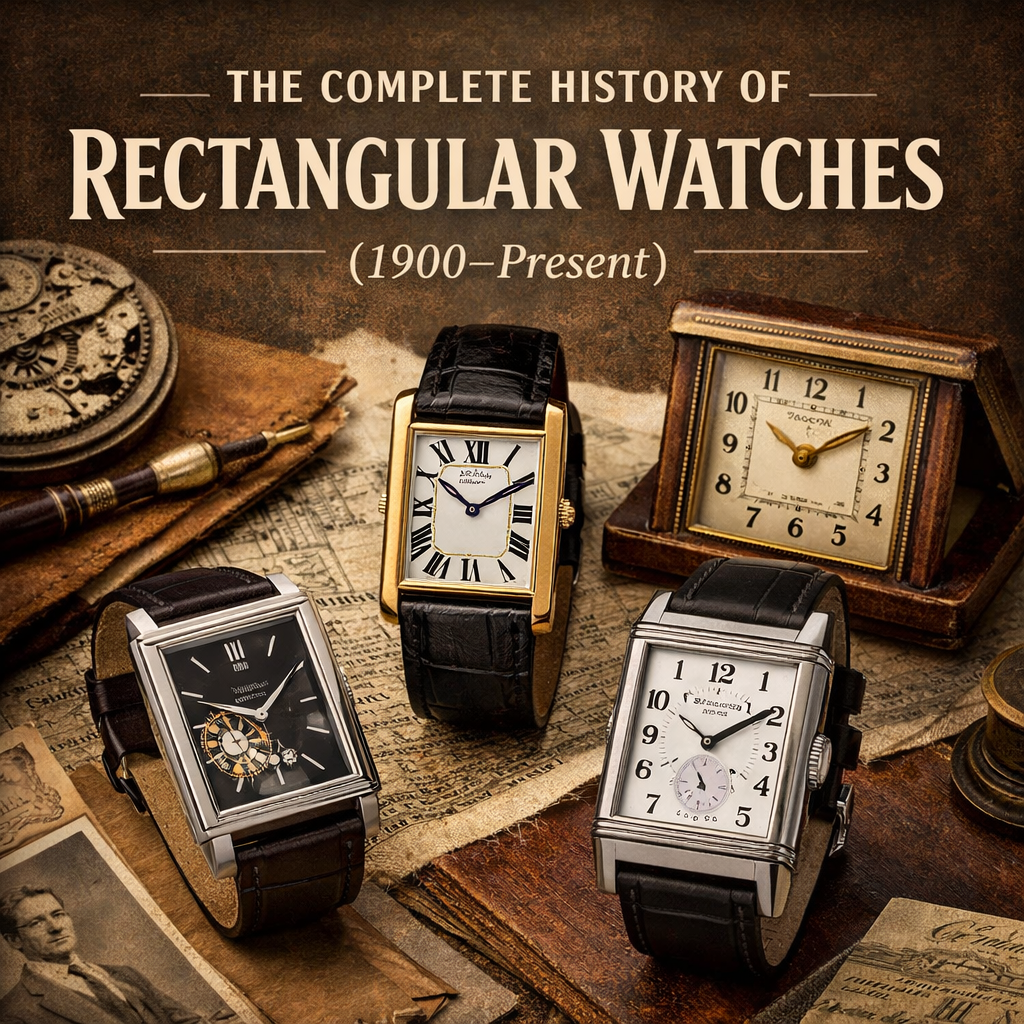
The Art Deco movement of the 1920s and 1930s produced the most enduring wristwatch designs in history. The Cartier Tank (1917), the Jaeger-LeCoultre Reverso (1931), and the Patek Philippe Calatrava established the rectangular and round dress watch traditions that continue today. For the specific history of how rectangular watches developed through this period, see our complete history of rectangular watches.
Modern Timekeeping: Quartz and Atomic Precision
The Quartz Revolution
The Seiko Astron, launched on Christmas Day 1969, was the first commercially available quartz wristwatch. Its battery-powered quartz crystal oscillator delivered accuracy that no mechanical movement could match at any price point, triggering the quartz crisis of the 1970s that fundamentally restructured the Swiss watch industry.
Quartz movements vibrate at 32,768 Hz - a frequency precisely chosen because it is a power of two, making it easy to divide down to a one-second pulse using digital counters. The result is a watch accurate to within 15 seconds per month under normal conditions - compared to the -4/+6 seconds per day standard for COSC-certified mechanical movements.
Atomic Clocks: The Ultimate Precision
Developed in the mid-20th century, atomic clocks measure time using the vibration frequency of caesium or rubidium atoms, achieving accuracy within billionths of a second. A caesium atomic clock will neither gain nor lose a second over millions of years. These instruments power GPS satellites, global telecommunications networks, the internet's time synchronisation protocols, and the scientific community's definition of the second itself.
The International System of Units (SI) defines one second as exactly 9,192,631,770 oscillations of the caesium-133 atom - a definition that has been in place since 1967 and underpins virtually every precision measurement made anywhere on earth.
The Future: Quantum Clocks and Beyond
Optical lattice clocks and quantum logic clocks represent the next generation of timekeeping precision. These instruments use optical frequencies - visible light rather than microwave frequencies - and are already demonstrating accuracy that would not gain or lose a second over the age of the universe. Practical applications include testing the fundamental constants of physics, detecting gravitational waves, and enabling navigation systems precise enough to track the position of a vehicle to within millimetres.
The story of timekeeping is far from over. From shadow-casting sundials to atom-measuring superclocks, each chapter has reflected humanity's drive for greater precision - and each innovation has shaped how we live, work, and understand the world.
Frequently Asked Questions
What was the first timekeeping device?
The sundial is among the earliest documented timekeeping devices, with evidence of use in Ancient Egypt around 1500 BCE. Water clocks (clepsydras) from the same period provided an alternative for use at night or indoors. Both predate mechanical clocks by over two thousand years.
Who invented the mechanical clock?
Mechanical clocks were developed in 13th-century Europe, with no single inventor. The earliest surviving examples are from English cathedrals - the Salisbury Cathedral clock (c.1386) is among the oldest still functioning. The fundamental escapement mechanism that makes mechanical clocks work was refined progressively across multiple inventors and centuries.
Who invented the pendulum clock?
Dutch scientist Christiaan Huygens invented the pendulum clock in 1656. His design reduced daily timekeeping error from minutes to seconds, representing the most significant accuracy improvement in horology up to that point. The pendulum clock's regulated oscillator principle is the direct ancestor of the balance wheel in modern mechanical watches.
When did wristwatches become popular?
Wristwatches became popular for men during and after World War I (1914-1918), when soldiers adopted them for hands-free timekeeping in the field. By the late 1920s the wristwatch had largely replaced the pocket watch for daily use. For the detailed history of the wristwatch's development, see our complete timeline of the first wristwatch.
How accurate is an atomic clock?
A caesium atomic clock is accurate to within billionths of a second per day. The best optical lattice clocks today would neither gain nor lose a second over several billion years - longer than the current age of the universe. These instruments define the SI second and underpin GPS, telecommunications, and scientific measurement globally.
What is the most accurate watch you can wear on your wrist?
Radio-controlled and GPS-synchronized watches are the most accurate wearable timepieces, synchronising to atomic clock signals to correct any drift automatically. Among conventional movements, thermo-compensated quartz achieves accuracy within a few seconds per year. COSC-certified mechanical chronometers are accurate to -4/+6 seconds per day. For a detailed comparison of movement types and their accuracy, see our complete wristwatch dictionary.