


 Published on
Table of Contents
The short answer: there are 13 main types of watches for men, each built for a different purpose. Knowing which category fits your lifestyle is the fastest way to find the right watch.
This guide covers every major watch type, what distinguishes each one, and which models represent the category best. At the end, a buying framework helps you match the right watch to your actual life.
I'm Freddie Palmgren, founder of Söner Watches - the only brand in the world built exclusively around rectangular watches. I've spent a decade thinking about watch design and proportion. Here's what I know.
The 13 Main Types of Watches for Men
| # | Type | Best For | Typical Size |
|---|---|---|---|
| 1 | Dress Watches | Formal wear, business attire | 36-40mm |
| 2 | Sports Watches | Active lifestyles, outdoor use | 40-44mm |
| 3 | Digital Watches | Everyday practicality | 40-50mm |
| 4 | Smartwatches | Connectivity, fitness tracking | 40-45mm |
| 5 | Casual Watches | Everyday wear, versatility | 38-42mm |
| 6 | Luxury Watches | Status, investment, craftsmanship | 36-42mm |
| 7 | Pilot Watches | Aviation, travel, legibility | 42-46mm |
| 8 | Dive Watches | Underwater use, water sports | 40-44mm |
| 9 | Vintage Watches | Collecting, historical interest | 34-38mm |
| 10 | Tourbillon Watches | Ultra-luxury, mechanical artistry | 38-42mm |
| 11 | Rectangular Watches | Dress wear, architectural presence | 24-35mm wide |
| 12 | Chronograph Watches | Timing, motorsport, aviation | 40-44mm |
| 13 | Chronometer Watches | Certified precision, professional use | 38-42mm |
1. Classic and Dress Watches for Men
Dress watches are designed to enhance formal and professional attire. They prioritise simplicity, a slim profile, and refined materials. The dial is clean and uncluttered - clean hour markers, slender hands, and at most a discreet date window. Nothing more.
The defining characteristic is restraint. A dress watch should complement an outfit, not compete with it. It should slip under a shirt cuff without creating a bump. It should be noticed when the sleeve rides up, not when you walk into the room.

Key Characteristics
- Slim case - typically under 9mm thick
- Minimal dial - clean markers, no chronograph sub-dials
- Elegant materials - polished steel or gold, leather strap
- 36-40mm case diameter for most wrists
Notable Examples
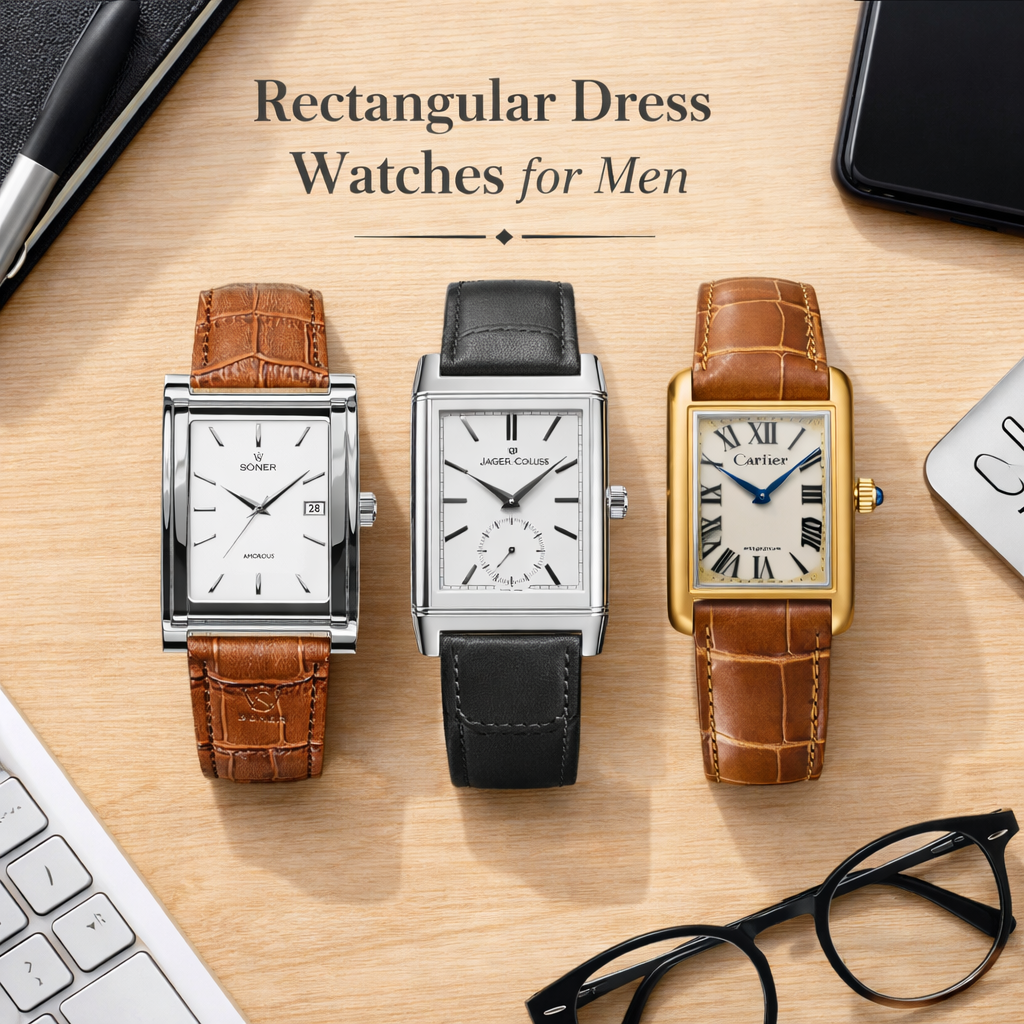
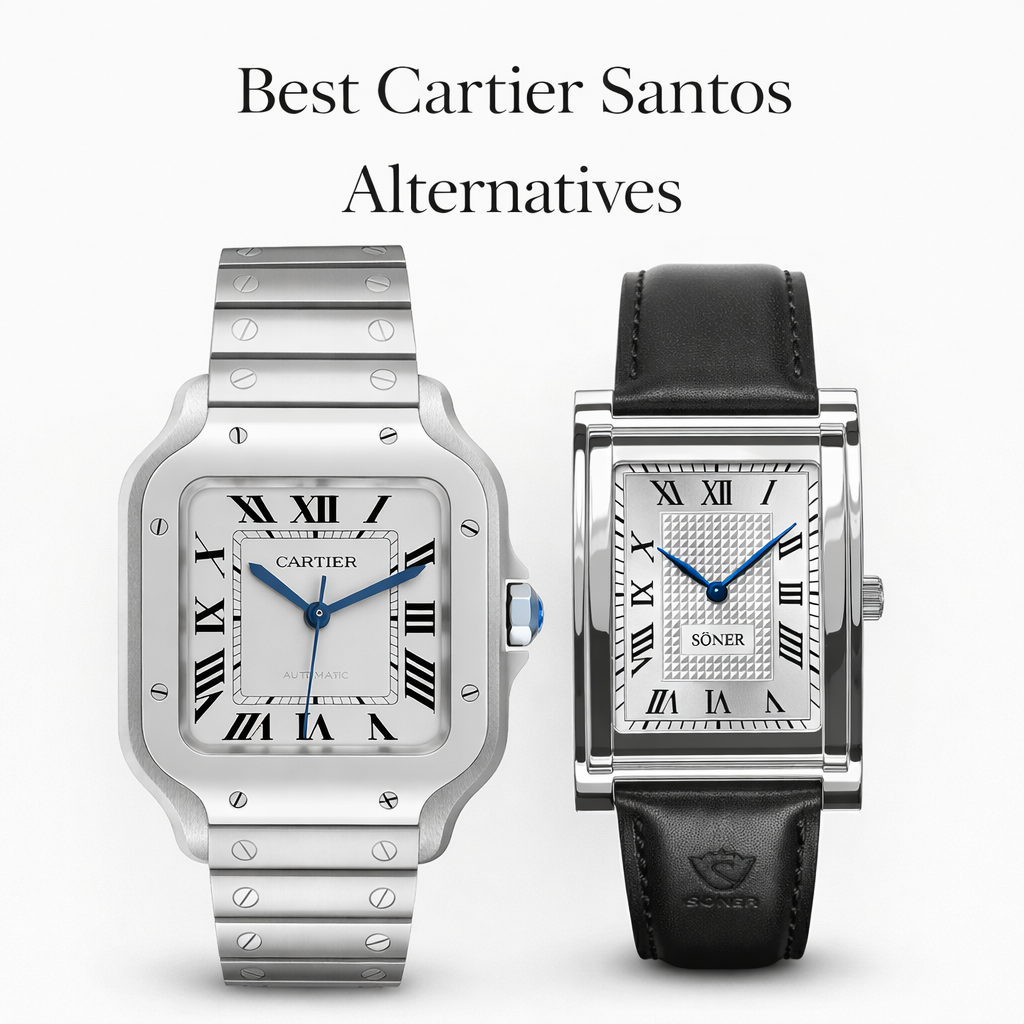
- Cartier Tank Must - the benchmark rectangular dress watch, Art Deco-inspired, continuously produced since 1917
- Jaeger-LeCoultre Reverso Classic - reversible case, minimalist dial, the polo player's original dress watch
- Söner Amorous - Swiss automatic rectangular dress watch, slim profile, sapphire crystal
2. Sports Watches for Men
Sports watches are built for physical activity and demanding conditions. They prioritise durability, legibility, and practical features over formal aesthetics. Shock resistance, water resistance, and high-contrast dials are standard.
Unlike dress watches, sports watches are designed to be noticed. Bold dials, substantial cases, and rubber or metal bracelets communicate purpose rather than refinement.
Key Characteristics
- Water resistance - typically 100m or more
- Shock resistance - reinforced cases and movements
- Legible dials - large numerals, luminous hands
- Robust straps - rubber, silicone, or solid metal bracelet
Notable Examples
- Rolex Submariner - the defining dive-sports watch, equally at home in a boardroom
- Omega Speedmaster Professional - chronograph, first watch worn on the moon
- TAG Heuer Monaco - square-cased racing chronograph, made famous by Steve McQueen

3. Digital Watches for Men
Digital watches display time numerically on an LCD or LED screen rather than through analog hands. They are practical, accurate, and typically the most affordable category of functional watch.
Modern digital watches often include alarms, timers, multiple time zones, and fitness tracking. Their lightweight construction - usually resin or plastic - makes them comfortable for extended daily wear.
Key Characteristics
- Digital display - numerical readout, often with backlight
- Feature-packed - alarms, world time, countdown timers
- Lightweight - resin or composite cases
- Affordable - accessible price point across most brands
Notable Examples
- Casio G-Shock DW-5600 - shock-resistant, water-resistant, extremely durable
- Timex Ironman - sports-focused with multiple timers and alarms
- Seiko Prospex Fieldmaster - hybrid digital-analog for outdoor adventures
4. Smartwatches for Men
Smartwatches function as miniature computers on the wrist, syncing with smartphones to deliver notifications, health tracking, and app integration. They run on dedicated operating systems - Apple's watchOS, Google's Wear OS, or proprietary platforms from Samsung and Garmin.
Their versatility is unmatched. Customisable watch faces, third-party apps, fitness sensors, GPS, and contactless payment make them the most functionally dense category in watchmaking. The trade-off is battery life and, for many traditionalists, aesthetics.
Key Characteristics
- Touchscreen interface - app navigation, customisable faces
- Health sensors - heart rate, step counting, ECG on premium models
- Smartphone integration - notifications, calls, messages
- GPS and NFC - navigation and contactless payments
Notable Examples
- Apple Watch Series 9 - the most integrated option for iPhone users
- Samsung Galaxy Watch 6 - strong Android integration, clean design
- Garmin Fenix 7 - rugged GPS smartwatch for outdoor sports
5. Casual Watches for Men
Casual watches occupy the space between dress watches and sports watches - versatile enough for daily wear without the formality of the former or the ruggedness of the latter. They work with jeans and a t-shirt as well as business-casual attire.
The category is broad. A simple three-hand quartz watch on a leather strap is a casual watch. So is a clean automatic on a NATO strap. The defining quality is adaptability rather than specialisation.
Key Characteristics
- Versatile design - suits casual and semi-formal occasions
- Moderate proportions - 38-42mm, not too formal or sporty
- Comfortable straps - leather, canvas, or silicone
- Accessible price - generally the best value-per-wear category
Notable Examples
- Seiko 5 SNK809 - reliable automatic, clean aesthetic, excellent value
- Citizen Eco-Drive BM8180 - solar-powered, practical, zero battery costs
- Timex Weekender - simple, affordable, interchangeable straps

6. Luxury Watches for Men
Luxury watches represent the highest tier of watchmaking - premium materials, in-house mechanical movements, and often limited production runs. They function as both timepieces and investments. Some models appreciate significantly over time.
What separates luxury from premium is craftsmanship depth. A luxury watch movement may contain hundreds of hand-assembled components. Cases are made from gold, platinum, or high-grade steel with bevelled edges polished by hand. Dials feature hand-applied details, guilloché patterns, or rare materials like meteorite or mother-of-pearl.
Key Characteristics
- Premium materials - precious metals, sapphire crystals, exotic straps
- In-house movements - hand-assembled mechanical calibres
- Limited production - exclusivity drives desirability and value
- Strong resale value - top brands hold or appreciate over time
Notable Examples
- Rolex Day-Date - the President's watch, the defining luxury status piece
- Patek Philippe Nautilus - the most sought-after luxury sports watch
- Audemars Piguet Royal Oak - octagonal case, steel luxury, created the sports luxury category
7. Pilot Watches for Men
Pilot watches were developed as essential navigation tools for aviators before modern flight computers existed. Large, high-contrast dials with luminous hands allowed time readings at a glance in dark cockpits. Oversized crowns could be adjusted while wearing gloves.
Modern pilot watches preserve the aviation aesthetic while adding GMT complications for multiple time zones and slide-rule bezels for flight calculations. They remain a favourite for frequent travellers and those who appreciate purposeful, legible design.
Key Characteristics
- Large legible dials - high-contrast numerals, luminous hands
- Oversized crown - originally designed for gloved hands
- GMT function - dual or multiple time zone tracking
- Slide rule bezel - on some models, for aviation calculations
Notable Examples
- IWC Big Pilot - classic aviation proportions, power reserve indicator
- Breitling Navitimer - slide rule bezel, the pilot's chronograph
- Rolex GMT-Master II - dual time zone, the traveller's standard
8. Dive Watches for Men
Dive watches are engineered for underwater use, with water resistance typically starting at 200 metres. Unidirectional rotating bezels allow divers to track elapsed dive time. Luminous markers ensure visibility in dark water. Screw-down crowns prevent water ingress under pressure.
The Rolex Deepsea Challenge holds the depth record - worn on the exterior of James Cameron's submersible during his 2012 descent to 10,908 metres in the Mariana Trench. Most dive watches will never be tested to those limits, but the engineering principles remain sound at any depth.
Key Characteristics
- High water resistance - 200m minimum for true dive watches
- Rotating bezel - unidirectional, tracks dive time
- Luminous markers - readable in low-light underwater conditions
- Screw-down crown - seals the case against water pressure
Notable Examples
- Rolex Submariner - the defining dive watch, equally wearable out of water
- Omega Seamaster 300M - James Bond's watch, helium escape valve
- Seiko Prospex Marinemaster - serious depth capability at a fraction of Swiss prices
9. Vintage Watches for Men
Vintage watches are generally considered to be at least 20-30 years old. They attract collectors for their historical significance, unique patina, and connection to eras of watchmaking that prioritised craft over volume. Many feature hand-wound movements, domed acrylic crystals, and smaller case sizes that feel refined on the wrist.
The world's oldest known surviving watch is the Pomander Watch, made by Peter Henlein around 1505, now displayed at the Germanisches Nationalmuseum in Nuremberg.
Key Characteristics
- Age - typically 20-30 years old minimum
- Patina - aged dials, faded bezels add character
- Smaller cases - 34-38mm reflects era conventions
- Hand-wound movements - mechanical tradition without automatic rotors
Notable Examples
- Rolex Explorer 1016 - collectible reference with mountaineering history
- Omega Speedmaster 1969 - the original Moonwatch
- Patek Philippe Calatrava 1940s - vintage dress watch at its most refined

10. Tourbillon Watches for Men
The tourbillon was invented by Abraham-Louis Breguet in 1801 to counteract the effect of gravity on a pocket watch's balance wheel. By placing the escapement in a continuously rotating cage, Breguet could average out the positional errors that caused inaccuracy.
Modern timekeeping technology has made the tourbillon's accuracy benefit largely irrelevant. What remains is the mechanical artistry - a tiny rotating cage, visible through an open-worked dial, that represents some of the most intricate hand-assembly in manufacturing. Tourbillon watches are bought for what they represent, not what they do.
Key Characteristics
- Rotating cage - houses the escapement, rotates to average positional errors
- Open-worked dials - display the movement and tourbillon visually
- Ultra-luxury price - typically starting from $20,000
- Prestige signal - the most technically demanding complication
Notable Examples
- Audemars Piguet Royal Oak Tourbillon - sports luxury meets haute horology
- Breguet Classique Tourbillon - tribute to the mechanism's inventor
- Vacheron Constantin Overseas Tourbillon - sporty and technically exceptional
11. Rectangular Watches for Men
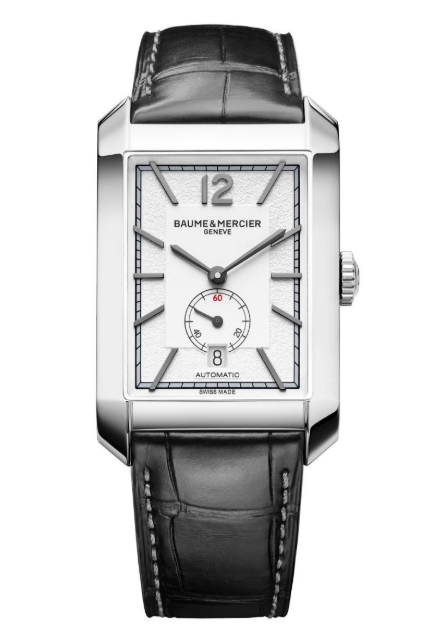
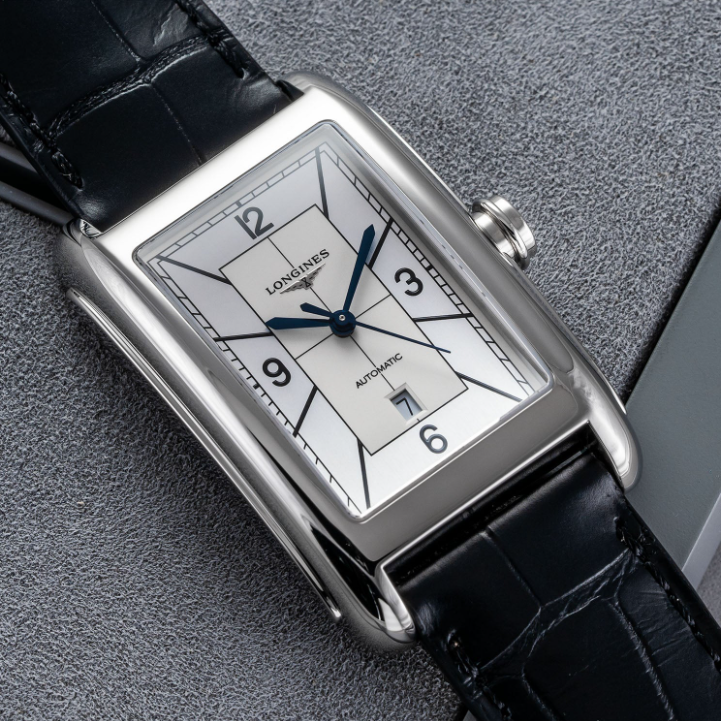
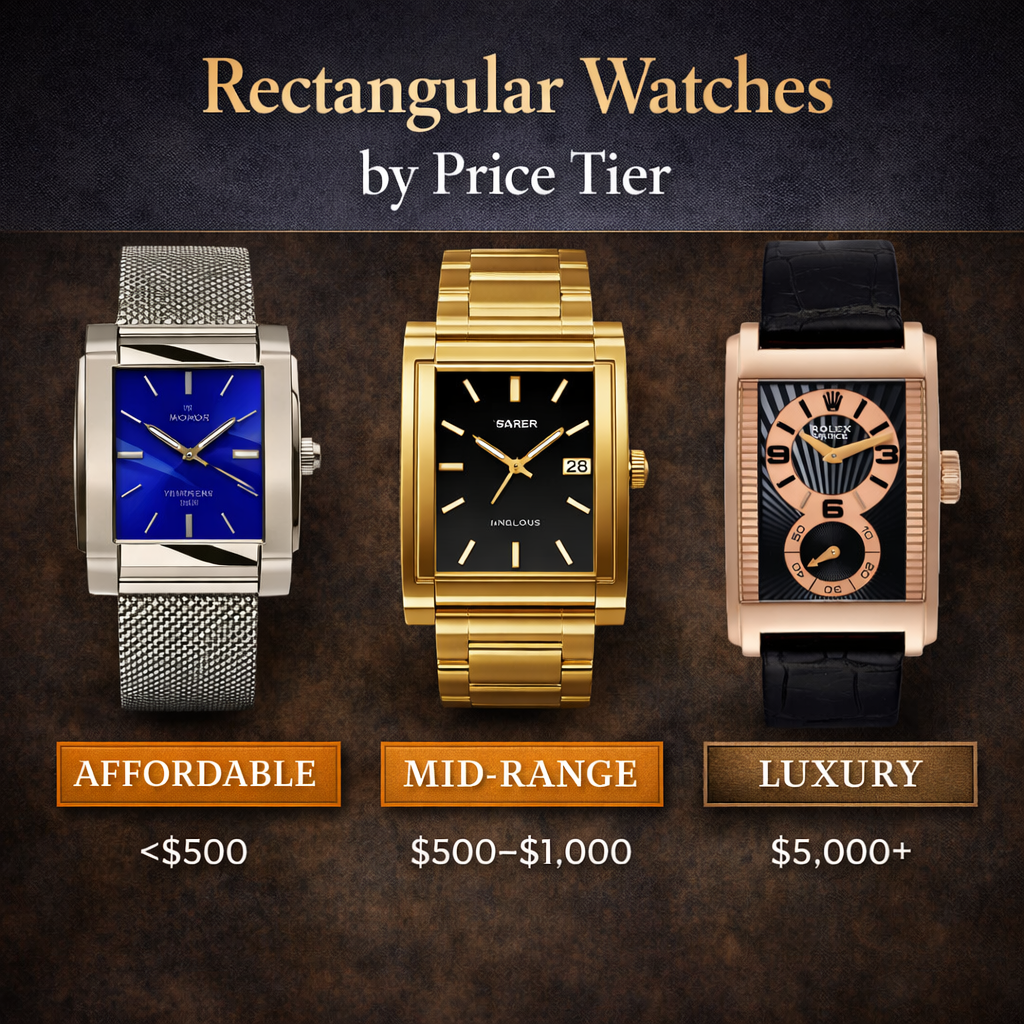
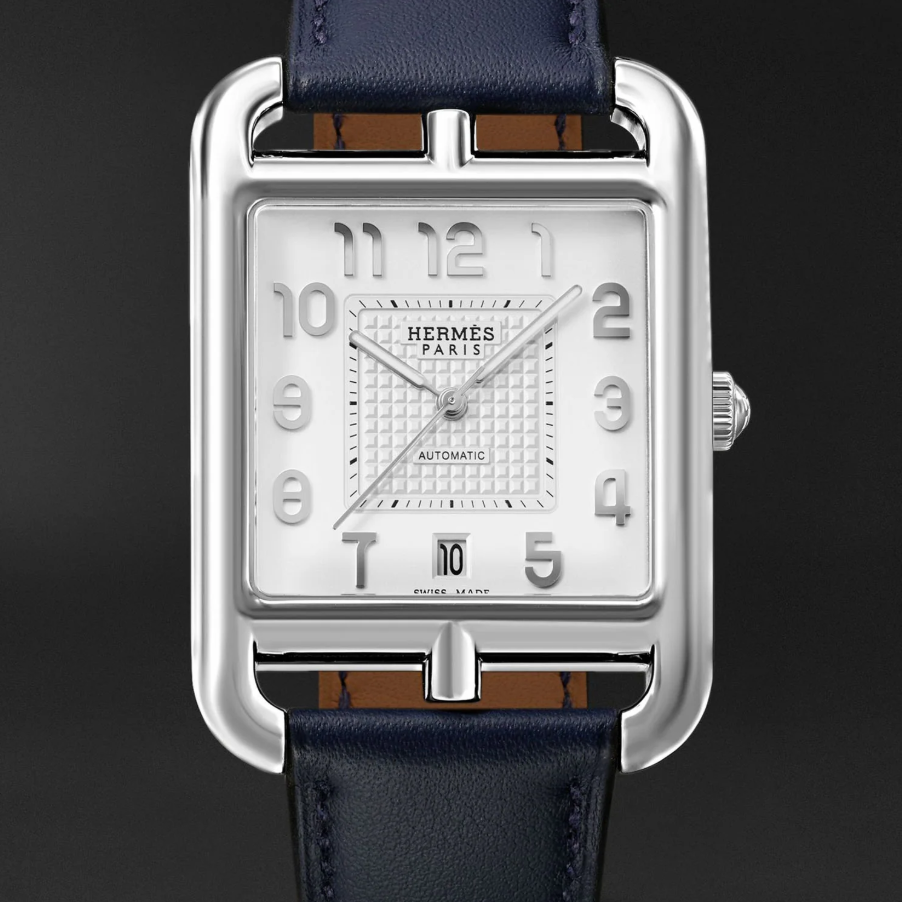
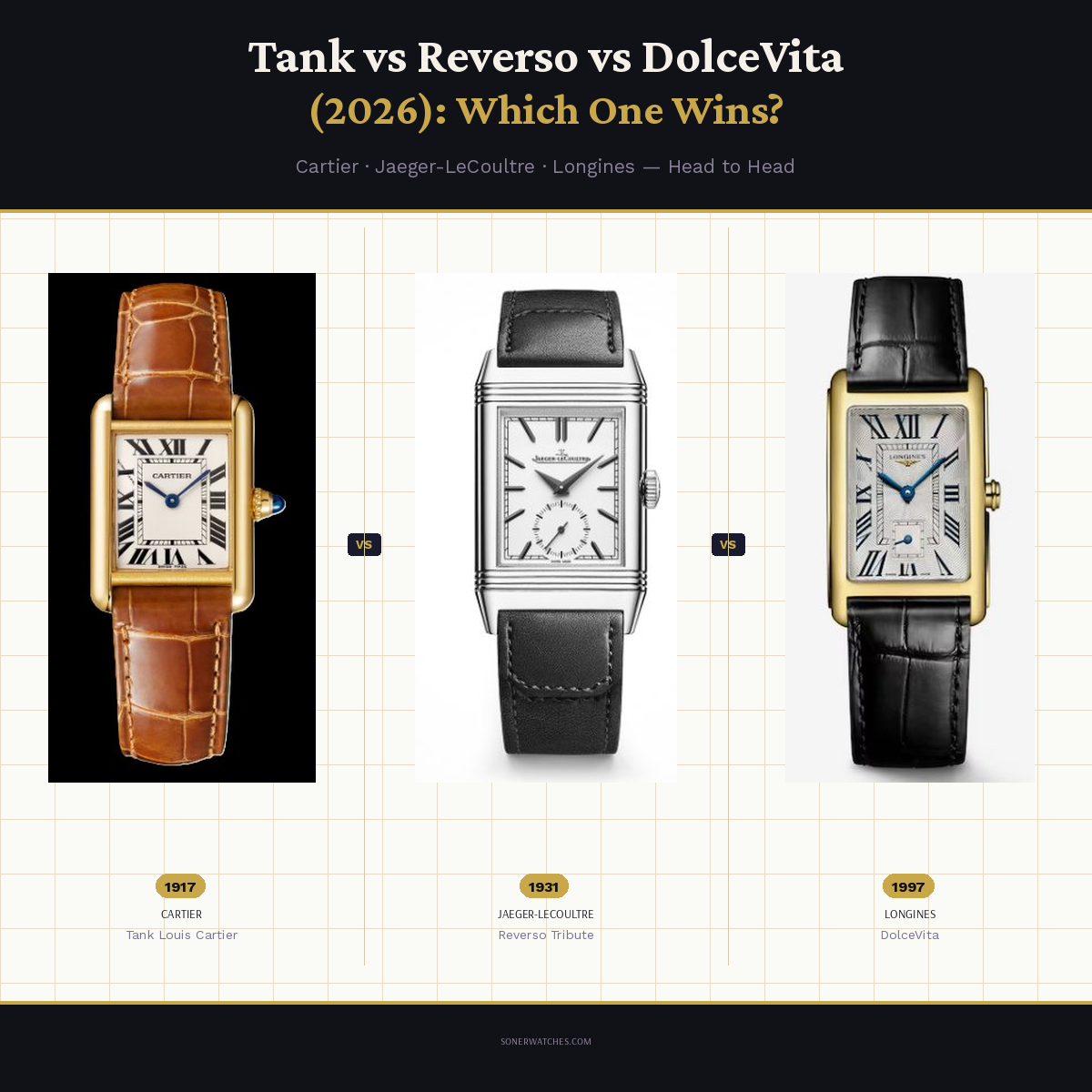
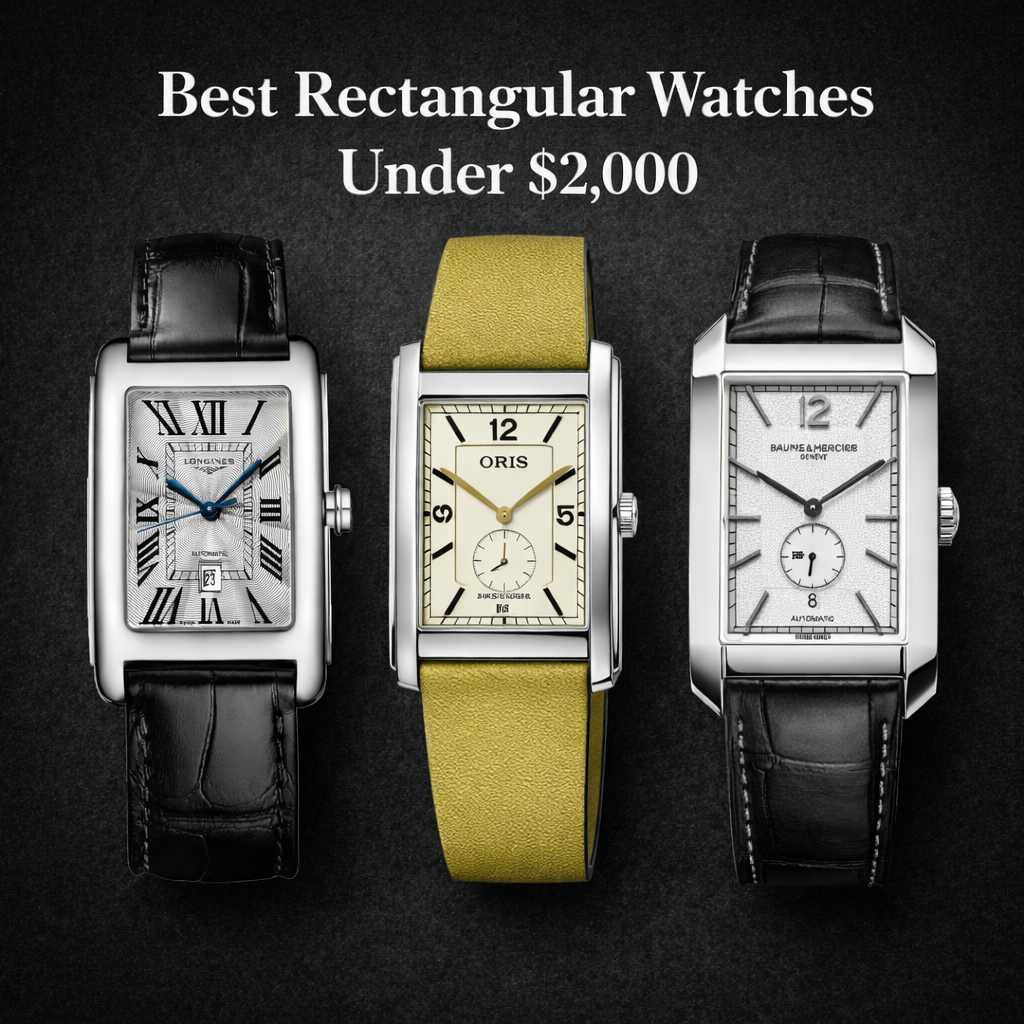
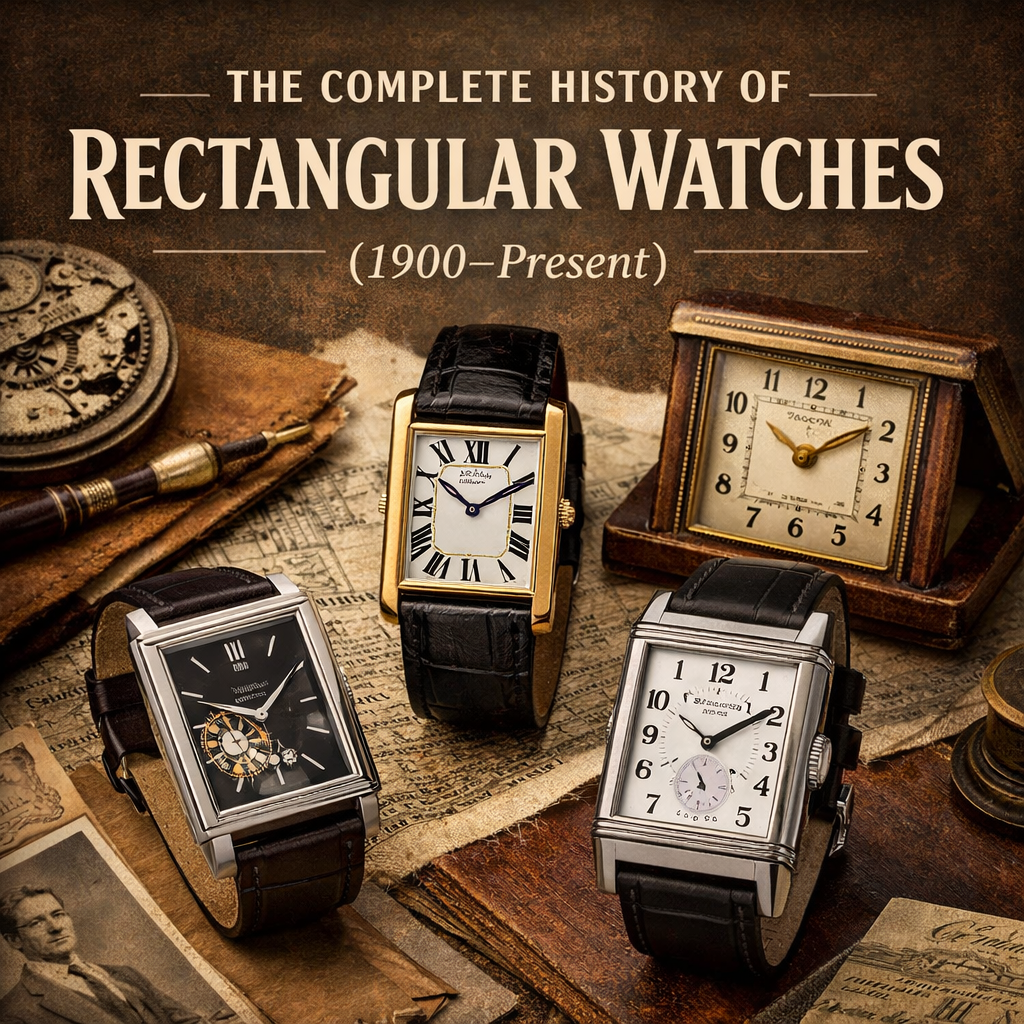
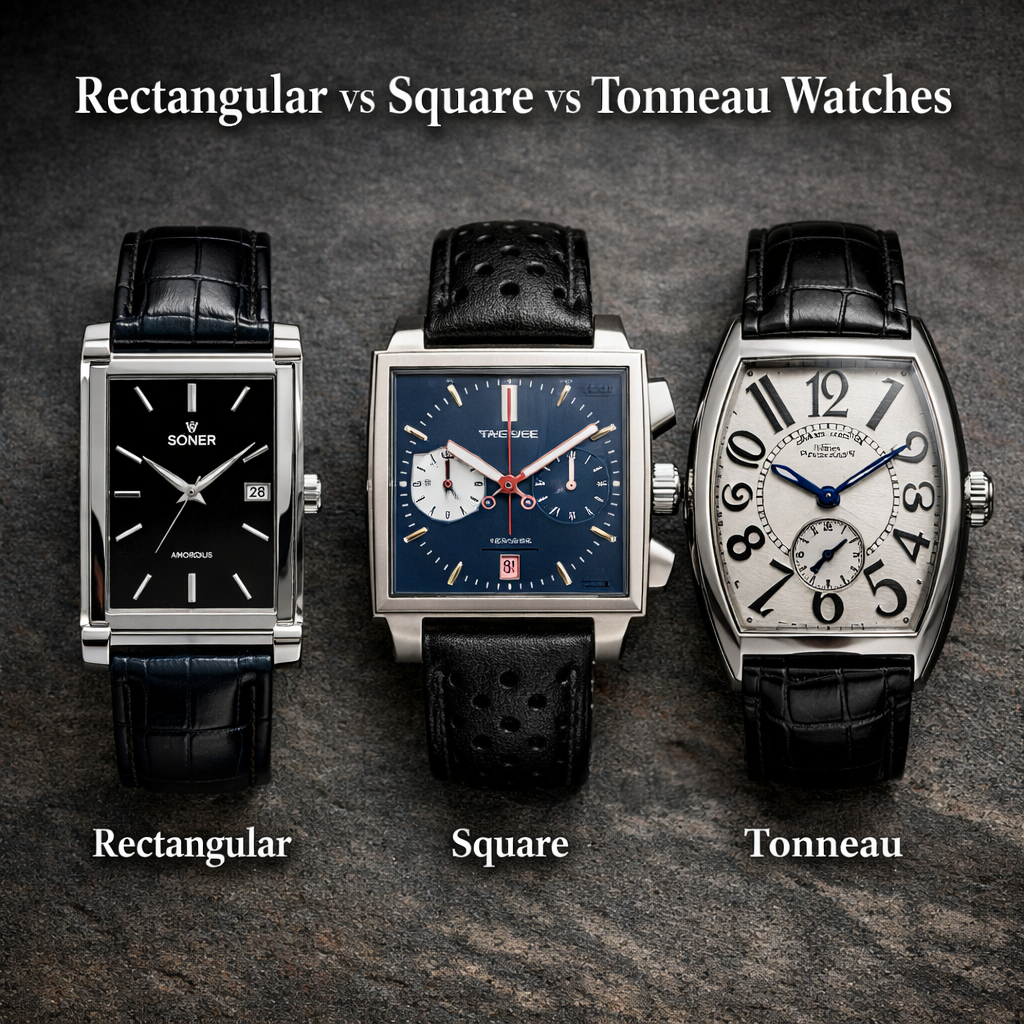
Rectangular watches are the category most people know least about - and the one with the deepest design heritage. The Cartier Tank (1917), the Jaeger-LeCoultre Reverso (1931), and the Patek Philippe Gondolo are all rectangular. The most significant dress watches ever made share one thing: they are not round.
The reason is geometric. The wrist is flat and elongated. A rectangular case tracks its natural line. A slim rectangular watch sits flush under a shirt cuff in a way a round case never quite achieves. This is why most watches are round - manufacturing efficiency - but it is also why the rectangular watch has endured as the dress watch's natural form.

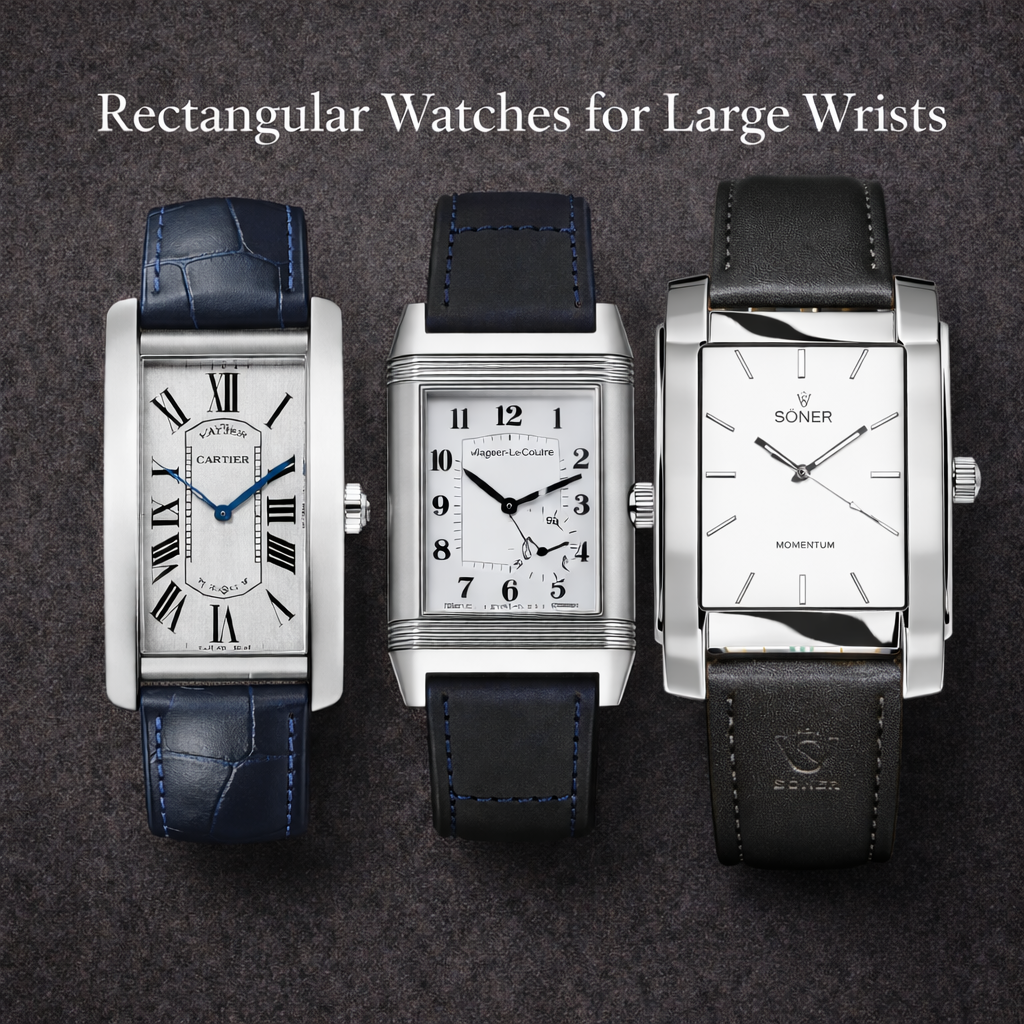
Rectangular watches also wear larger on the wrist than their dimensions suggest. The elongated case creates visual presence through height rather than width, which allows a formally proportioned watch to make an impact without being bulky. For a full technical explanation, see The Definitive Guide to Rectangular Watches.
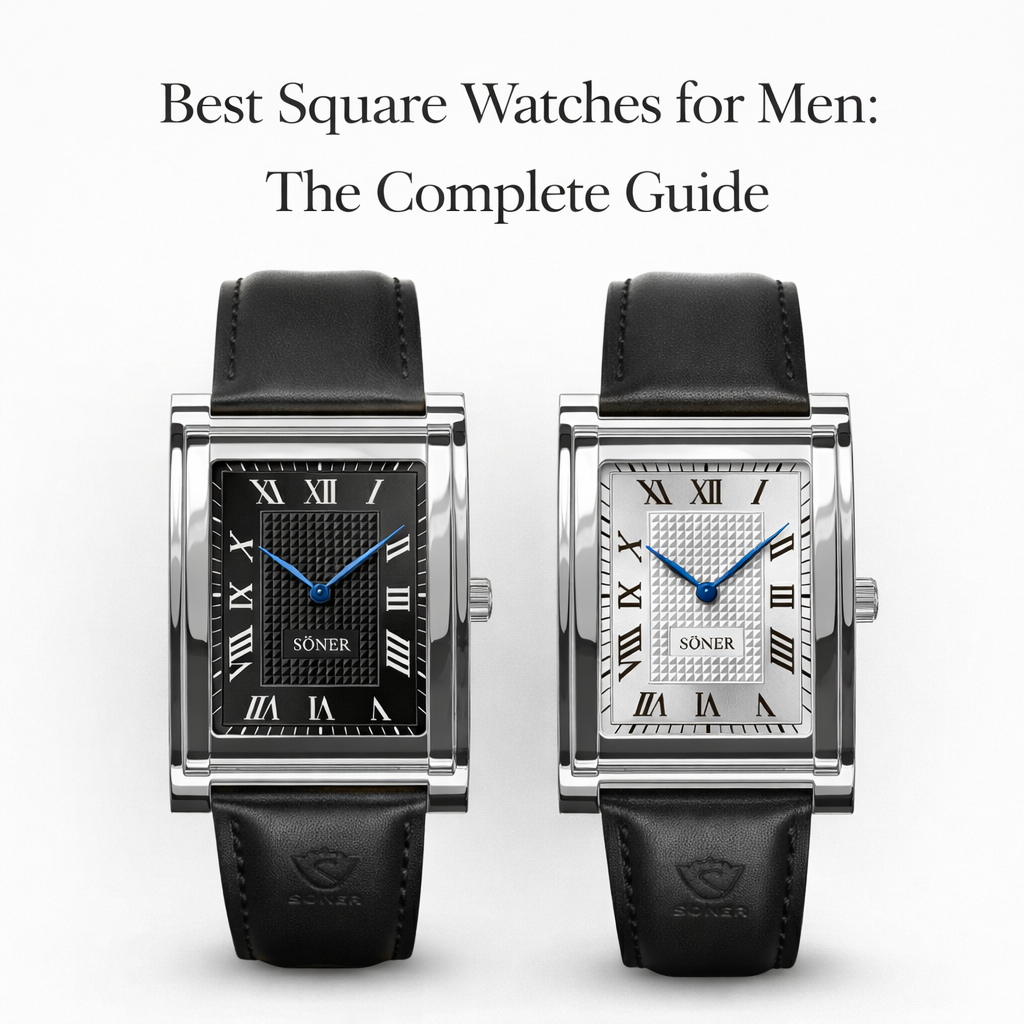
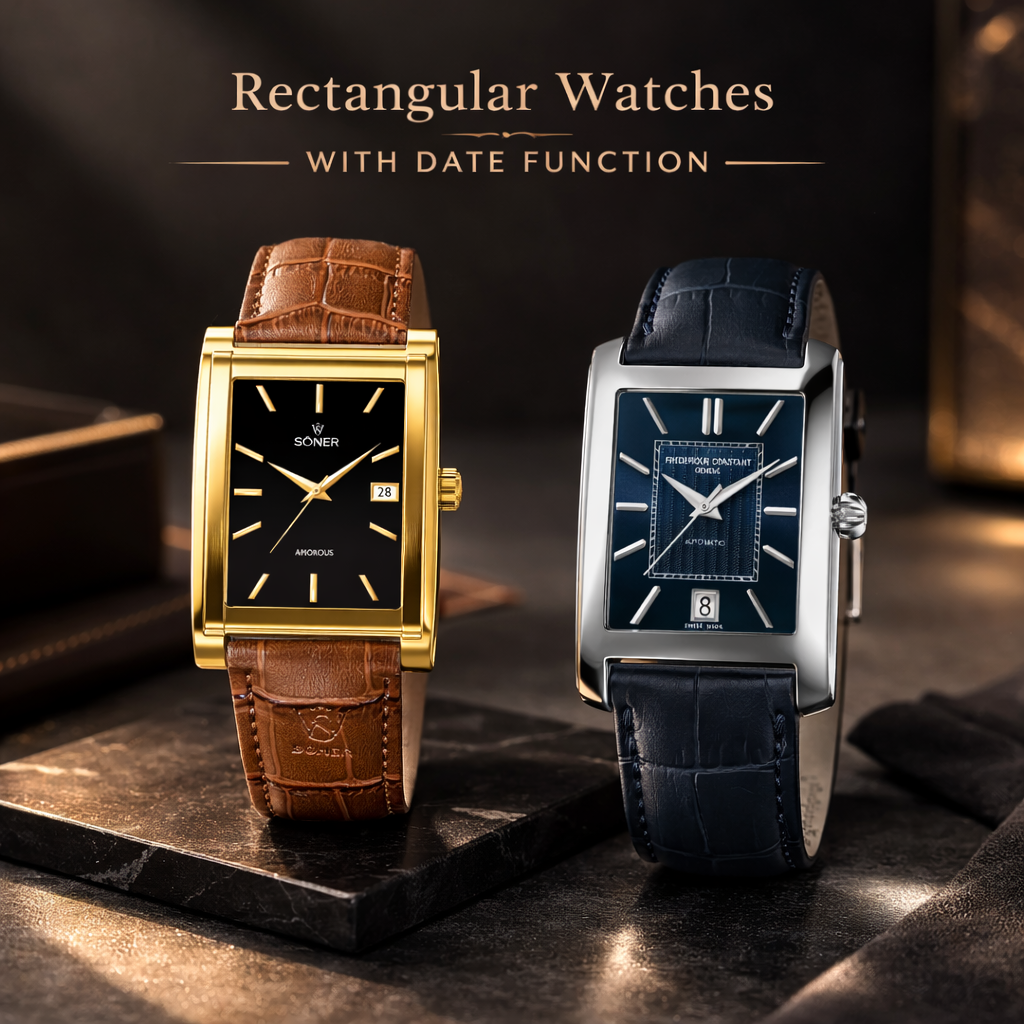
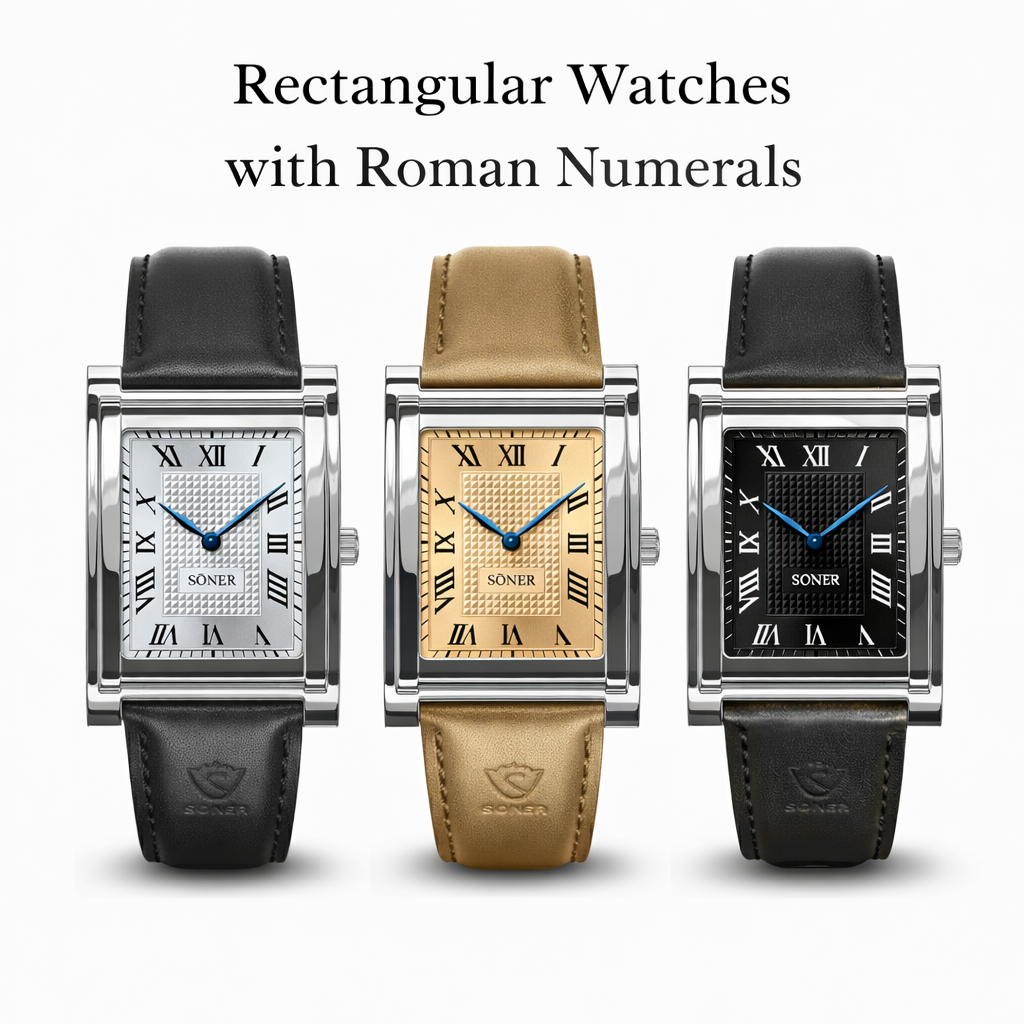
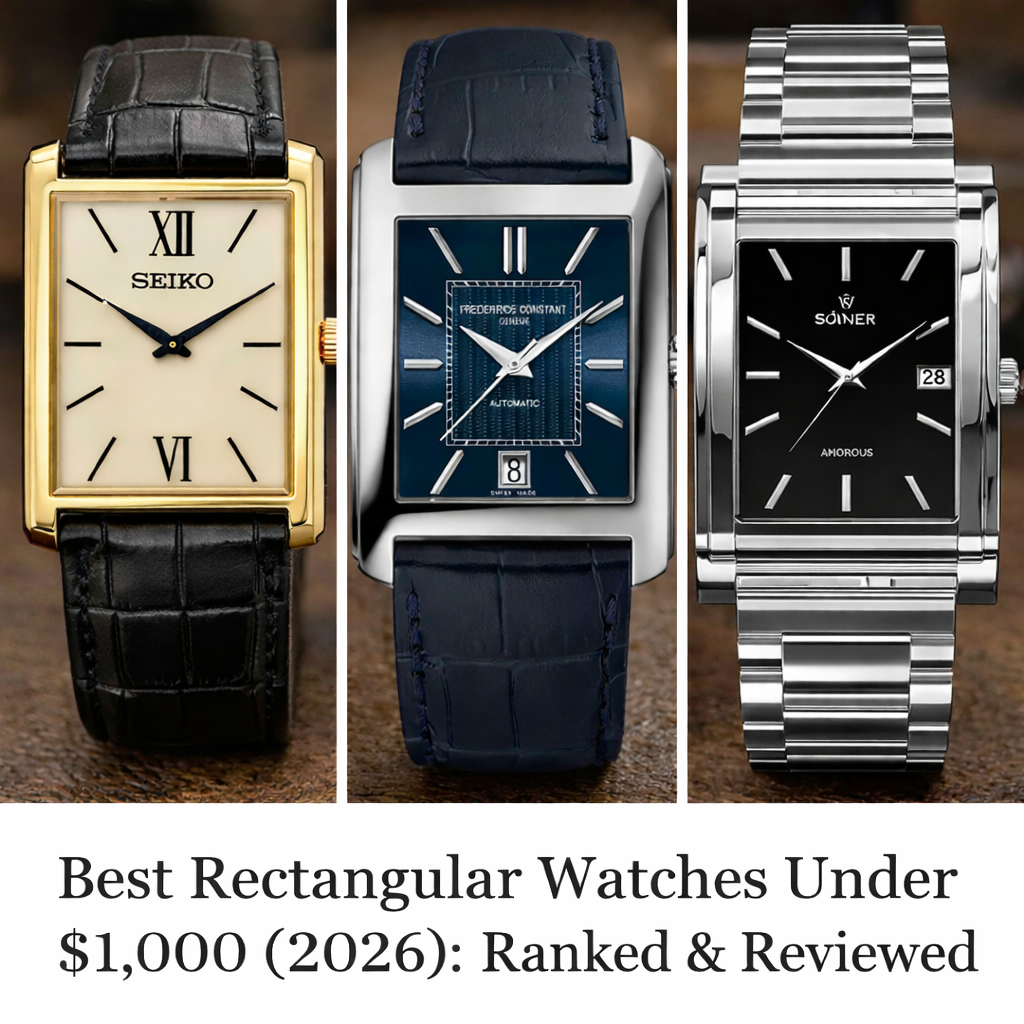
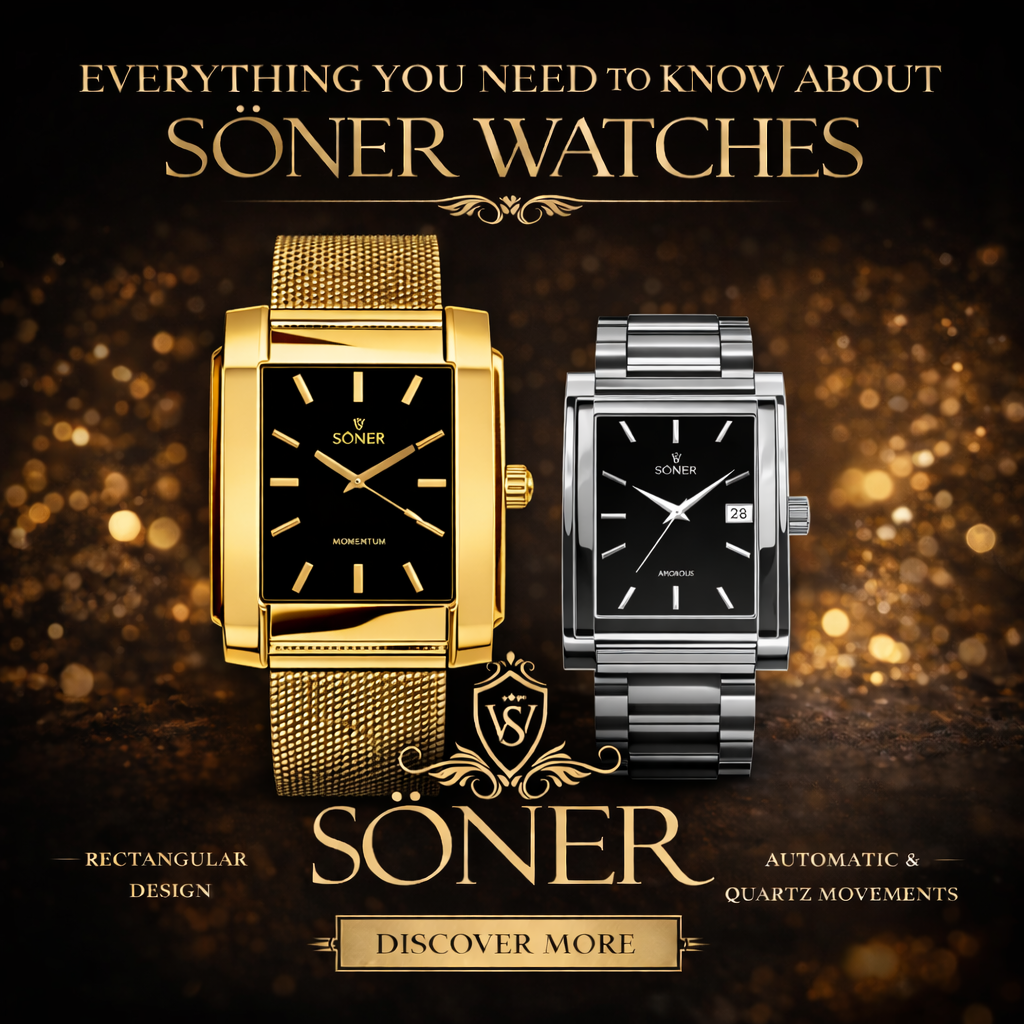
Unlike every other category covered in this guide, Söner Watches is built entirely around this one case shape. Every model - Nostalgia, Amorous, Momentum, Legacy - is rectangular. That singular focus produces a design consistency that brands treating rectangulars as secondary lines cannot match. See the best rectangular watches in 2026 for the full category overview.
Key Characteristics
- Non-circular case - elongated geometry, four corners
- Art Deco heritage - design lineage from the 1920s-1930s
- Slim profiles - dress watch proportions, cuff-friendly
- Architectural presence - linear geometry aligns with tailored clothing
- Harder to manufacture - custom crystals, complex case machining, higher cost per unit
Notable Examples
- Cartier Tank - 100+ years of continuous production, the rectangular benchmark. See Cartier Tank alternatives at every price point.
- Jaeger-LeCoultre Reverso - reversible case, Art Deco masterpiece. See the Tank vs Reverso comparison.
- Söner Momentum - Swedish-designed rectangular automatic, the only brand exclusively dedicated to this category

12. Chronograph Watches for Men
A chronograph is a watch with a built-in stopwatch function, operated by pushers on the case side. The term is often confused with chronometer - a chronograph measures elapsed time, while a chronometer is a precision-certified movement. They are different things.
Chronographs originated in aviation and motorsport, where timing over short intervals was operationally important. Today they remain a favourite for their complex, layered dials and the visual interest created by multiple sub-registers.
Key Characteristics
- Stopwatch function - start, stop, reset via case pushers
- Sub-dials - display elapsed seconds, minutes, sometimes hours
- Tachymeter scale - on many models, calculates speed over distance
- Larger cases - complications require more dial space, typically 40-44mm
Notable Examples
- Omega Speedmaster Moonwatch - first watch worn on the moon, still produced unchanged
- TAG Heuer Carrera - motorsport-inspired, clean execution
- Breitling Navitimer - pilot's chronograph with slide-rule bezel
13. Chronometer Watches for Men
A chronometer is a watch whose movement has been tested and certified to meet strict accuracy standards by an official body, most commonly COSC (Contrôle Officiel Suisse des Chronomètres) in Switzerland. COSC certification requires accuracy within -4 to +6 seconds per day across multiple temperature conditions and positions.
The distinction matters because "chronometer" is a regulated term - a watch can only carry it if it has passed official testing. Many watches claim precision; chronometer certification proves it.
Key Characteristics
- Official certification - COSC or equivalent body
- Accuracy standard - -4 to +6 seconds per day for COSC
- Premium movements - high-grade components, regulated to standard
- Marked on dial - certified pieces display "Chronometer" or "COSC" on the dial
Notable Examples
- Rolex Oyster Perpetual - every Rolex is COSC-certified as standard
- Omega Seamaster Aqua Terra - METAS-certified, stricter than COSC
- Breitling Superocean - professional-grade accuracy for diving

How to Choose the Right Watch for You
| Your Priority | Best Category | Key Spec to Check |
|---|---|---|
| Formal occasions, cuff wear | Dress or Rectangular | Thickness under 9mm |
| Active lifestyle, water exposure | Sports or Dive | Water resistance 100m+ |
| Daily wear, versatility | Casual | 38-42mm, leather or metal strap |
| Technology, fitness tracking | Smartwatch | Battery life, ecosystem compatibility |
| Travel, multiple time zones | Pilot or GMT | GMT complication, legible dial |
| Investment, prestige | Luxury or Tourbillon | Brand heritage, limited production |
| Timing, motorsport interest | Chronograph | Pushers, sub-dial layout |
| Architectural, distinctive look | Rectangular | Lug-to-lug vs wrist width |
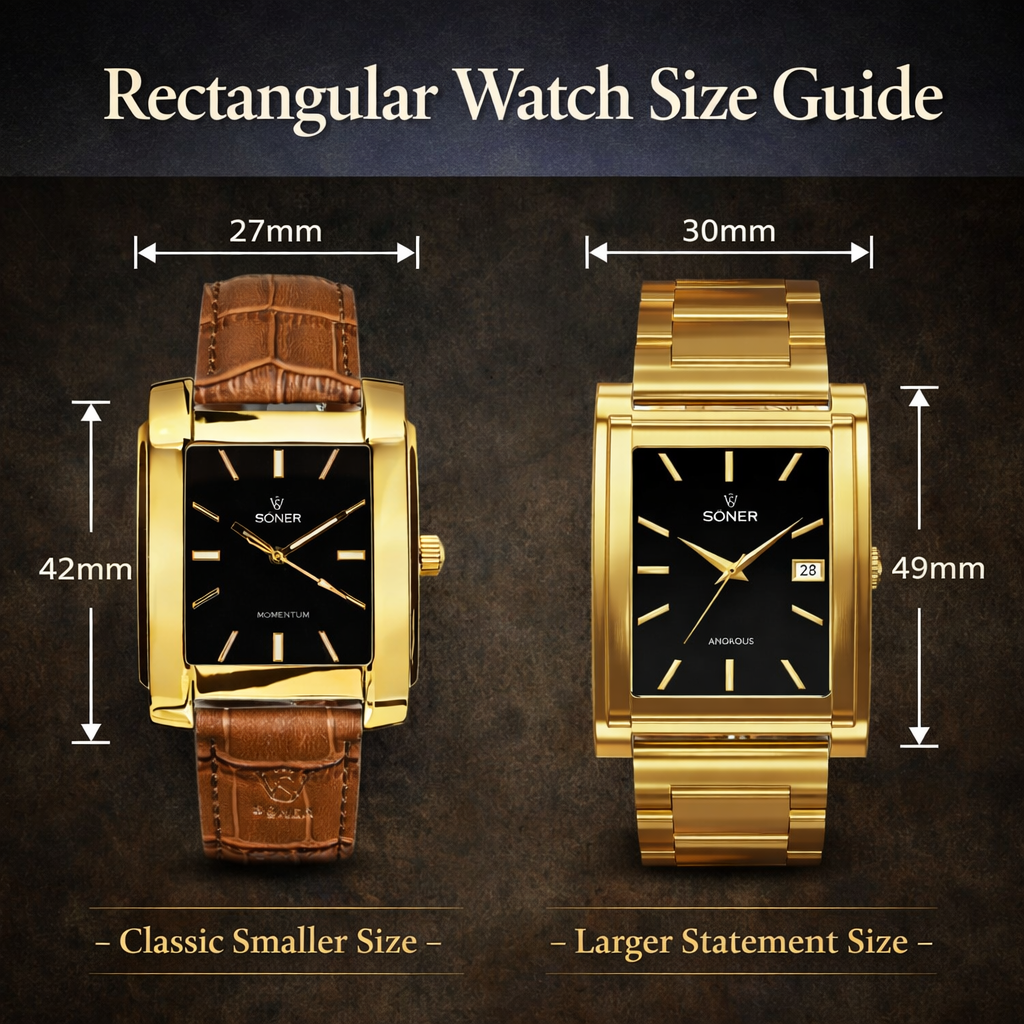
For rectangular watches specifically, the rectangular watch size guide covers the lug-to-lug measurement in detail - the single most important number when buying this category.
Frequently Asked Questions
What type of watch should a man wear every day?
A casual or dress watch with at least 3 ATM water resistance, a sapphire crystal, and a steel case handles daily wear well. If you want something more distinctive, a rectangular dress watch like the Söner Nostalgia is built for daily wear despite its formal proportions.
What is the difference between a chronograph and a chronometer?
A chronograph measures elapsed time using a stopwatch function. A chronometer is a movement that has been officially certified for accuracy by a body like COSC. A watch can be both - or neither. They are unrelated terms that are frequently confused.
Are rectangular watches practical for everyday wear?
Yes. Modern rectangular watches from Söner include 5 ATM water resistance, sapphire crystals, and hardened steel cases. The slim profile actually makes them more practical for office wear than many round watches, since they sit flush under a shirt cuff. See The Definitive Guide to Rectangular Watches for full details.
What size watch should a man wear?
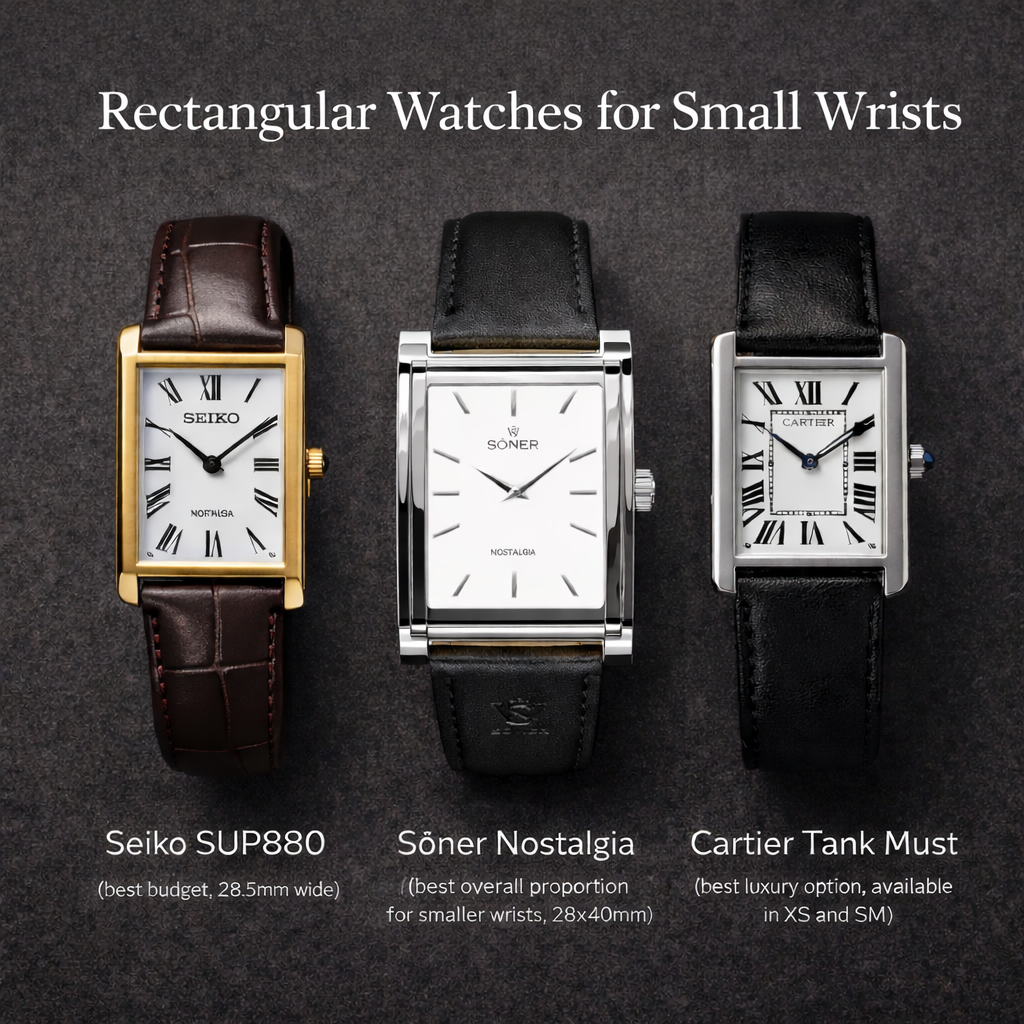
For round watches, 38-42mm suits most wrists. For rectangular watches, the lug-to-lug measurement matters more than case width. A 28mm wide rectangular case can have a 48mm lug-to-lug, which wears larger than it sounds. The rectangular watch size guide covers this in detail.
What is the most versatile watch type for men?
A dress watch or slim rectangular watch works across the broadest range of occasions - from formal events down to smart-casual. A sports watch covers the other end. If you own one watch, a slim dress watch in steel on a leather strap covers the most ground.
Why are most watches round?
Manufacturing efficiency. Round cases are machined on a lathe in a single operation. Rectangular cases require milling across multiple setups, custom crystals, and more hand-finishing. The cost difference per unit is significant, which is why most brands default to round. The full explanation is here.