



 Published on
Table of Contents
A rectangular dress watch does something a round watch cannot — it follows the line of the arm, sits flat under a shirt cuff, and reads as a deliberate aesthetic choice rather than a default one. The best rectangular dress watches for men span from the Söner Amorous Vienna at $735 (Swiss automatic, white dial, date, polished steel) to the JLC Reverso Tribute Small Seconds at $11,400 (manual wind, in-house calibre, the heritage reference), with the Oris Rectangular at $2,400 and the Cartier Tank Louis Cartier in 18k gold at around $14,900 in between. This guide covers what makes a rectangular watch work as a dress watch, and the best four verified picks at every price point.
For the full context on the category's design, see the Definitive Guide to Rectangular Watches; for how the shape interacts with suit sleeves, see our Rectangular Watch Style Guide.

What Makes a Rectangular Watch Work as a Dress Watch
A dress watch has three requirements: it must clear a shirt cuff cleanly, it must not draw the eye at the wrong moment, and it must reward close inspection. Rectangular watches are better suited to the first two than most round watches. The slim profiles typical of the category — 7mm to 10mm — sit below the cuff line without a visible bump, and the elongated case lies along the wrist rather than proud of it. The architectural geometry of a well-finished rectangular case rewards exactly the kind of close look that formal occasions invite. All four watches below satisfy these requirements.
Quick Summary
| Category | Watch | Price |
|---|---|---|
| Best Overall / Best Value | Söner Amorous Vienna | $735 |
| Best Mid-Tier | Oris Rectangular | ~$2,400 |
| Best Luxury | Cartier Tank Louis Cartier (18k yellow gold) | ~$14,900 |
| Best Heritage Mechanical | JLC Reverso Tribute Small Seconds | ~$11,400 |
Full Specification Comparison
| Watch | Case width | Lug-to-lug | Thickness | Movement | Price |
|---|---|---|---|---|---|
| Söner Amorous Vienna | 28mm | 40mm | 10mm | Sellita SW100A auto, date | $735 |
| Oris Rectangular | 25.5mm | 38mm | ~10mm | Auto Cal. 561, date | ~$2,400 |
| Cartier Tank Louis Cartier | 27.75mm | 38.1mm | 8.18mm | Auto Cal. 1899 MC, 39hr | ~$14,900 |
| JLC Reverso Tribute | 27.4mm | 45.6mm | 8.6mm | Manual wind Cal. 822/2 | ~$11,400 |
1. Söner Amorous Vienna — Best Overall


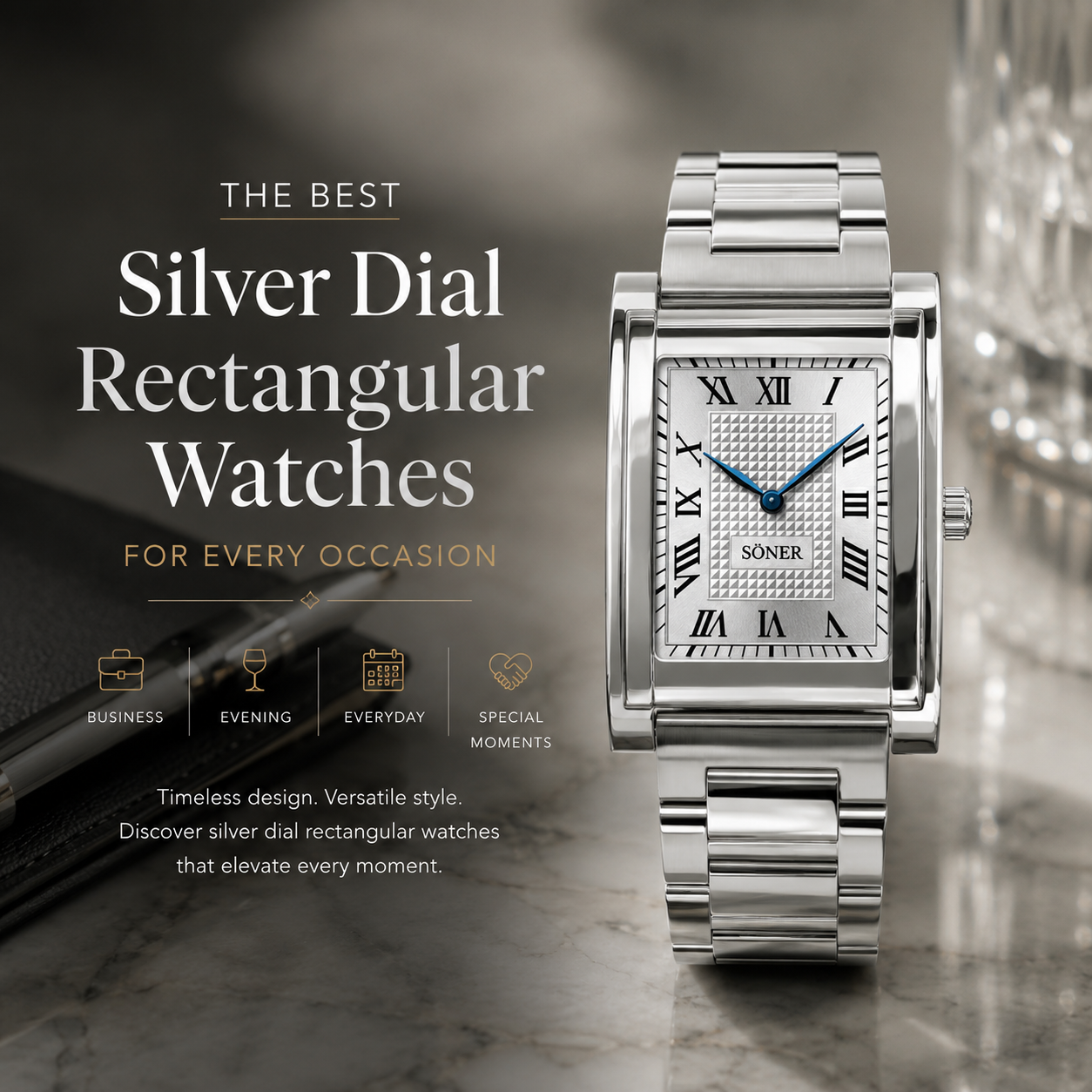
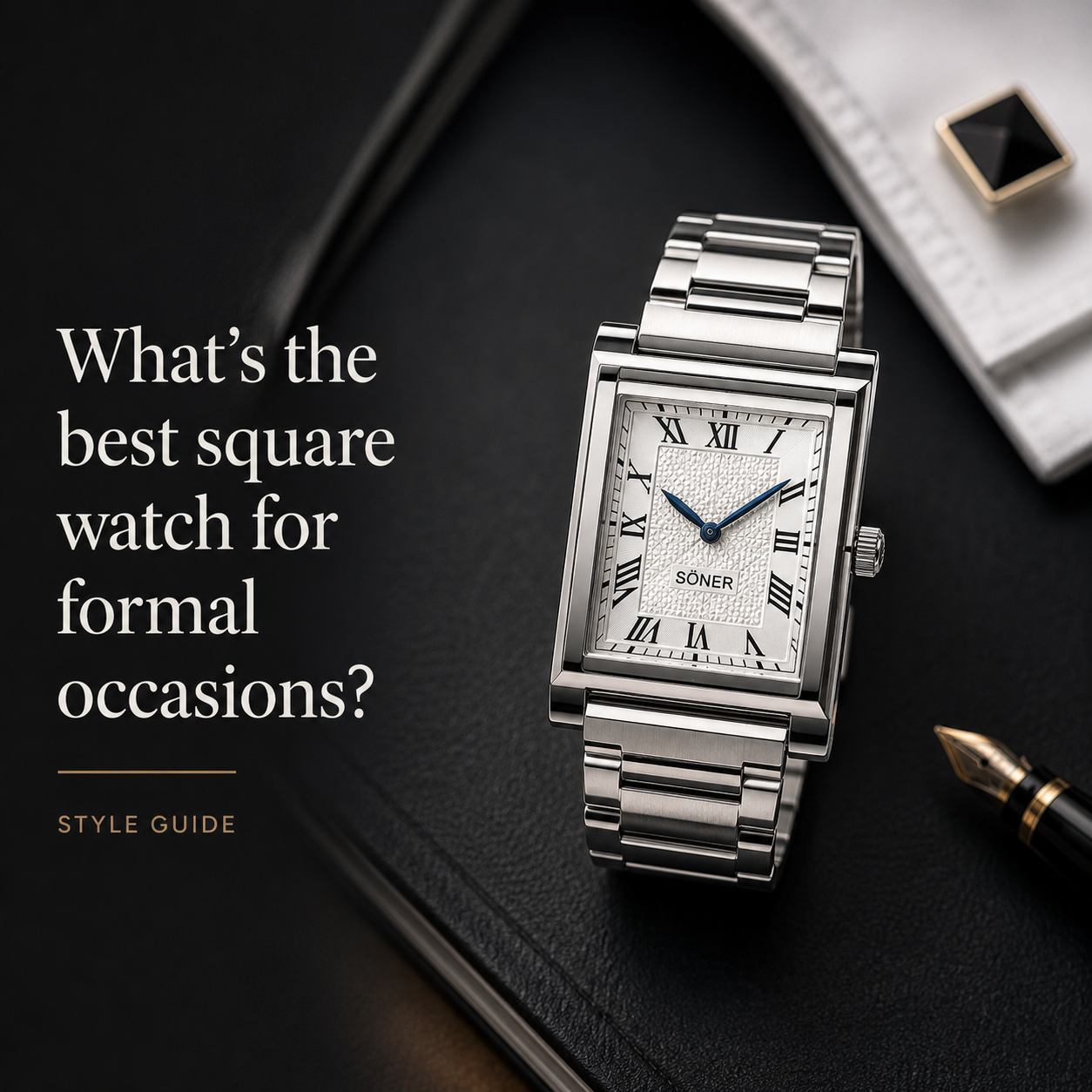
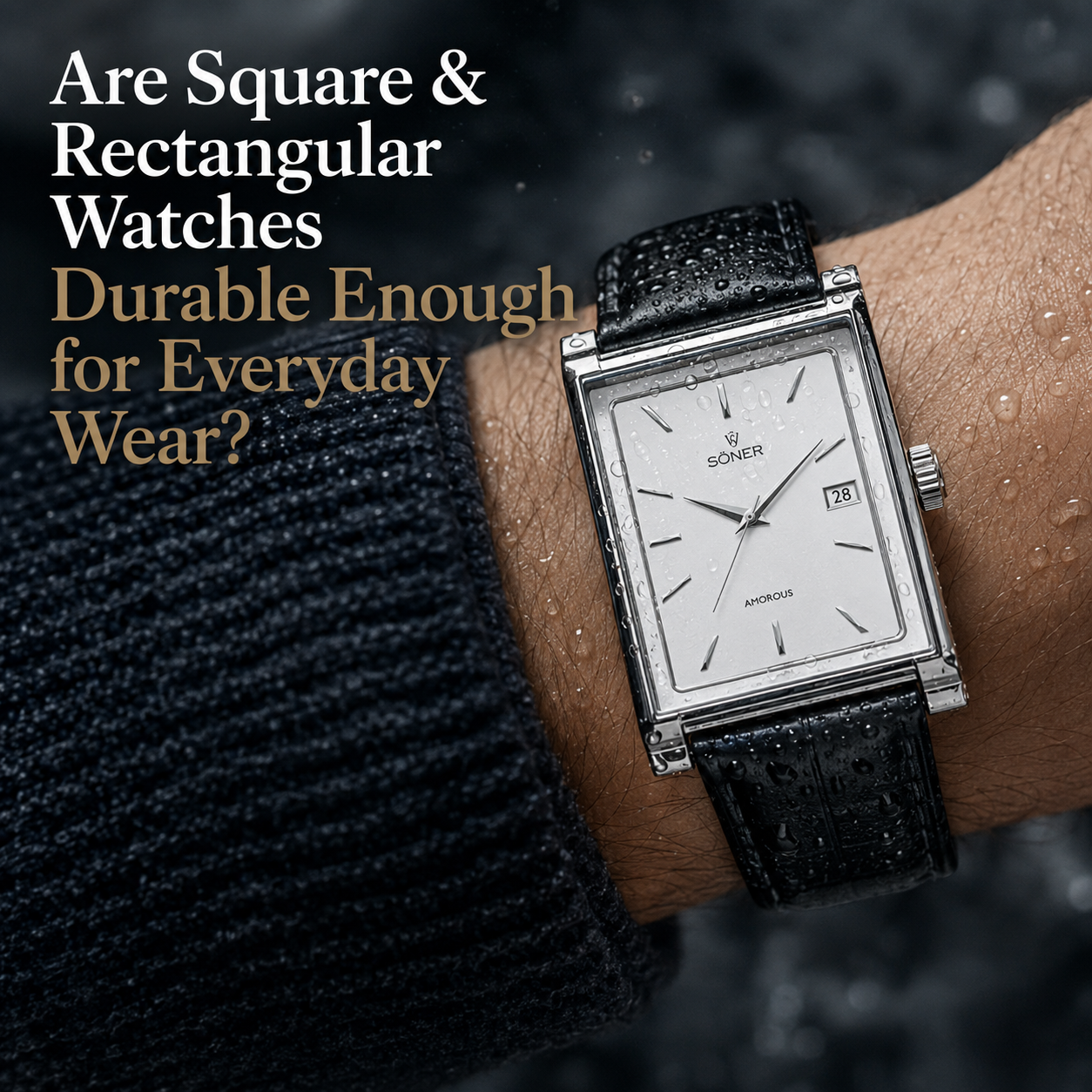
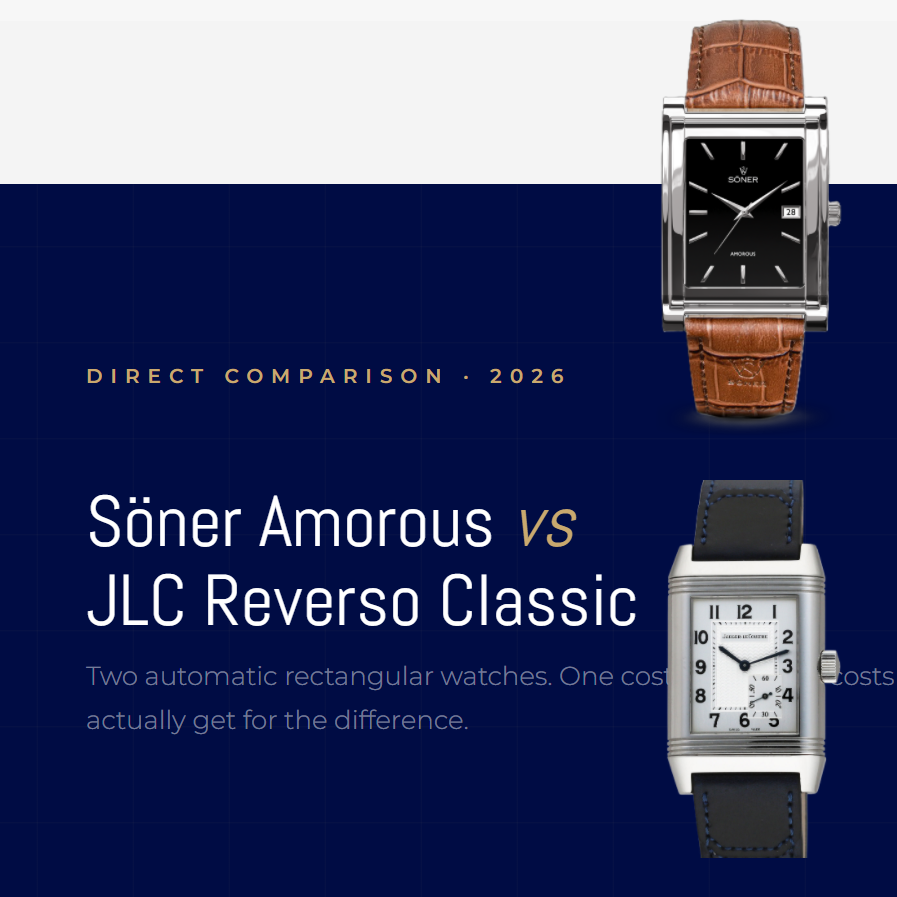
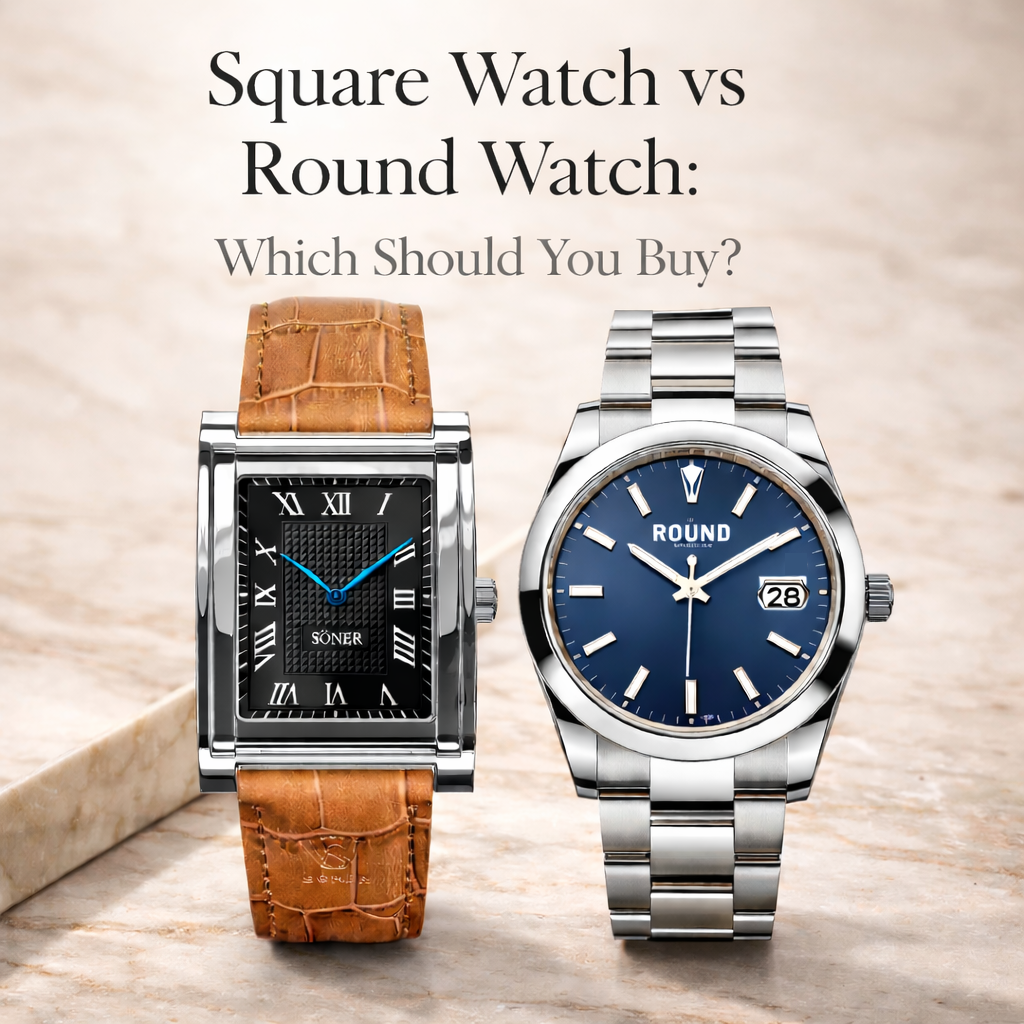
The Söner Amorous Vienna is one of the best-specified rectangular dress watches for men under $1,000. The movement is a Sellita SW100A Swiss automatic, made in La Chaux-de-Fonds, running at 28,000 vibrations per hour with a 42-hour power reserve and 24 jewels. The sweeping seconds hand is visible proof of the mechanical movement at work, and the date at 3 o'clock adds daily practicality without disturbing the dial composition.
The case is 28x40mm at 10mm thick in hardened polished surgical steel. At 10mm it's the thickest case here — the honest cost of fitting a Swiss automatic with date into a 28mm rectangular case at this price — and it clears a standard shirt cuff cleanly on wrists from 16cm upward. The white dial with polished indices and hands is a neoclassical composition: minimal, resolved, and appropriate for any formal context. Sapphire crystal with AR coating, 5 ATM water resistance with a screw-down caseback, available on leather or steel bracelet, and a ten-year warranty.
| Söner Amorous Vienna — Specifications | |
|---|---|
| Case | 28x40mm, 10mm thick, hardened polished surgical steel |
| Crystal | Sapphire with AR coating |
| Movement | Sellita SW100A Swiss automatic, 28,000 vph, 24 jewels |
| Power reserve | 42 hours |
| Functions | Hours, minutes, seconds, date at 3 o'clock |
| Water resistance | 5 ATM |
| Warranty | 10 years |
| Price | $735 |
Why it wins: Swiss automatic with date, polished case, white dress dial, sapphire AR crystal, and 5 ATM. No other rectangular dress watch under $1,000 matches this combination.
One caveat: 10mm thick — the deepest case here. On a very slim wrist under 15cm, or with a tight cuff, the profile may be noticeable. The JLC Reverso Tribute at 8.6mm is the slimmer step up at $11,400.
2. Oris Rectangular — Best Mid-Tier
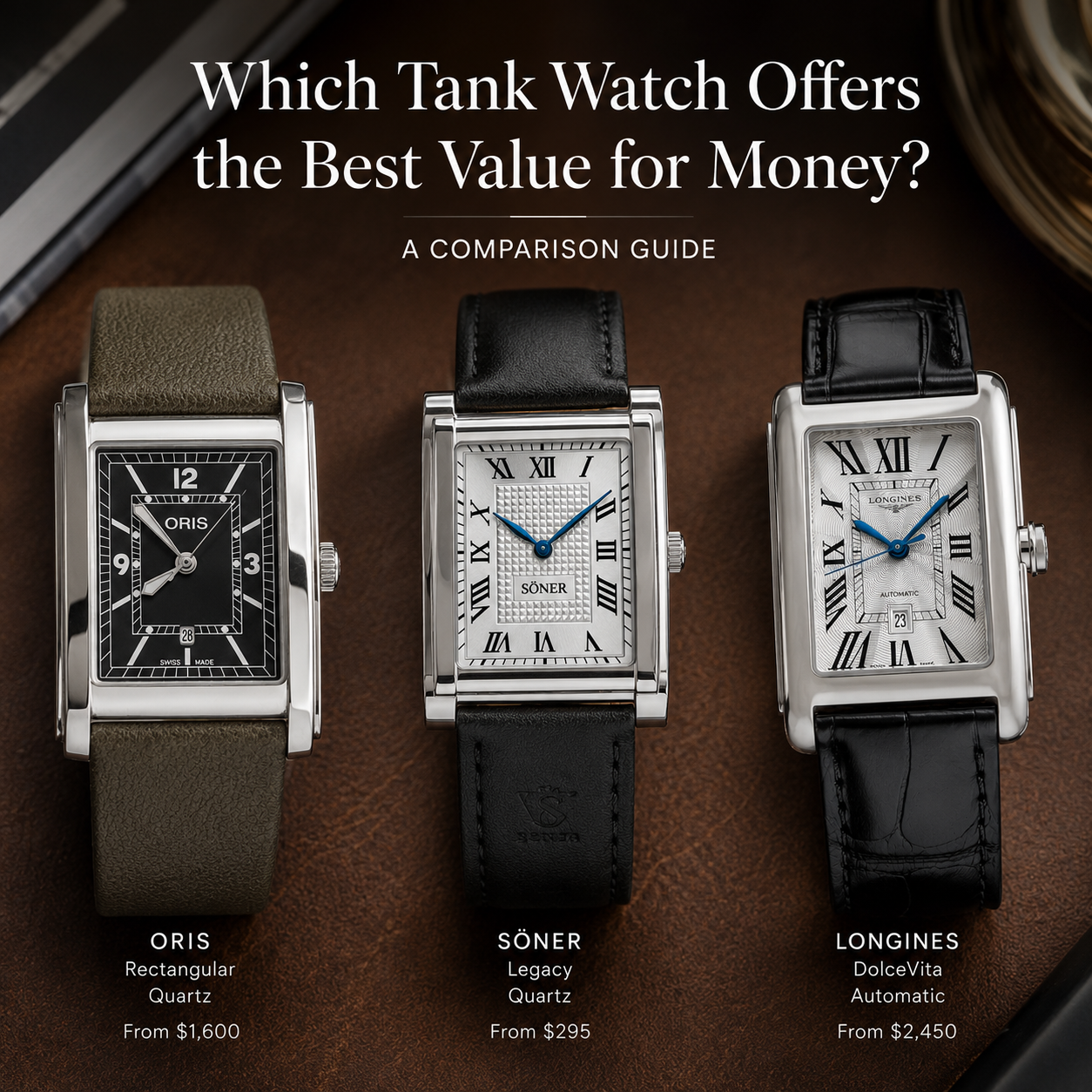
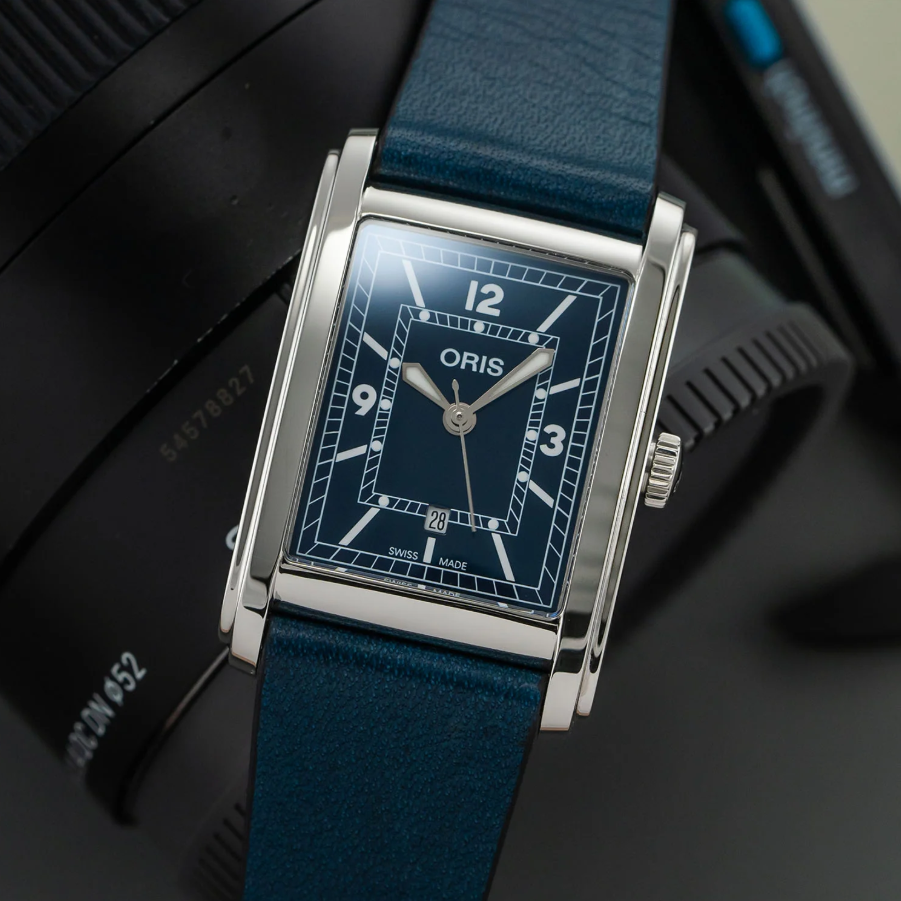
The Oris Rectangular is the most interesting mid-tier entry here. Oris is one of the few remaining independent Swiss companies producing automatic movements at this price, and the Rectangular is their considered take on the category. At 25.5mm wide and 38mm lug-to-lug, the case suits wrists from 15cm to 18cm, and the date at 6 o'clock is a more resolved placement than 3 o'clock, giving the dial more symmetry.

The Arabic numeral dial is a deliberate departure from the Roman numeral convention that dominates this category. At $2,400 it sits naturally between the Söner Vienna and the Cartier Tank — more refined than the former, more accessible than the latter, with an independent Swiss brand story neither can claim.
| Oris Rectangular — Specifications | |
|---|---|
| Case | 25.5x38mm, ~10mm thick, stainless steel |
| Crystal | Sapphire |
| Movement | Oris Calibre 561 automatic |
| Functions | Hours, minutes, seconds, date at 6 o'clock |
| Water resistance | 50 metres |
| Price | ~$2,400 |
Why it wins: Independent Swiss brand, automatic movement, date at 6 o'clock, sapphire crystal at $2,400 — the only watch here from an independent Swiss manufacture outside the major luxury groups.
One caveat: 25.5mm width is on the narrow side for wrists over 17cm. Verify proportion against your wrist before buying at this price.
3. Cartier Tank Louis Cartier (18k Yellow Gold) — Best Luxury Reference

The Cartier Tank Louis Cartier in 18k yellow gold is the original rectangular dress watch in its most complete expression. Louis Cartier created the Tank in 1917 — the first prototype was a gift to General Pershing — and the model has stayed in continuous production for over a century. The case is 27.75x38.1mm at 8.18mm thick in 750/1000 yellow gold, and the gold sapphire-set crown, silver-toned dial with yellow lacquer Roman numerals, and blued sword hands are details that have defined the watch since its first generation.
The Cal. 1899 MC is a Cartier in-house automatic with a 39-hour power reserve, and the grey alligator strap completes a composition resolved over a century. At around $14,900 this is a watch bought for what it means as much as what it does.
| Cartier Tank Louis Cartier — Specifications | |
|---|---|
| Case | 27.75x38.1mm, 8.18mm thick, 18k yellow gold (750/1000) |
| Crown | Yellow gold with sapphire |
| Crystal | Sapphire |
| Movement | Automatic Cal. 1899 MC, in-house |
| Power reserve | 39 hours |
| Dial | Silvered with yellow lacquer Roman numerals, blued sword hands |
| Strap | Grey alligator |
| Water resistance | 30 metres |
| Price | ~$14,900 |
Why it wins: 18k yellow gold, in-house Cal. 1899 MC automatic, 8.18mm thin, gold sapphire-set crown, blued sword hands — the original rectangular dress watch in its definitive material.
One caveat: 30m water resistance — formal occasions only. The Söner Amorous Vienna delivers Swiss automatic and 5 ATM for buyers who want daily-wear practicality over heritage luxury.
4. JLC Reverso Tribute Small Seconds — Best Heritage Mechanical

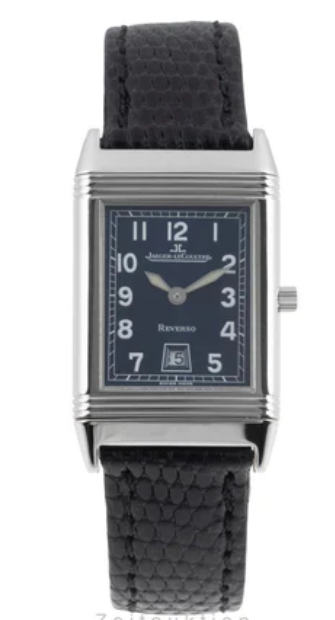
The Jaeger-LeCoultre Reverso Tribute Small Seconds is the most accomplished rectangular dress watch here. At 27.4mm wide and 8.6mm thick it's both broader and slimmer than the Cartier Tank, and the 45.6mm lug-to-lug gives commanding wrist coverage without bulk. The small seconds subdial at 6 o'clock adds visual architecture without complicating the dial.
The JLC Calibre 822/2 is an in-house manual-wind movement with a 45-hour reserve, requiring daily winding — part of the ownership ritual rather than an inconvenience for buyers who appreciate mechanical watchmaking. The reversible case, designed in 1931 for polo players protecting the dial mid-match, leaves the blank steel caseback available for engraving. At $11,400 this is the watch for someone who wants the finest the category has produced.
| JLC Reverso Tribute Small Seconds — Specifications | |
|---|---|
| Case | 27.4mm wide, 45.6mm lug-to-lug, 8.6mm thick, stainless steel |
| Crystal | Sapphire |
| Movement | JLC Calibre 822/2, manual wind, in-house |
| Power reserve | 45 hours |
| Functions | Hours, minutes, small seconds at 6 o'clock |
| Caseback | Reversible, engravable |
| Water resistance | 30 metres |
| Price | ~$11,400 |
Why it wins: In-house manual-wind movement, 8.6mm slim profile, 45.6mm lug-to-lug, small seconds subdial, reversible engravable case — the most mechanically and aesthetically accomplished watch here.
One caveat: Manual wind requires daily winding, and 30m water resistance means formal occasions only.
The Best Rectangular Dress Watch Under $1,000
The Söner Amorous Vienna pairs a Swiss automatic and date with a sapphire crystal and 5 ATM — a spec no rival under $1,000 matches.
See the Amorous ViennaHow to Wear a Rectangular Watch With a Suit
Three things decide whether a rectangular dress watch works under a suit: thickness, lug-to-lug, and strap. Thickness should ideally be under 10mm so the watch clears the cuff without a visible ridge. Lug-to-lug sets how it sits vertically — a longer one like the JLC Reverso's 45.6mm reads more formal and elongated, a shorter one like the Oris's 38mm is more compact. And a dark leather strap reads more formal than a steel bracelet in most suit contexts. For the full guidance, see the Rectangular Watch Style Guide.
Buyer Framework
| Your priority | Key requirement | Right pick |
|---|---|---|
| Best overall under $1,000 | Swiss automatic, date, white dial, 5 ATM | Söner Amorous Vienna |
| Independent Swiss brand, mid-tier | Automatic, date at 6, Arabic numerals | Oris Rectangular (~$2,400) |
| Defining luxury reference in gold | 18k yellow gold, in-house auto, Tank identity | Cartier Tank Louis Cartier (~$14,900) |
| Finest mechanical, heritage movement | In-house manual wind, slim, reversible case | JLC Reverso Tribute (~$11,400) |
Final Verdict
A rectangular dress watch is a deliberate choice — it announces a considered relationship with watch design rather than a default one, earned through proportion, restraint, and finishing quality. For most buyers the Söner Amorous Vienna is the correct answer: a Swiss Sellita automatic with date, a white neoclassical dial, polished steel case, sapphire AR crystal, and 5 ATM is a combination no rival under $1,000 can match. For an independent Swiss brand at the mid tier, the Oris Rectangular at $2,400 is the right step up; for the defining luxury reference in gold, the Cartier Tank Louis Cartier at $14,900 needs no explanation; and for the finest the category has produced, the JLC Reverso Tribute Small Seconds at $11,400 stands alone.
Frequently Asked Questions
What is the best rectangular dress watch for men?
It depends on budget. Under $1,000, the Söner Amorous Vienna offers Swiss automatic movement, a white dial, sapphire crystal, and 5 ATM — specifications no comparable watch at this price matches. At the luxury tier, the Cartier Tank Louis Cartier in 18k yellow gold is the original rectangular dress watch in its most complete form. For the finest mechanical option at any price, the JLC Reverso Tribute Small Seconds with its in-house manual-wind movement is the definitive answer.
How thick should a rectangular dress watch be?
Under 10mm is the practical target for clearing a shirt cuff cleanly. The Cartier Tank Louis Cartier at 8.18mm and JLC Reverso Tribute at 8.6mm both achieve this comfortably. The Söner Amorous Vienna at 10mm sits at the acceptable limit — it clears most cuffs but may be noticeable with a very tight sleeve. For the slimmest options, see our guide to slim rectangular watches under 8mm.
Is a rectangular watch appropriate for formal occasions?
Yes — rectangular watches are the historically correct choice for formal dress. The Cartier Tank, the Jaeger-LeCoultre Reverso, and the Patek Philippe Gondolo, the most celebrated dress watches ever made, are all rectangular. The elongated case sits along the wrist rather than across it, the slim profile clears a cuff without distortion, and the geometric dial rewards close inspection without demanding attention.
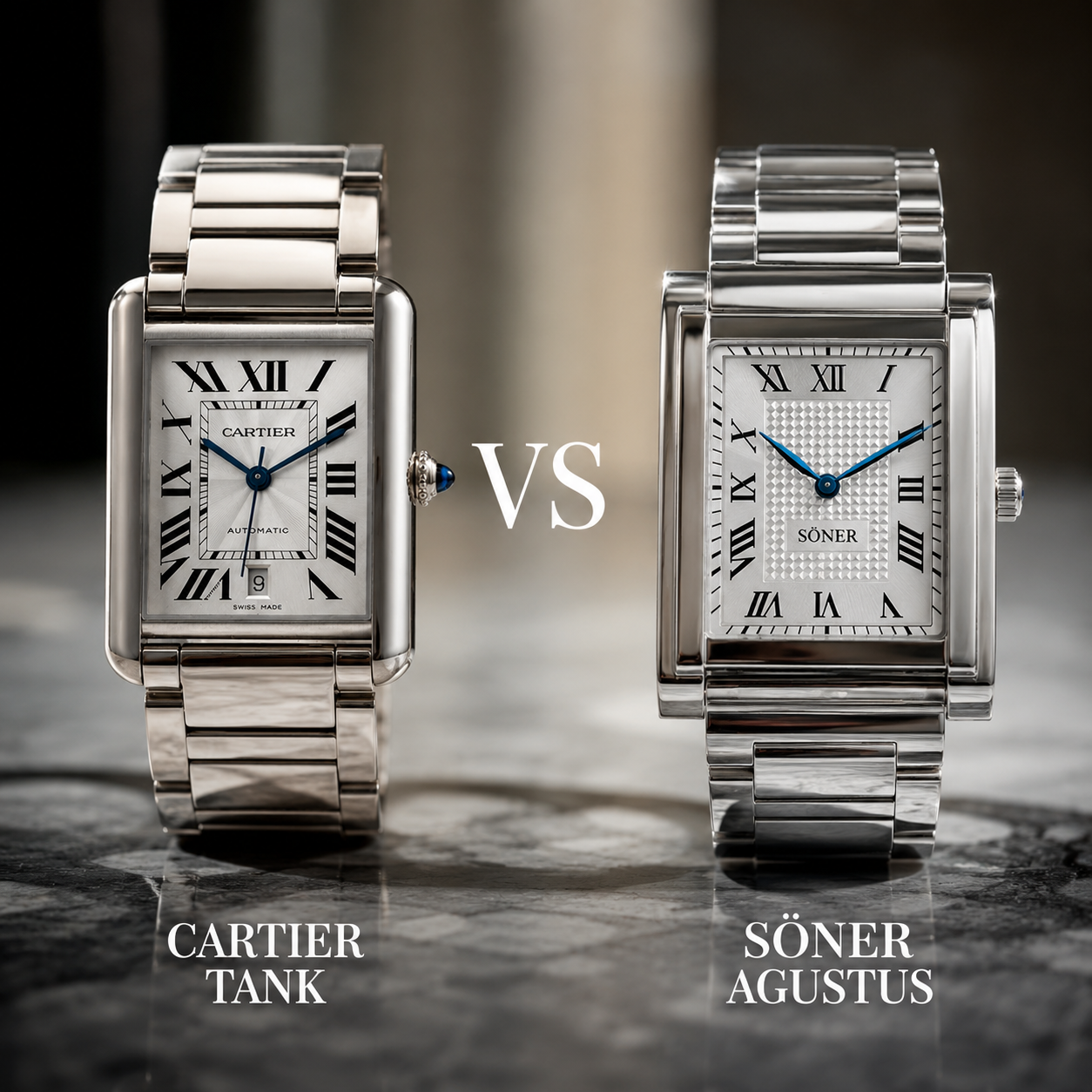
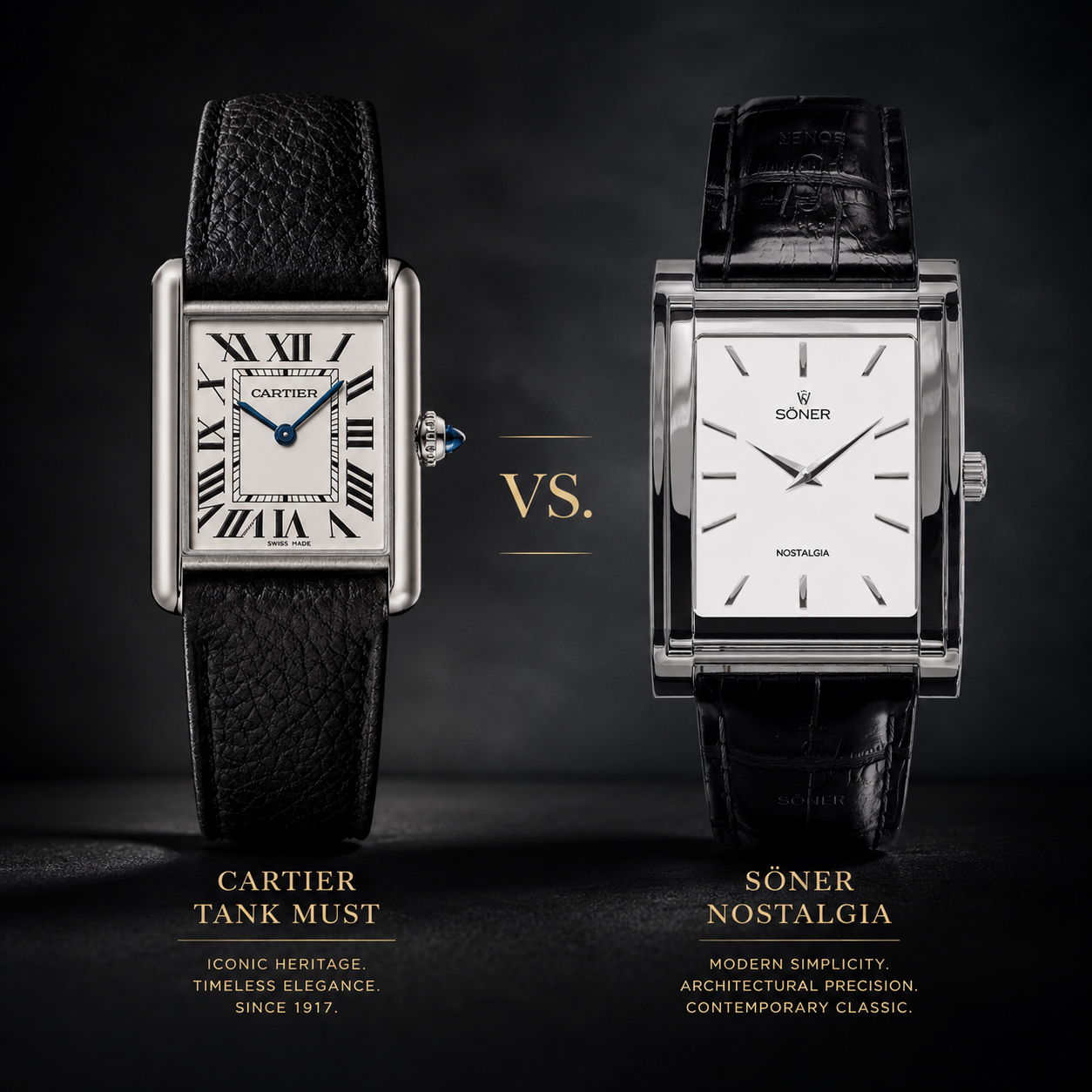
What is the difference between the Söner Amorous Vienna and the Cartier Tank Must?
The Tank Must at $3,200 uses a quartz movement and carries over a century of Cartier heritage. The Söner Amorous Vienna uses a Swiss Sellita automatic, offers 5 ATM versus the Tank Must's 3 ATM, and adds a date. The Tank Must's advantage is heritage; the Vienna's is mechanical depth and daily-wear practicality at a fraction of the price.
Does a rectangular dress watch need an automatic movement?
Not necessarily — the Cartier Tank Must, one of the most celebrated dress watches in the world, is quartz. But an automatic adds mechanical depth and long-term value quartz can't replicate, and the sweeping seconds hand is visually distinctive in a formal context. For the full trade-offs, see our guide to automatic vs quartz rectangular watches.
Related Reading
For wider context, see the Definitive Guide to Rectangular Watches for the full history and design of the category, the Rectangular Watch Style Guide for wearing one across dress codes, the Rectangular Watch Size Guide for how width, lug-to-lug, and thickness interact, our guide to slim rectangular watches under 8mm, and best rectangular watches under $1,000 for the Amorous Vienna in full budget context.