



 Published on
Table of Contents
This comprehensive wristwatch dictionary is your fast, reliable reference for decoding the language of horology. From case anatomy and crystals to movements, escapements, and complications, each definition is concise and accurate, written to help you read spec sheets and reviews with confidence. You will also find essential standards around water resistance, anti-magnetism, accuracy, and finishing so you can compare watches on more than just looks.
Beyond the technical terms, we cover real-world ownership: buying and distribution terms, smart and connected features, packaging and carry, and the forum slang you keep seeing in comment threads. To round it out, there is an A-Z of 40 foundational brands, each with a short profile and its most iconic models.
If you would like to suggest new terms or notice an error, please contact us at info@sonerwatches.com.
Case Shapes and Styles
- Round: Circular case shape, the industry default for legibility and sealing.
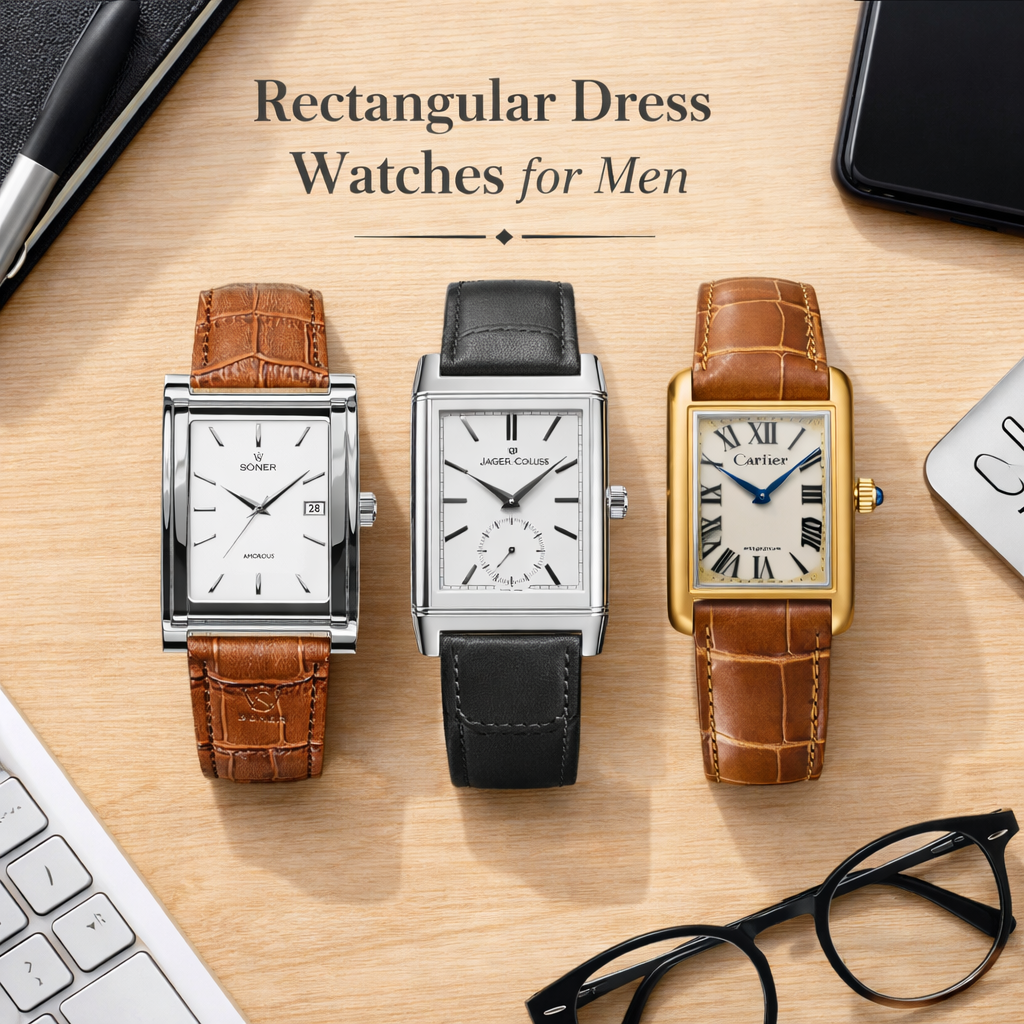
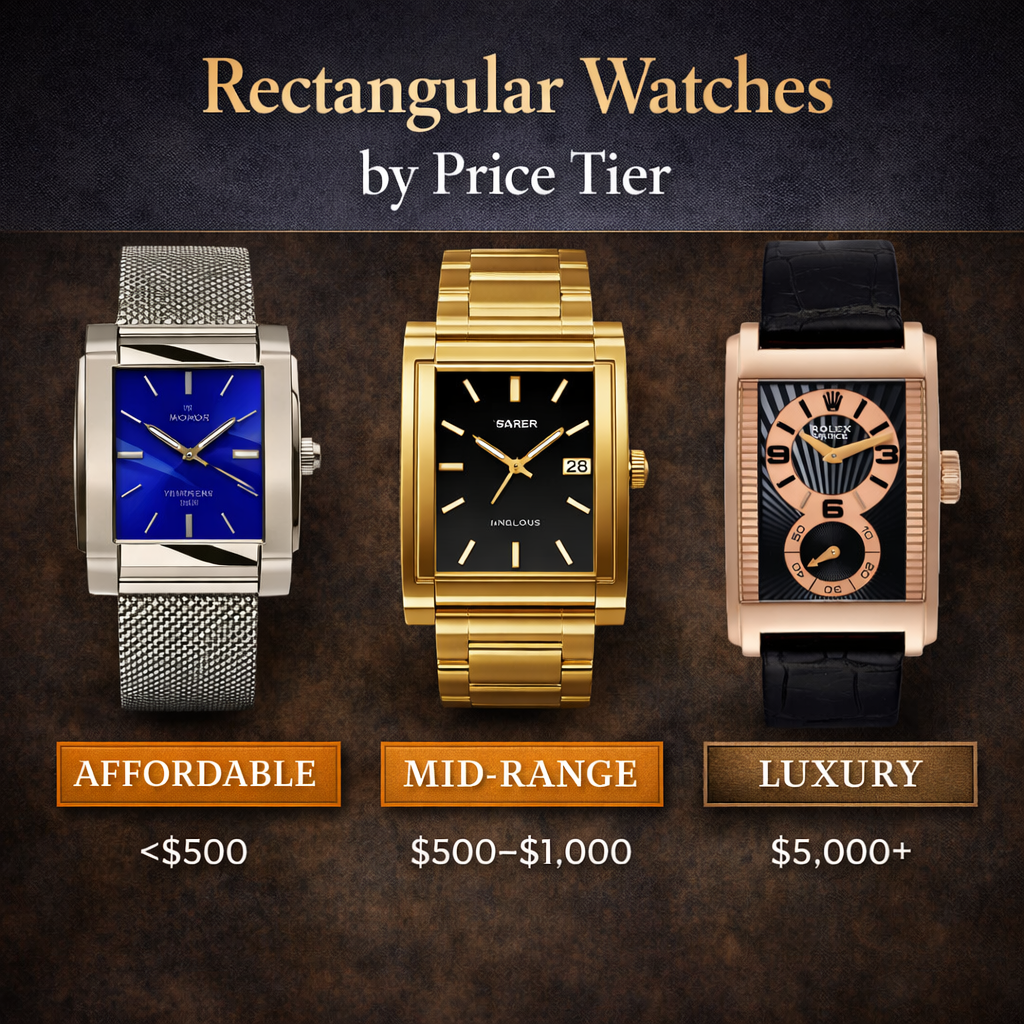
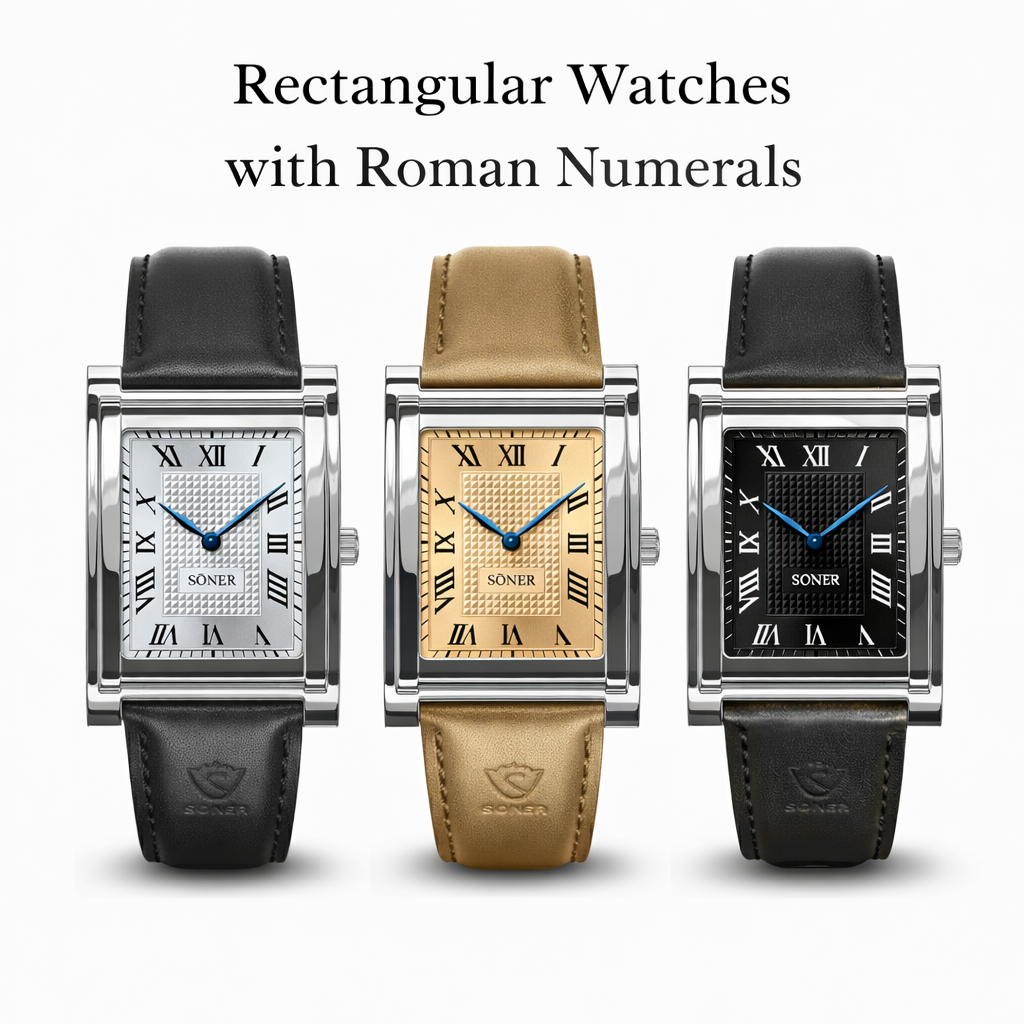
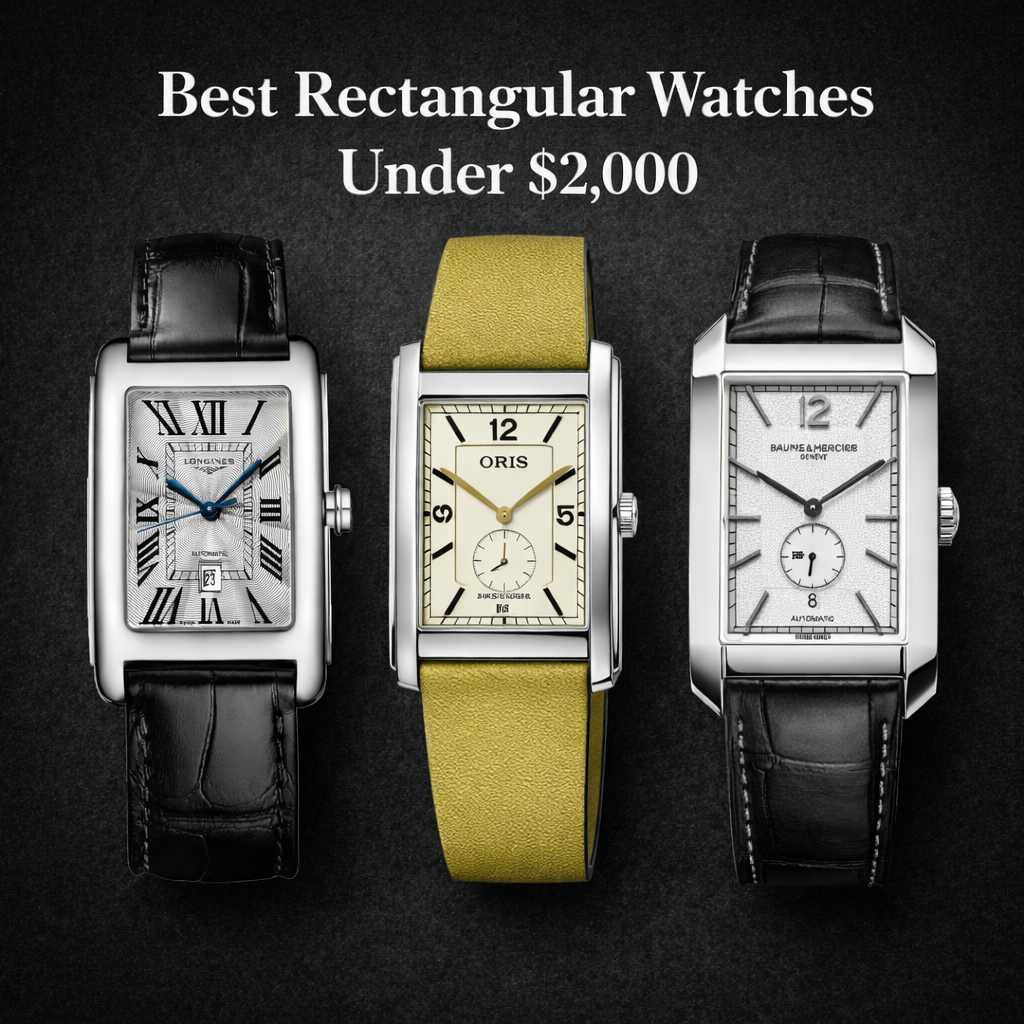
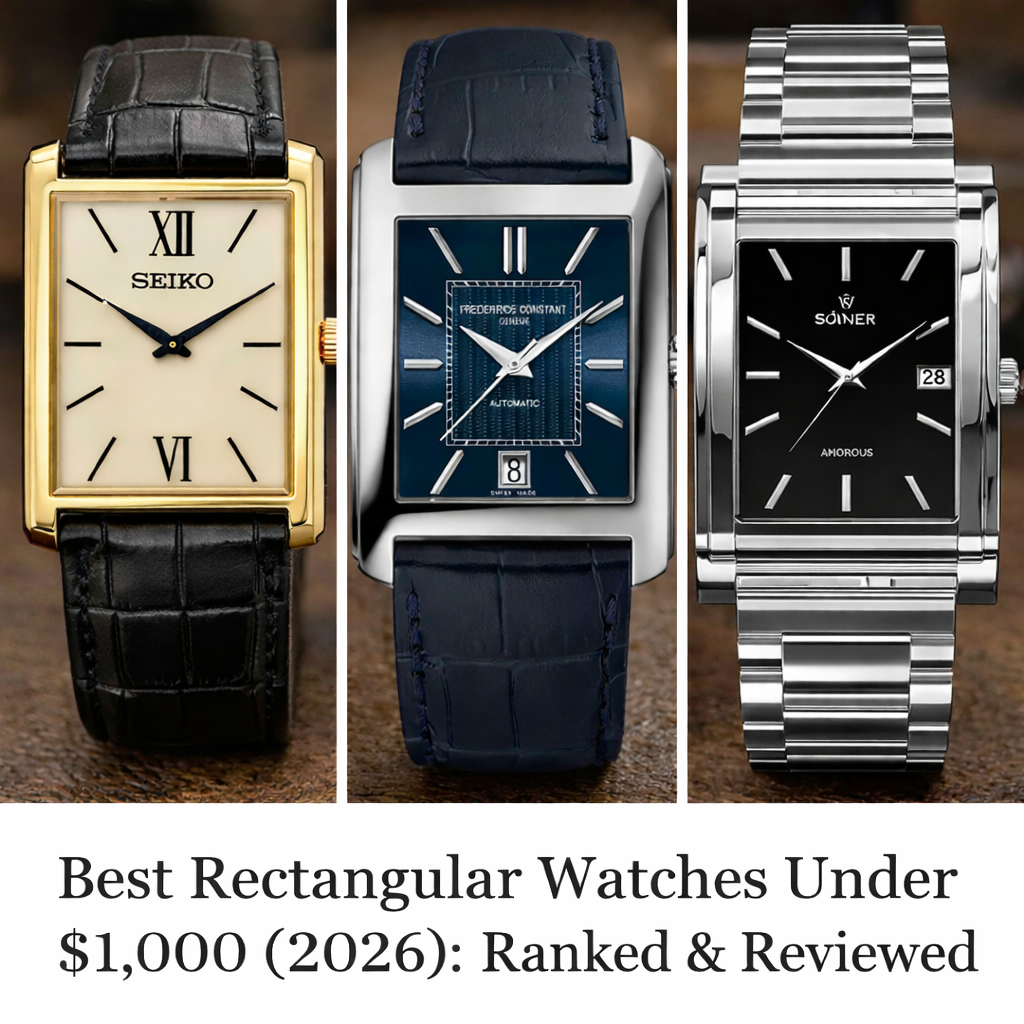
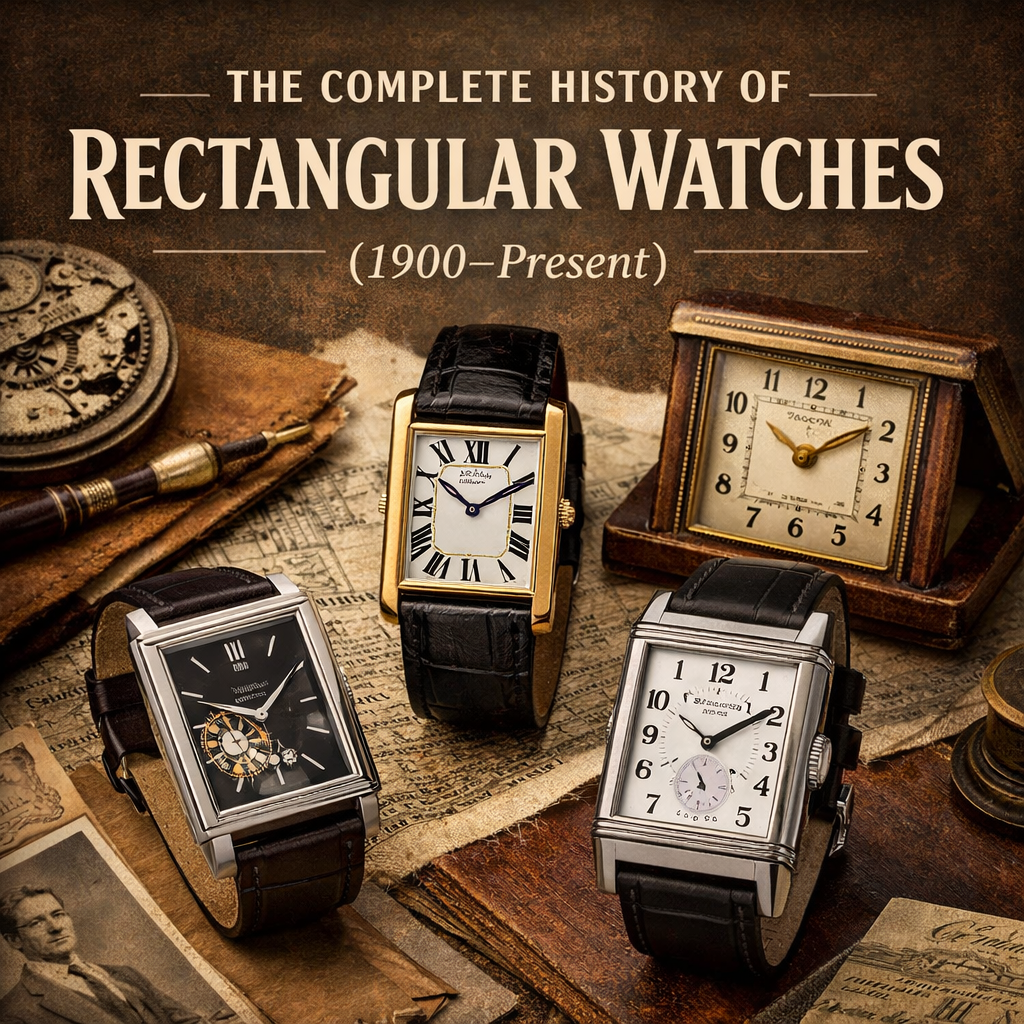
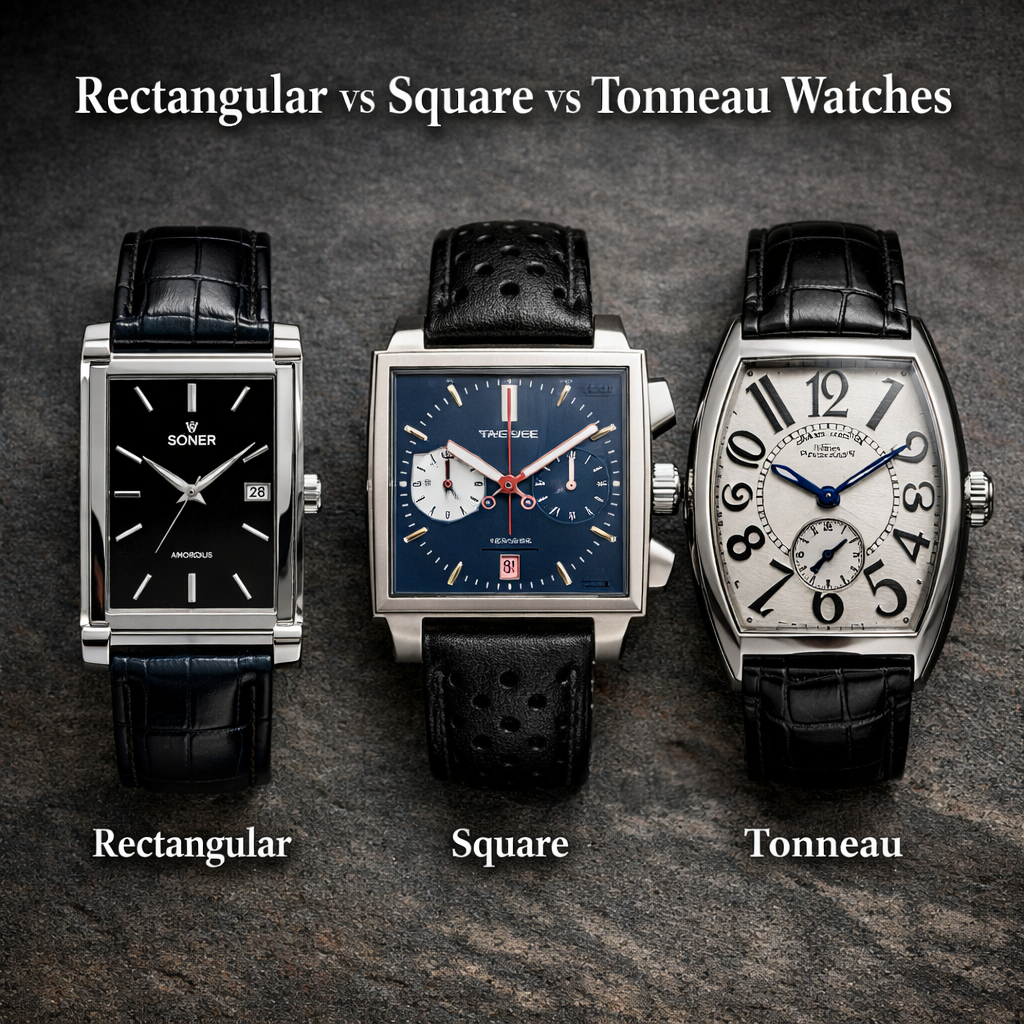
- Rectangular: Four-sided elongated case with right angles. The classic dress watch form. For the full history and best options, see our guide to rectangular watches.
- Square: Equal-sided case with right angles. Compact wrist presence.
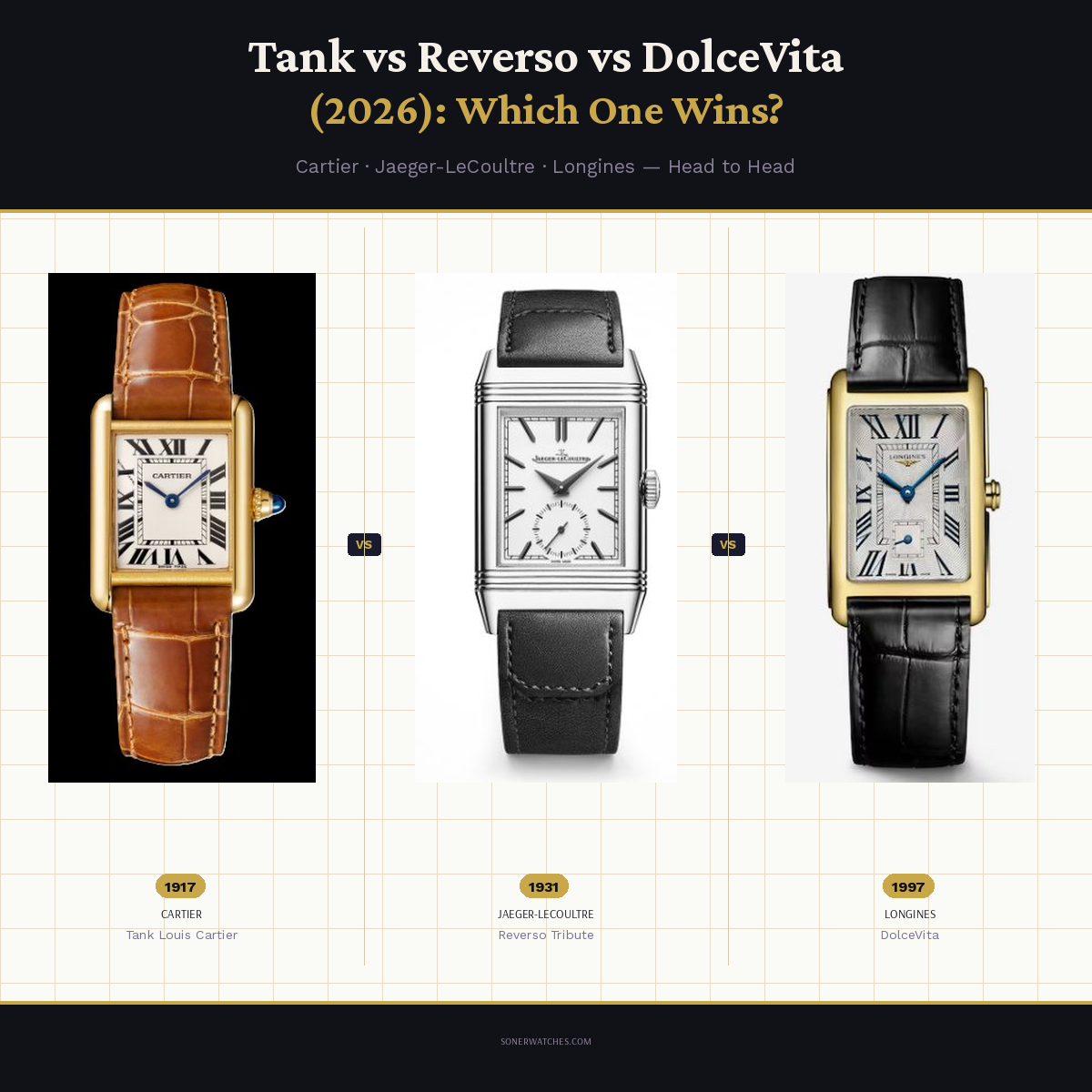
- Tank: Rectangular case with parallel brancards inspired by Art Deco geometry. Originated with Cartier in 1917.
- Tonneau: Barrel-shaped case with curved flanks and short lugs.
- Cushion: Rounded-square case with soft corners and broad bezel.
- Oval: Elliptical case with smooth, elongated symmetry.
- Octagonal: Eight-sided case often paired with an integrated bracelet.
- Dodecagonal: Twelve-sided case used for technical or tool-watch aesthetics.
- TV-screen: Wide rectangular case with softened corners evoking vintage televisions.
- Lozenge: Diamond-shaped case rotated on its point for a driver's look.
- Coin-edge case: Fluted case band resembling a coin rim for added grip.
- Pilot case: Large, simple case with oversize crown for gloved use.
- Compressor case: Case that seals tighter as external pressure increases.
- Super-compressor: Dual-crown compressor case with internal rotating bezel.
- Monocoque: One-piece case loaded from the front for rigidity and sealing.
- Bullhead: Crown and pushers at the top of the case for motorsport timing.
- Driver's watch: Case angled or rotated for easy reading while driving.
- Officer's watch: Vintage military style with hinged or snap caseback.
- Trench watch: Early wristwatch with wire lugs and robust guards from the WWI era.
- Doctor's watch: Rectangular watch optimised for pulsometer readings.
- Dress watch: Slim, refined watch meant to disappear under a shirt cuff.
- Field watch: Simple, legible, durable watch for outdoor duty.
- Diver: Water-resistant watch with timing bezel and strong lume.
- Flieger Type A: Pilot dial with simple triangle at 12 and minutes track.
- Flieger Type B: Pilot dial with outer minutes and inner hours scale.
- Racing chronograph: High-contrast stopwatch watch for motorsport timing.
- Yacht timer: Regatta countdown watch with coloured segments or discs.
- Marine: Nautical chronometer-inspired design with railroad tracks and Roman numerals.
- Skeleton: Case and dial opened to reveal the movement architecture.
- Openworked: Bridges and plates pared back to showcase mechanics.
- Reversible case: Case that flips to protect the crystal or display another face. The Jaeger-LeCoultre Reverso is the defining example.
Case Components and Exterior Parts
- Mid-case: Central body holding movement, bezel, and caseback together.
- Bezel: Ring surrounding the crystal. Can be decorative or functional.
- Bezel insert: Material ring seated in a bezel bearing scales or colour.
- Crystal: Transparent cover over the dial protecting against dust and impacts.
- Caseback: Rear cover sealing the movement side of the case.
- Display back / Exhibition back: Caseback with a window to view the movement.
- Snap-back: Caseback pressed into place with friction fit.
- Screw-back: Caseback threaded for better water resistance and serviceability.
- Gasket: Elastic seal preventing moisture and dust ingress.
- Crown: Knob used to wind, set, and adjust functions.
- Tube: Threaded sleeve the crown screws onto, housing its gasket.
- Crown guards: Projections protecting the crown from impacts.
- Pusher: Button that actuates chronograph or other functions.
- Corrector: Recessed pusher for quick setting of date or calendar.
- Helium escape valve: Pressure-relief device for saturation diving.
- End links: Metal end pieces connecting bracelet to lugs.
- Solid end links (SEL): Rigid, machined end links for tighter fit.
- Spring bars: Spring-loaded bars that secure strap or bracelet to lugs.
- Screw bars: Solid bars with screws for heavy-duty attachment.
- Drilled lugs: Lug holes that allow tool access from the outside.
- Hooded lugs: Lugs partially covered by case metal for a tidy look.
- Wire lugs: Early fixed-wire attachments for straps, common on WWI-era watches.
- Integrated lugs: Lugs blended into case and bracelet with proprietary fit.
- Shroud: Protective outer shell around the case for impact resistance.
Dimensions and Fit
- Case diameter / Width: Side-to-side size excluding the crown.
- Length / Lug-to-lug: End-to-end span across the lugs affecting overhang.
- Lug width / Interhorn: Gap between lugs that determines strap size.
- Thickness / Case height: Crystal-to-back depth influencing cuff fit.
- Curvature / Camber: Case or crystal arch that hugs the wrist.
- Overhang: Lugs extending beyond wrist edges causing poor fit.
- Endlink drop: Bracelet's first link articulation that shortens effective span.
- Taper: Strap or bracelet narrowing toward the clasp for comfort.
- Clasp span: Closed-clasp length that affects centred fit.
- Effective length: Real wearable length once curvature is considered.
- Weight / Centre of gravity: Mass and balance that affect comfort and roll on the wrist.
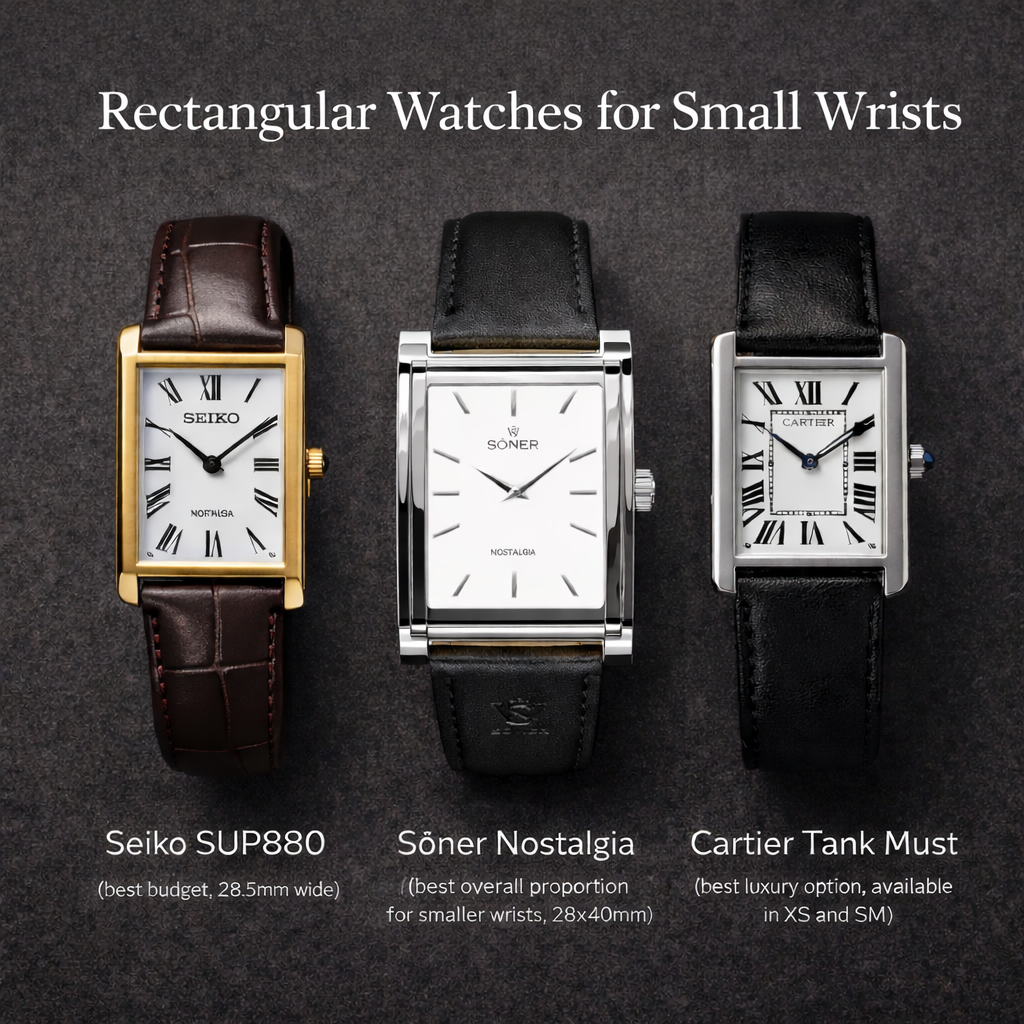
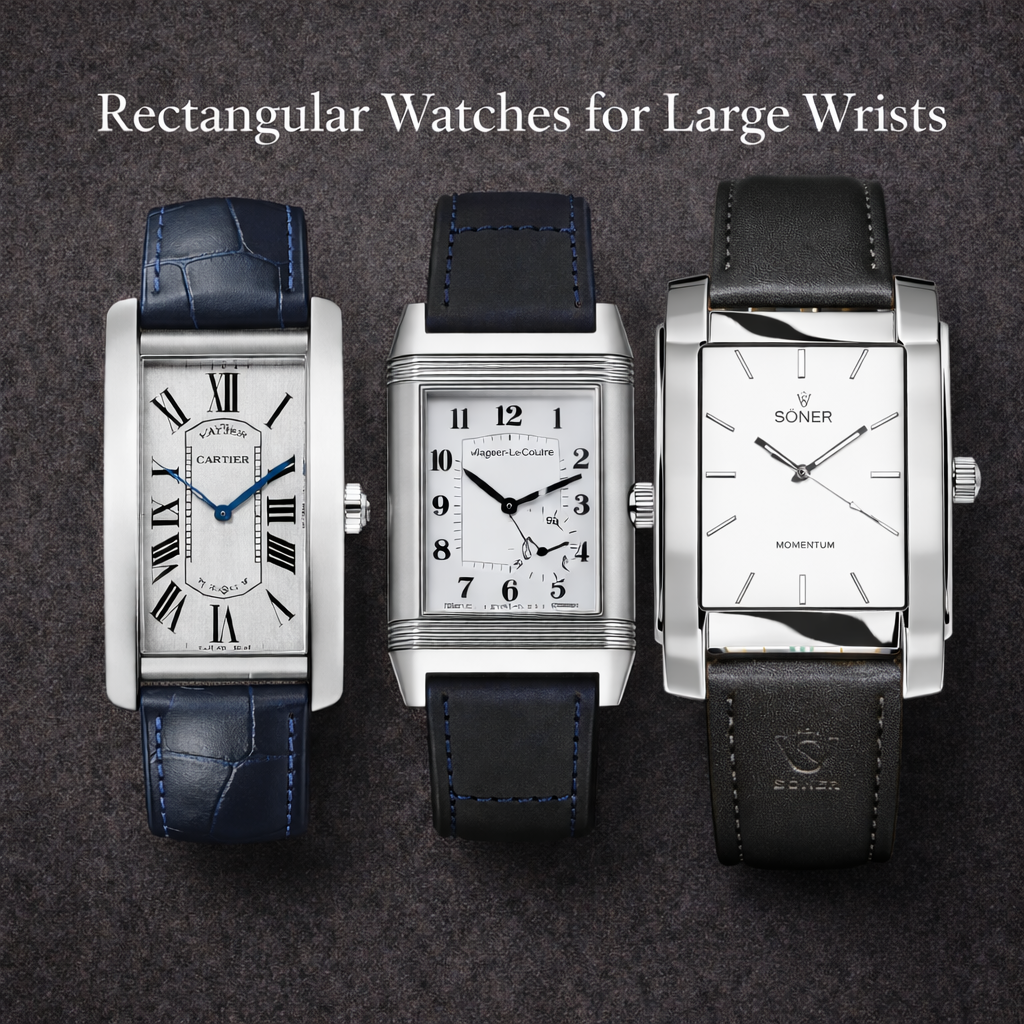
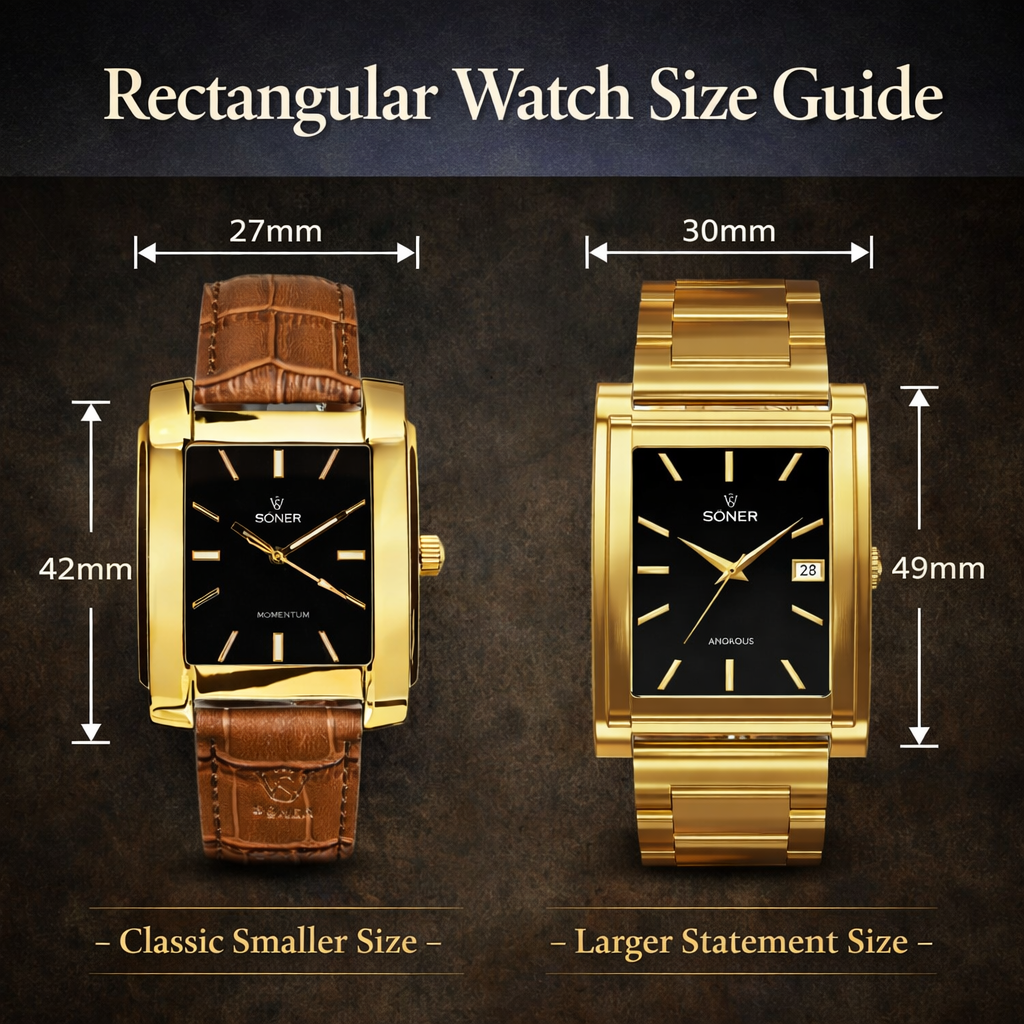
For a detailed guide to how these measurements affect rectangular watch fit specifically, see our rectangular watch size guide.
Dials and Textures
- Dial: Face of the watch carrying markers, scales, and apertures.
- Rehaut / Flange: Inner wall between dial and crystal, often bearing scales.
- Chapter ring: Ring with minute or seconds markings around the dial.
- Chemin de fer: Railroad-style minute track with parallel lines and ticks.
- Sector dial: Dial divided into concentric or radial zones for clarity.
- California dial: Mixed Roman numerals at top and Arabic numerals at bottom.
- Pie-pan: Dial sloping down at the edge like an inverted plate.
- Sandwich dial: Two-layer dial with cutouts revealing lume beneath.
- Fumé / Dégradé: Gradient dial darkening toward the edges.
- Sunburst / Sunray: Radial brushed texture that catches light in spokes.
- Brushed / Matte / Glossy: Surface finishes controlling reflection and contrast.
- Lacquer: Polished, layered paint finish with depth and sheen.
- Enamel / Grand feu: Fired glass surface with luminous, durable colour.
- Champlevé / Cloisonné: Enamel techniques using recessed cells or wire partitions.
- Porcelain: Fired ceramic dial with milky white gloss.
- Opaline: Silky, low-gloss finish with fine grain.
- Guilloché / Engine-turning: Mechanical engraving in repeating geometric patterns.
- Clous de Paris / Hobnail: Small pyramid guilloché pattern.
- Barleycorn: Elongated, grain-like guilloché motif.
- Tapisserie: Repeating squares pattern associated with luxury sports watches.
- Linen: Fine cross-hatch texture resembling woven fabric.
- Frosted / Sandblasted / Grained: Micro-textured finishes that diffuse light.
- Meteorite / Aventurine / MOP / Stone: Natural materials used as dial surfaces for visual drama.
- Skeletonized dial: Cut-out face exposing parts of the movement.
- Aperture: Window showing date, day, or other indications.
- Open-heart: Window that exposes the balance wheel area on the dial side.
- Big date / Panorama date: Oversized date display using two discs.
Hour Markers and Scales
- Applied markers: Separate metal markers affixed to the dial surface.
- Printed markers: Flat inked indices directly on the dial.
- Arabic numerals: 1-12 numerals for high legibility.
- Roman numerals: Classic I-XII layout for dressy style.
- Breguet numerals: Curly, calligraphic Arabic numerals.
- Baton / Stick / Dagger: Simple linear markers of varying sharpness.
- Diamond markers: Gem-set indices for sparkle.
- Railway minute track: Precise track aiding minute reading.
- Pulsometer: Scale to measure heart rate over a set beat count.
- Tachymeter: Scale converting elapsed time to speed over a known distance.
- Telemeter: Scale reading distance from the time delay of sound.
- Decimal scale: Scale dividing minutes into decimal fractions.
- Yacht countdown scale: Coloured segments for 5-minute regatta starts.
- Slide-rule / Logarithmic scale: Circular calculator for aviation mathematics.
- Regatta discs: Rotating windows showing pre-race countdown.
Hands
- Hour / Minute / Seconds hand: Primary time-telling pointers.
- Small seconds / Sub-seconds: Seconds shown on a subdial.
- Running seconds: Continuous seconds indication confirming movement health.
- Dauphine / Alpha / Feuille: Faceted or leaf-shaped dress hands.
- Sword / Baton / Stick / Pencil: Straight, utilitarian hand styles.
- Syringe: Tapered hand with a needle-like tip.
- Cathedral: Segmented, stained-glass-style hands for vintage pilot watches.
- Breguet hands: Hollow pomme tips with elegant curves.
- Lance / Arrow: Pointed, aggressive shapes for sport models.
- Lollipop: Seconds hand with a round luminous dot at its tip.
- Spade: Broad club-like tip for classic designs.
- Snowflake: Angular, blocky hands with large lume surface area.
- Mercedes: Three-spoke hour hand favoured on dive watches.
- Skeletonized hands: Cut-out hands to reduce mass and show dial below.
- Heat-blued / Thermally blued: Steel hands heated to a stable blue oxide for contrast.
- Foudroyante hand: Hand indicating fractions of a second on a subdial.
Lume and Night Visibility
- Luminescent compound: Material that glows after light exposure.
- Lume plots: Luminous areas on markers or hands.
- Lume pip: Dot of lume at bezel zero for timing in the dark.
- Full-lume dial: Entire dial coated for maximum night visibility.
- Sandwich lume: Lume applied on a lower layer shining through cutouts.
- Super-LumiNova / X1: Modern non-radioactive lume grades with high output.
- Tritium / T25 / T100: Radioactive gas tubes or paint providing constant glow without charging.
- GTLS / Tritium tubes: Sealed glass tubes with tritium for long-term glow.
- Radium (historic): Early radioactive lume now discontinued for safety.
- Patina / Fauxtina: Aged or intentionally vintage-coloured lume.
- Afterglow / Charge time: Duration and speed of lume brightness after light exposure.
Crystals and Glass
- Sapphire crystal: Hard, scratch-resistant synthetic corundum. Industry standard above the entry level.
- Boxed / High-domed / Double-domed sapphire: Shaped sapphires reducing distortion and glare.
- Mineral crystal: Tempered glass with moderate scratch resistance.
- Hardened mineral: Chemically strengthened mineral glass.
- Acrylic / Plexiglass / Hesalite: Soft, warm-looking plastic crystal that polishes easily. Used on vintage references and some modern reissues.
- Anti-reflective coating (AR): Thin film reducing reflections. Applied to inner or both surfaces.
- Beveled / Stepped crystal: Edged or tiered crystal for vintage character.
Bezels
- Fixed bezel: Stationary ring for protection or design.
- Rotating bezel: Turnable ring used for timing or navigation.
- Unidirectional: One-way rotation to prevent accidental over-timing underwater.
- Bidirectional: Free or ratcheted rotation in both directions.
- Internal bezel: Scale under the crystal adjusted by a crown.
- Friction bezel: Smooth, click-less rotation by friction.
- Ratcheting bezel: Indexed clicks for precise setting.
- Timing / GMT / 24-hour / Compass / Countdown: Common functional bezel scales.
- Regatta bezel: Coloured countdown segments for race starts.
- Slide-rule bezel: Circular calculator for conversions, favoured on pilot watches.
- Fluted / Coin-edge / Smooth: Common decorative or grip patterns.
- Ceramic / Sapphire / Aluminium / Steel / Bakelite insert: Insert materials and their relative durability.
- Ghost bezel: Naturally faded insert prized by collectors for its aged character.
Crowns, Pushers and Correctors
- Push-pull crown: Simple stem seal for daily use.
- Screw-down crown: Threaded crown significantly increasing water resistance.
- Onion / Conical / Recessed / Signed crown: Crown shapes or branding details.
- Crown tube: Fixed sleeve the crown engages with.
- Mono-pusher: Single button operating all chronograph functions.
- Pump / Mushroom pushers: Vintage-style chronograph buttons.
- Screw-down pushers: Threaded buttons to prevent accidental activation.
- Corrector pusher: Tiny case button for date or calendar quickset.
Straps, Bracelets and End-Links
- Two-piece / One-piece strap: Standard separate halves or single pass-through.
- NATO / Zulu / RAF: Nylon pass-through straps with varying hardware.
- Bund / Cuff: Leather pad under the case for comfort and style.
- Curved-end / Straight-end: Strap end shaped to match or sit flat against the case.
- Quick-release: Built-in spring bar tabs for tool-less strap swaps.
- Leather types: Calf, full-grain, nubuck, suede, shell cordovan, exotic hides.
- Fabric types: Canvas, perlon, sailcloth.
- Rubber types: FKM, silicone, fluoroelastomer.
- Tropic / Waffle / Isofrane: Classic perforated or ribbed rubber patterns.
- Mesh / Milanese / Shark mesh: Interlinked metal strands forming a draping bracelet.
- Beads-of-rice / Jubilee / Oyster / President / H-link / Engineer / Ladder / Bonklip: Named bracelet architectures.
- Riveted / Folded / Solid link: Bracelet construction methods by quality level.
- Half-links / Micro-adjust: Fine sizing via smaller links or clasp holes.
- Diver's extension / On-the-fly adjust: Extra clasp length for use over a wetsuit.
For a practical guide to choosing between leather and metal, see our leather vs metal watch band guide.
Buckles and Clasps
- Tang / Ardillon / Pin / Prong: Simple pin-through-hole closures.
- Deployant / Single-fold / Double-fold / Butterfly: Hinged metal closures that protect strap holes from wear.
- Friction / Push-button / Safety / Flip-lock / Hidden: Retention and security styles.
- Ratcheting clasp / Glide-style adjustment: Tool-less micro-sizing within the clasp itself.
- Jewelry clasp / Seat-belt clasp: Slim or snap-style closures.
Movement Types and Power Sources
- Mechanical: Spring-powered movement regulated by an escapement.
- Manual-wind / Hand-wind: Wound by turning the crown. No rotor.
- Automatic / Self-winding: Rotor winds the mainspring with wrist motion.
- Bidirectional / Unidirectional winding: Rotor winds in both directions or one.
- Micro-rotor / Peripheral rotor: Compact or rim-mounted rotors for thinner movements.
- Bumper automatic: Early rotor design that rebounds off springs.
- Quartz: Battery-powered movement regulated by a quartz crystal oscillator.
- Thermo-compensated quartz / HAQ: Temperature correction for higher accuracy.
- Solar quartz: Light-charged accumulator powering quartz movement.
- Kinetic: Rotor charges a capacitor for quartz regulation.
- Mechaquartz: Quartz base with mechanical chronograph module.
- Tuning-fork: Electromechanical movement vibrating a metal fork.
- Spring-Drive-type hybrid: Mechanical energy with electronic regulation.
- Radio-controlled / GPS-synchronized: Time set by broadcast or satellite signals.
- Smart-hybrid: Analog hands with sensors and phone connectivity.
Movement Architecture and Key Parts
- Mainplate / Bridges / Cock: Structural plates holding the gear train and organs.
- Barrel / Mainspring / Arbor: Power storage drum, coiled spring, and central axle.
- Ratchet wheel / Crown wheel / Click: Winding gear train and pawl preventing unwinding.
- Center / Third / Fourth / Escape wheel: Wheels transmitting power to the escapement.
- Cannon pinion / Minute wheel / Hour wheel: Motion works driving the hands.
- Keyless works: Setting and winding mechanism linked to the crown.
- Hacking lever / Stop-seconds: Device that halts the seconds hand for precise setting.
- Pallet fork / Impulse jewel: Escapement parts transferring impulses to the balance.
- Jewels / Cap jewel: Synthetic rubies reducing friction and wear at pivot points.
- Shock spring: Spring device protecting balance pivots from impacts.
- Balance wheel / Staff: Oscillator rim and axle.
- Hairspring / Overcoil / Flat: Balance spring types controlling oscillation.
Escapements and Regulation
- Swiss lever escapement: Industry-standard escapement used in the vast majority of mechanical watches.
- Co-axial escapement: Reduced-friction escapement using radial impulses. Associated with Omega.
- Detent / Chronometer detent: High-precision escapement with minimal interference, used in marine chronometers.
- Duplex / Cylinder / Pin-pallet: Historic escapements no longer in mainstream production.
- Deadbeat seconds mechanism: Seconds hand jumps in one-second steps rather than sweeping.
- Remontoir d'égalité: Secondary spring delivering constant torque to the escapement.
- Fusée-and-chain: Cone and chain equalizing mainspring torque across the power reserve.
- Free-sprung / Variable-inertia balance: Rate adjusted by mass on the balance wheel.
- Regulator index / Swan-neck: Fine adjustment of effective hairspring length.
- Beat error / Amplitude / Frequency / VPH / BPH: Core timing parameters read on a timegrapher.
Complications: Timekeeping and Displays
- Small / Central / Deadbeat seconds: Variants of seconds display.
- Power-reserve indicator: Readout of remaining running time.
- Retrograde: Hand that travels across a scale then snaps back to zero.
- Jumping hours: Digital hour display that flips at the top of each hour.
- Wandering hours: Hours indicated by rotating satellites on the dial.
- Regulator display: Separated hour, minute, and seconds on individual axes.
- 24-hour display: Full day shown on one rotation.
- Dual time / GMT / Multi-time-zone: Additional time zone indications.
- World time / City ring: Global time with city names on a 24-hour ring.
- Day-night indicator: AM/PM visualization.
- Alarm: On-wrist acoustic alert mechanism.
Complications: Calendar and Astronomical
- Date / Quickset / Semi-quickset: Basic calendar with direct or partial fast-set.
- Pointer date: Hand indicates date around the dial perimeter.
- Big date / Panorama date: Oversized date using two discs.
- Day-date: Displays both day of week and date.
- Triple / Complete calendar: Day, date, and month with moonphase.
- Annual calendar: Corrects automatically for 30 and 31-day months. Needs one correction per year.
- Perpetual calendar: Accounts for all month lengths including leap years. Self-correcting.
- Leap-year indicator: Shows the current year in the 4-year cycle.
- Moonphase: Graphic display of the lunar cycle.
- Equation of time: Difference between apparent solar time and mean time.
- Sunrise / Sunset / Tide / Zodiac: Further astronomical indications found in grand complications.
Complications: Chronograph and Timing
- Chronograph: On-demand stopwatch with start, stop, and reset functions.
- Monopusher / Two-register / Three-register: Button count or sub-register layouts.
- Flyback: Resets and restarts with a single press rather than three separate actions.
- Rattrapante / Split-seconds: Second hand to record intermediate lap times.
- Foudroyante: Fraction-of-a-second indicator on a subdial.
- Column wheel / Cam-actuated: Mechanisms that control the feel and precision of chronograph operation.
- Horizontal / Vertical clutch: Engagement systems affecting hand jump at start.
- Tachymeter / Telemeter / Pulsometer / Decimal: Timing scales on the bezel or dial.
Complications: Chiming and Acoustic
- Minute / Quarter / Five-minute / Decimal repeater: On-demand chiming of elapsed time intervals.
- Grande / Petite sonnerie: Automatic striking of hours and quarters.
- Carillon: Repeater with three or more gongs for a chord effect.
- Cathedral gongs: Extra-long gongs for greater resonance and volume.
- Governor: Regulator that controls striking speed.
- Silence slider: Selector to disable or enable striking on demand.
Finishing and Decoration
- Côtes de Genève / Stripes: Parallel wave graining on movement plates and bridges.
- Perlage / Circular graining / Snailing: Swirled or spiral textures on hidden surfaces.
- Straight graining / Satin brushing: Linear texture reducing glare on case flanks.
- Frosting: Matte finish by bead-blasting or acid treatment.
- Black polishing / Specular: Mirror finish appearing black when viewed at certain angles.
- Anglage / Beveling: Chamfering and polishing of bridge and plate edges by hand.
- Heat-blued screws: Thermally coloured screws adding decoration to movements.
- Gilding / Rhodium / NAC / Anthracite: Plated or chemically treated movement colours.
- Skeletonization / Hand-engraving: Material removal or ornamental carving.
Materials and Alloys
- 316L / 904L steel: Corrosion-resistant stainless steels. 904L is used by Rolex for enhanced polish.
- Hardened steel: Surface-treated steel with increased scratch resistance.
- Titanium Grade 2/5: Lightweight pure or alloyed titanium, approximately 40% lighter than steel.
- Bronze / Brass / Copper: Warm-toned metals that develop a patina over time.
- Tantalum / Tungsten: Dense, hard exotic metals used for distinctive weight and colour.
- Ceramic / Zirconium: Scratch-proof, lightweight case materials.
- Forged carbon / Carbon fiber: Composite materials prized for lightness and pattern.
- Gold (yellow/rose/red/pink/white/green): Precious metal alloys in various compositions.
- Platinum / Palladium / Rhodium: Noble metals at the top of the materials hierarchy.
- Vermeil / Gold-filled / Gold-plated: Layered gold techniques of varying thickness and durability.
- PVD / DLC / ADLC: Thin, hard physical or chemical vapour deposition coatings for colour and wear resistance.
- Damascus / Mokume-gane: Patterned metal laminations used for visual drama.
- Meteorite / MOP / Aventurine / Stone: Natural materials used as dial surfaces.
Water Resistance and Diving
- WR rating / Metres / Feet / ATM / Bar: Depth ratings expressed in different units.
- ISO 22810 / ISO 6425: General water-resistance and diver's watch standards.
- Screw-down crown / Pushers / Caseback gasket / Crown gasket: Key sealing components.
- Pressure / Vacuum / Condensation tests: Methods used to verify sealing integrity.
- Helium ingress / Saturation diving / HEV: Gas management considerations for professional deep diving.
- Diver's extension / Unidirectional bezel / Lume pip: Practical features required by the ISO 6425 diver standard.
Anti-Magnetism and Shock
- Anti-magnetic / ISO 764: Resistance to magnetic fields of a defined strength.
- Soft-iron / Faraday cage: Inner shell that redirects magnetic flux away from the movement.
- Silicon / Paramagnetic hairspring: Springs immune to magnetism, used in modern movements.
- Gauss rating: Field strength a movement can withstand without rate deviation.
- Shock protection: Systems protecting balance pivots from impact damage.
- Drop test / ISO 1413: Impact-resistance standards.
Accuracy, Rates and Timing
- Rate / Daily rate / Average rate: Gain or loss in seconds per day.
- Positional variance: Rate change across different wearing positions.
- Isochronism: Consistency of rate across the power reserve.
- Amplitude: Balance wheel swing measured in degrees.
- Beat error: Asymmetry between tick and tock indicating misalignment.
- Timing machine / Timegrapher: Instrument measuring rate, amplitude, and beat error simultaneously.
- Hi-beat / 18k / 21.6k / 28.8k / 36k: Common beat frequencies in vibrations per hour.
- Regulation / Fine adjustment: Tuning the movement to meet a target accuracy.
Certification and Seals
- Chronometer / COSC: Swiss Official Chronometer Testing Institute certification for daily accuracy within -4/+6 seconds.
- METAS Master Chronometer: Tests accuracy, magnetism resistance, and waterproofing to a higher standard than COSC.
- Qualité Fleurier: Independent quality and finishing standard.
- Poinçon de Genève (Geneva Seal): Hallmark of finishing quality and Genevan origin.
- Superlative Chronometer: Rolex's own enhanced accuracy standard, tested in-house.
- DIN 8330: German pilot watch performance standard.
Collecting, Condition and Provenance
- Reference / Model / Serial number: Identifiers used to track specific watches.
- NOS: New old stock - unworn vintage inventory never sold to a consumer.
- Full set / Box and papers / Open papers: Completeness levels affecting value.
- Provenance / Extract from archives: Documented origin and ownership history.
- Patina / Tropical / Spider / Crazing: Natural aging effects on dials and bezels.
- Ghost bezel / Service dial: Faded inserts or factory-replaced dial parts.
- Relumed / Redial / Frankenwatch / Mod / Homage / Counterfeit / Superclone: The alteration spectrum from legitimate to fraudulent.
- Gray market / Authorized dealer / Boutique / MSRP / Street price: Sales channels and their price implications.
- Grail / Beater / Strap monster / Safe queen / Barn find: Collector slang for relationship with a watch.
- Authentication / Appraisal / Insurance / Import duty / VAT / Customs: Trust, protection, and tax considerations.
Sales, Distribution and Buying
- Authorized dealer (AD): Brand-approved retailer with factory warranty and official pricing.
- Boutique: Store owned or operated by the brand itself.
- Grey market: New watches sold outside authorized channels, often below retail.
- Allocation: Controlled distribution of in-demand models to manage supply.
- Waitlist: Queue for limited or high-demand pieces at authorized dealers.
- MSRP / List price: Manufacturer's suggested retail price before discounts or premiums.
- Secondary market: Used or unworn watches traded between individuals or dealers.
- Box and papers (B&P): Original packaging and documentation. Significantly affects resale value.
- Grey premium / Over retail: Prices above MSRP caused by scarcity and demand.
- Trade-in: Exchange of an existing watch toward another purchase.
- Consignment: Dealer sells on your behalf, taking a commission.
- Flipping: Rapid resale for profit, often of allocated or scarce references.
Forum Slang and Culture
- WRUW: "What are you wearing?" - standard forum opening.
- SOTC: "State of the collection."
- NWA / NWD: "New watch alert / day."
- FS / FSOT / WTT: For sale, for sale or trade, want to trade.
- BNIB / LNIB: Brand new in box. Like new in box.
- Grail: The watch you ultimately want most, often just out of reach.
- Beater: An everyday watch you do not worry about scratching.
- Strap monster: A watch that looks good on many different straps.
- GADA: "Goes anywhere, does anything" - a versatile single watch.
- Panda / Reverse panda: White dial with black subdials, or the inverse.
- Ghost bezel / Tropical dial / Fauxtina: Aging and collector styling terms.
- Enabler: Someone in a forum or community who convinces you to buy.
- WIS: Watch-Interested Spouse, or Watch Idiot Savant, depending on context.
- Desk diving: Looking at watches online while at work instead of wearing them.
- Honeymoon phase: The period immediately after buying a watch when it feels perfect.
40 Iconic Watch Brands: A-Z
This section covers 40 foundational watch brands in alphabetical order. Each entry gives a short profile and its most iconic models. This is not a ranking - it is a reference.
A. Lange and Söhne
A. Lange and Söhne revives Saxon high watchmaking with sculptural movements and exceptional hand-finishing. The Lange 1's asymmetric dial and oversized date became an instant classic at its 1994 relaunch. The Datograph redefined modern chronographs. Three-quarter plates and hand-engraved balance cocks are house signatures. Design is sober, technical, and deeply crafted.
Iconic models: Lange 1, Datograph, Zeitwerk.
Audemars Piguet
Audemars Piguet fused haute watchmaking with audacious design through the Royal Oak. Its octagonal bezel and integrated bracelet, designed by Gérald Genta in 1972, reframed luxury steel watchmaking permanently. The Offshore amplified scale and attitude. AP also excels in skeletonization and high complications.
Iconic models: Royal Oak, Royal Oak Offshore, Royal Oak Concept.
Baume and Mercier
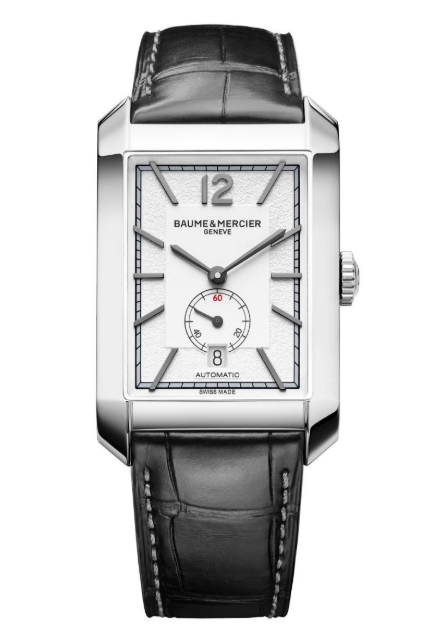
Baume and Mercier focuses on elegant, accessibly priced Swiss watchmaking. The Riviera revives a 12-sided sports case. Clifton and Classima serve classic dress needs with restrained proportions and daily comfort.
Iconic models: Riviera, Clifton Baumatic, Hampton.
Bell and Ross
Bell and Ross turns cockpit instruments into bold, square-cased watches. The BR 01 and BR 03 evoke dashboard legibility. High-contrast dials, oversized numerals, and visible screws define the aesthetic.
Iconic models: BR 01, BR 03, Vintage.
Breguet
Abraham-Louis Breguet invented or refined more watch mechanisms than any other single figure in horological history - the tourbillon, the overcoil hairspring, and the self-winding mechanism among them. Today's Breguet preserves that heritage with hand-engraved dials, guilloché, and distinctive engine-turned surfaces. Often credited with the first wristwatch commission in 1810.
Iconic models: Classique, Tradition, Marine, Reine de Naples.
Breitling
Breitling built its reputation on pilot and aviation instruments. The Navitimer's slide-rule bezel became the definitive aviator's watch in 1952. The Chronomat brought sports chronograph credentials. Modern Breitling balances heritage tool-watch identity with broader lifestyle appeal.
Iconic models: Navitimer, Chronomat, Superocean.
Bulgari
Bulgari approaches watchmaking through the lens of Italian jewelry design. The Serpenti coils around the wrist. The Octo Finissimo has pushed ultra-thin records repeatedly. The Lvcea and Divas' Dream bring Roman grandeur to the wrist.
Iconic models: Serpenti, Octo Finissimo, Lvcea.
Cartier
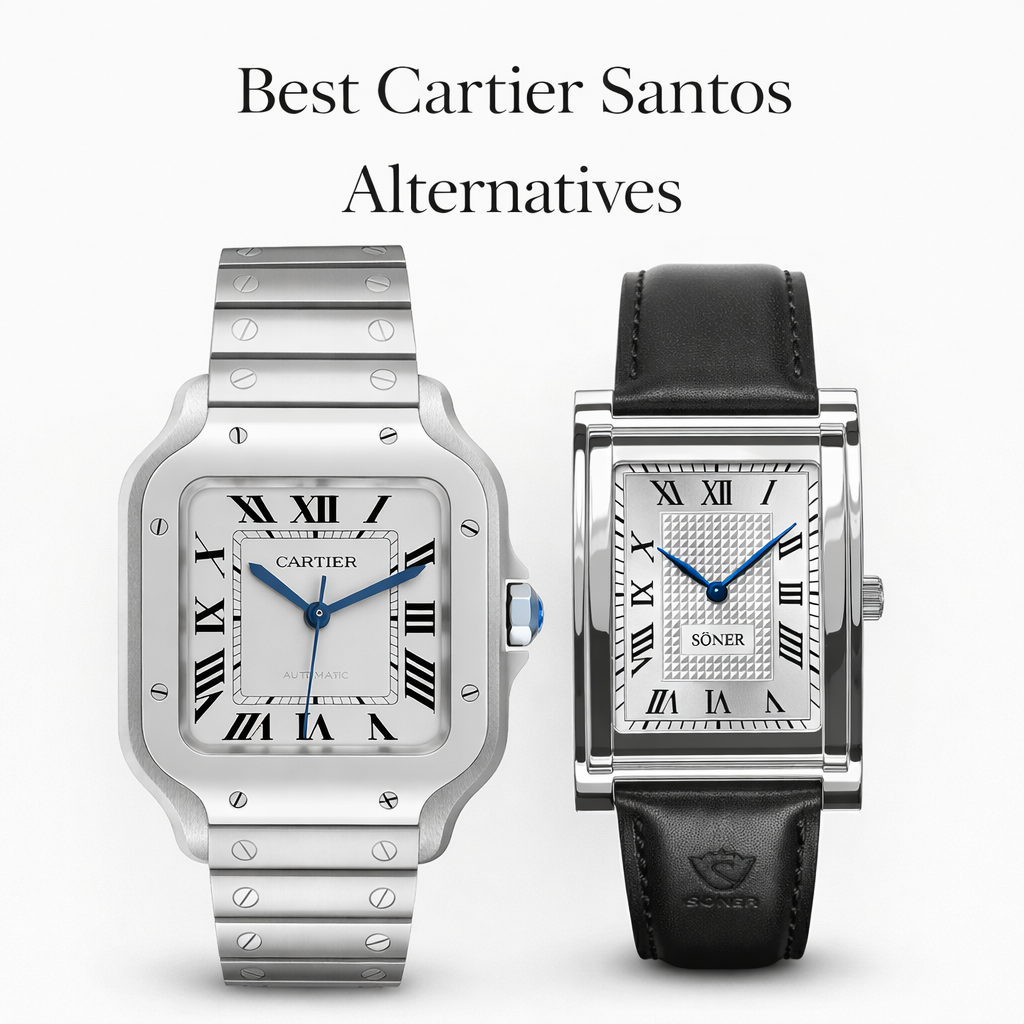
Cartier defined the shaped watch as a design category. The Santos (1904) was the first purpose-built men's wristwatch. The Tank (1917) remains the most influential rectangular watch design ever made. The Ballon Bleu and Santos de Cartier continue the house's design leadership. For the best Cartier alternatives, see our guides to Santos alternatives and Tank alternatives.
Iconic models: Tank, Santos, Ballon Bleu, Reverso collaboration (via JLC).
Casio
Casio democratised the digital watch and created some of the most durable and recognisable timepieces in the world. The G-Shock (1983) set a new standard for shock resistance. The F-91W remains one of the best-selling watches ever made at its price point.
Iconic models: G-Shock, F-91W, Edifice, Pro Trek.
Chopard
Chopard operates as a family-owned independent house across luxury watchmaking and jewelry. The Happy Sport with floating diamonds and the L.U.C manufacture movement line represent its dual identity. The Mille Miglia brings motorsport heritage.
Iconic models: Happy Sport, L.U.C XPS, Mille Miglia.
Citizen
Citizen pioneered Eco-Drive solar technology and has consistently delivered technically strong watches at accessible prices. The Navihawk and Promaster serve aviation and dive markets. The Chronomaster is their haute horlogerie offer.
Iconic models: Eco-Drive Navihawk, Promaster Diver, Chronomaster.
Frederique Constant
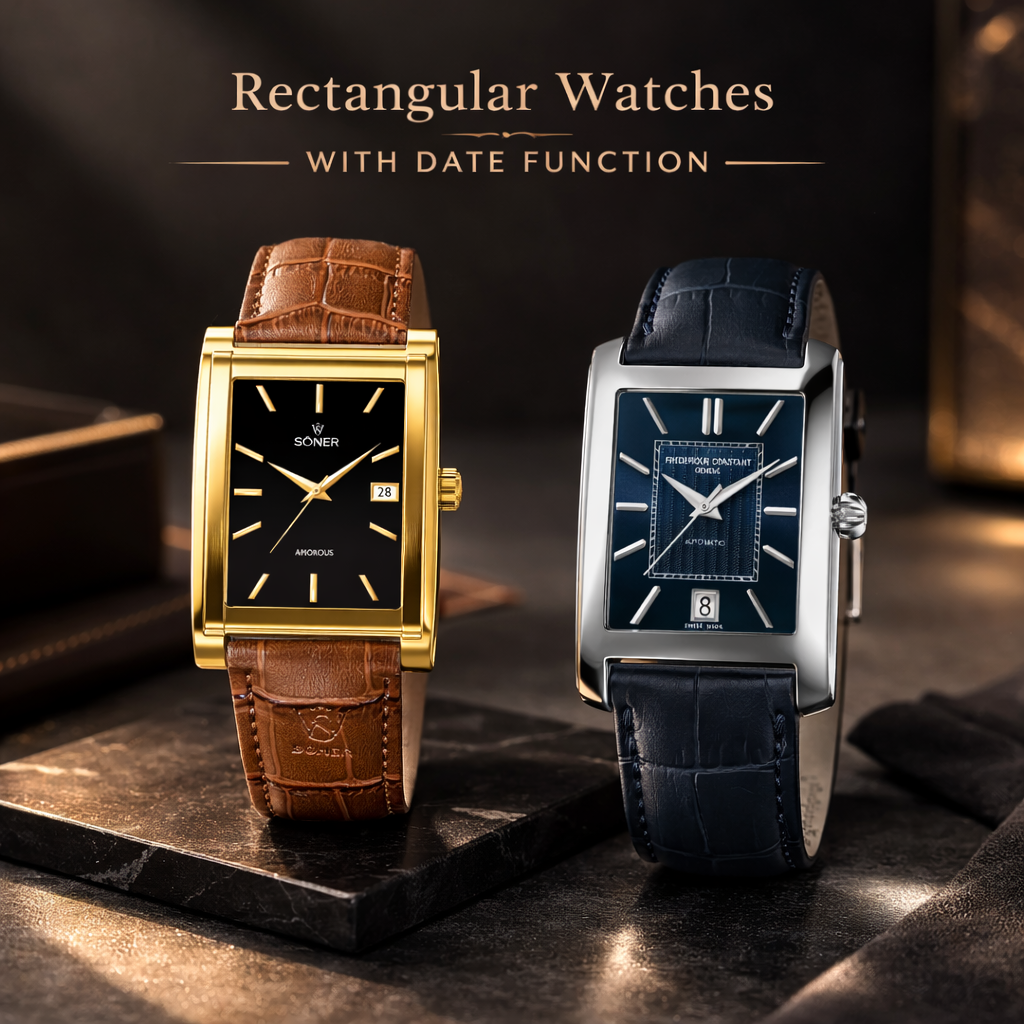
Frederique Constant makes Swiss automatic watches at mid-range prices, democratising the manufacture movement. The Classics Carree is their rectangular offering - a Swiss automatic dress watch at an accessible price point. The Slimline and Highlife serve dress and sport-luxury needs.
Iconic models: Classics Carree, Slimline Moonphase, Highlife.
Girard-Perregaux
Girard-Perregaux is one of the oldest Swiss manufactures, producing movements and cases in-house since 1791. The Three Bridges tourbillon is a movement architecture landmark. The Laureato integrated sports watch and the Vintage 1945 rectangular dress watch show the breadth of the catalogue.
Iconic models: Three Bridges Tourbillon, Laureato, Vintage 1945.
Glashütte Original
Glashütte Original represents the German watchmaking tradition of Saxony alongside A. Lange and Söhne. Panorama Date, Senator Cosmopolite, and SeaQ show the range. German finishing standards - three-quarter plates, Glashütte ribbing - distinguish the movements.
Iconic models: Senator Chronograph, Panorama Date, SeaQ.
Grand Seiko
Grand Seiko pursues accuracy and finishing to a standard that challenges Swiss haute horlogerie. The Snowflake dial from the Shinshu region is one of the most recognised watch dials in recent history. Spring Drive, mechanical, and quartz calibres all appear in the collection.
Iconic models: SBGA211 Snowflake, SLGH005 White Birch, Spring Drive GMT.
Hamilton
Hamilton bridged American railroad timekeeping and Swiss manufacturing. The Ventura (1957) was the first electric watch and an Elvis icon. The Khaki Field is the benchmark affordable field watch. The Boulton is the most accessible mechanical rectangular watch in production. For more on Hamilton's rectangular heritage, see our Hamilton rectangular watches guide.
Iconic models: Ventura, Khaki Field, Boulton, Intra-Matic.
Hermès
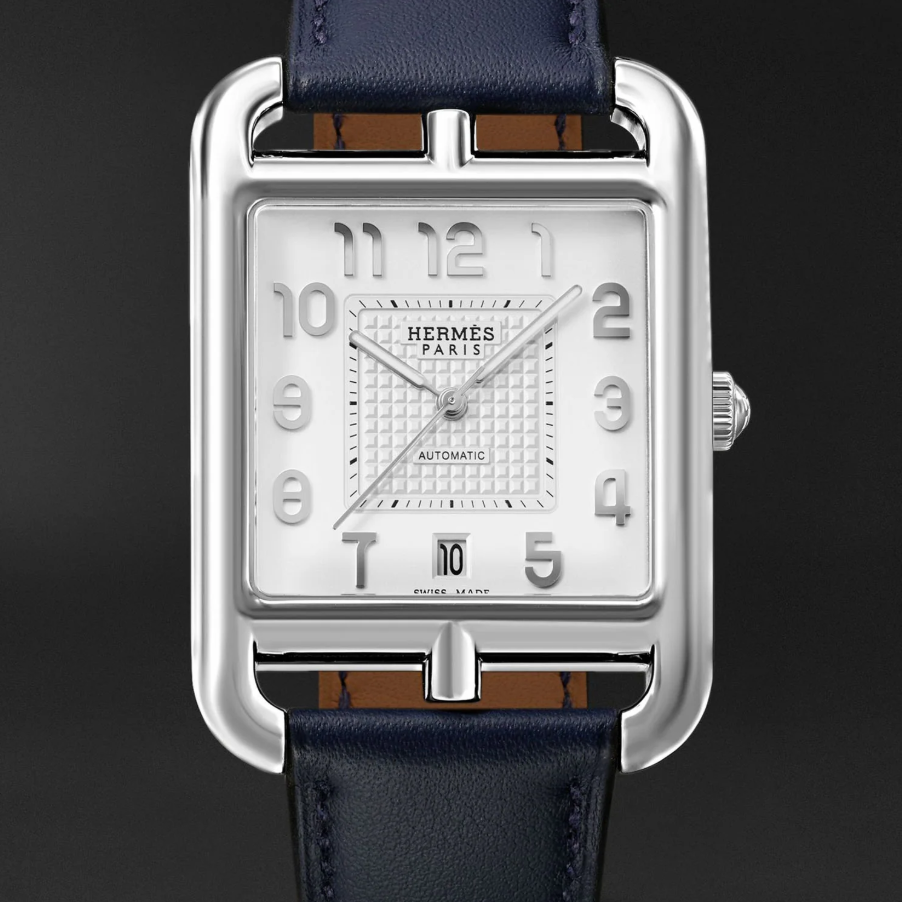
Hermès brings the craft language of its leather goods to watchmaking. The Cape Cod's curved rectangular case with triple-link lugs and Barenia leather strap is one of the most distinctive watch designs in the category. The H08 updates the house's rectangular vocabulary for contemporary wear.
Iconic models: Cape Cod, Arceau, H08.
Hublot
Hublot's Big Bang fused rubber, ceramic, carbon, and gold in ways the watch industry had not seen before. The concept of Art of Fusion - combining unexpected materials - drives the entire collection. Loud, technically ambitious, and polarising.
Iconic models: Big Bang, Classic Fusion, Spirit of Big Bang.
IWC
IWC Schaffhausen combines Swiss precision with engineering clarity. The Portugieser's large railroad-track dial set a new standard for legible dress watches. The Pilot's Watch family covers everything from field to cockpit. The Portofino serves dress needs.
Iconic models: Portugieser, Big Pilot, Mark XVIII, Portofino.
Jaeger-LeCoultre
Jaeger-LeCoultre is the watchmaker's watchmaker - supplying movements and expertise to other Richemont houses while building its own collection around the Reverso (1931), the most technically elegant rectangular watch ever made. The Master Control, Polaris, and Atmos clock demonstrate the manufacture's breadth. For the full Reverso history, see our Jaeger-LeCoultre Reverso guide.
Iconic models: Reverso, Master Ultra Thin, Polaris, Duomètre.
Longines
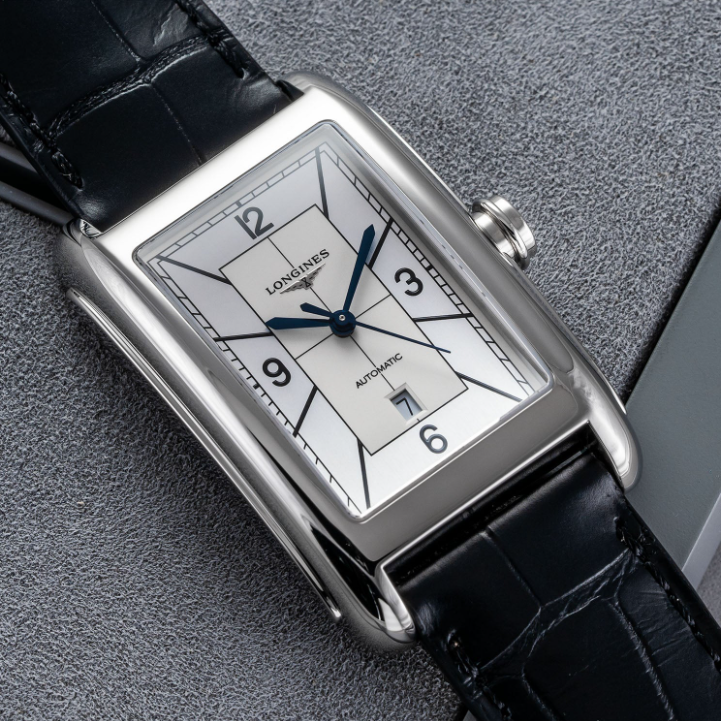
Longines offers Swiss heritage and reliable movements at accessible prices. The DolceVita rectangular dress watch has been a quiet favourite for decades. The HydroConquest covers diving. The Master Collection serves classic dress needs.
Iconic models: DolceVita, HydroConquest, Master Collection.
NOMOS Glashütte
NOMOS designs Bauhaus-influenced German watches in Glashütte, developing its own in-house movements. The Tetra is a clean, minimal square watch. The Tangente is the house's most celebrated design. Restrained, precise, and independently minded.
Iconic models: Tangente, Tetra, Club Campus.
Omega
Omega is the second-largest Swiss watch group brand and carries enormous cultural weight from its role as NASA's official watch and James Bond's timepiece. The Speedmaster went to the moon. The Seamaster serves diving. The Constellation and De Ville serve dress needs.
Iconic models: Speedmaster Professional, Seamaster 300M, Constellation.
Oris
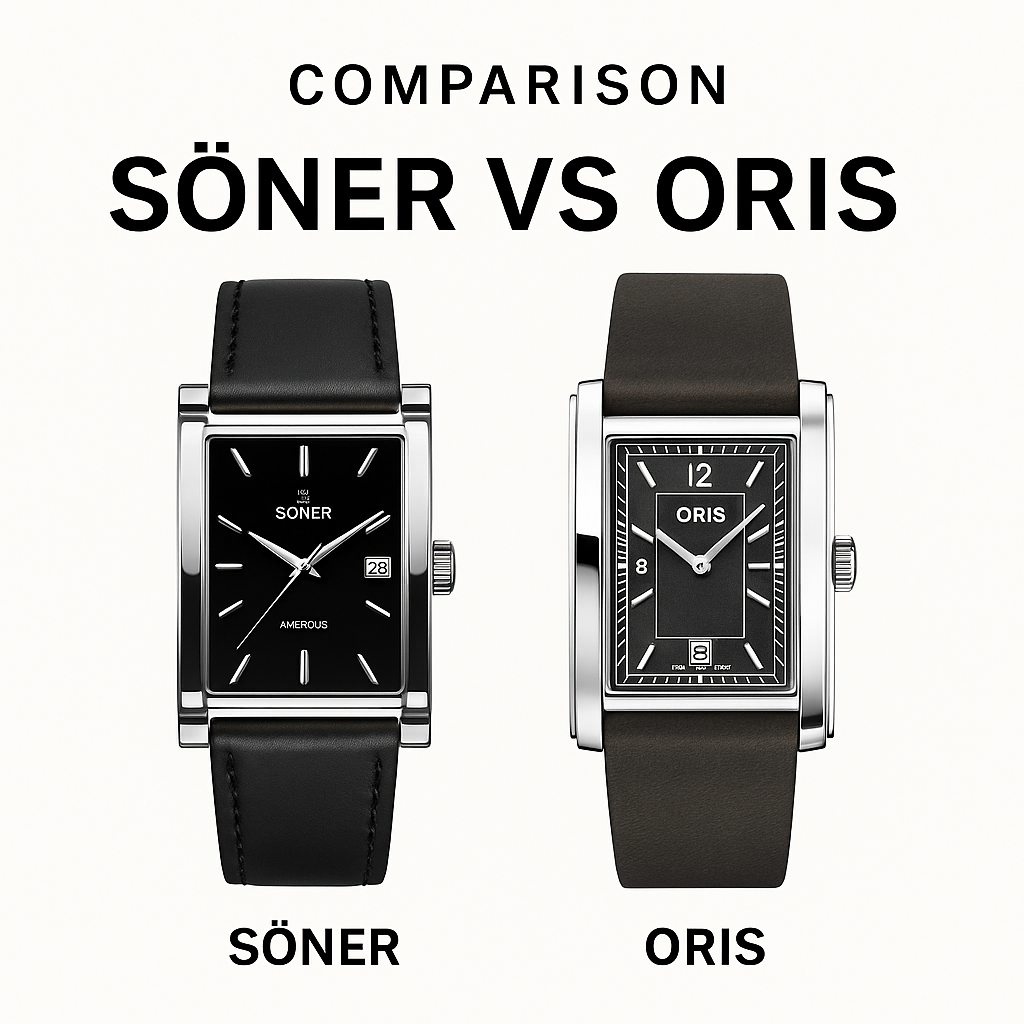
Oris is one of the few remaining independent Swiss manufactures. The Aquis dive watch and the Rectangular are the two poles of their collection. The brand commits to mechanical movements only and engages seriously with sustainability. For Oris rectangular history, see our Oris rectangular guide.
Iconic models: Aquis, Rectangular, Big Crown Pointer Date.
Panerai
Panerai grew from supplying the Italian Navy to becoming a cult brand for large-case enthusiasts. The Luminor and Radiomir cases are recognisable at any distance. California dials, cushion cases, and wrist-locking devices are house signatures.
Iconic models: Luminor, Radiomir, Submersible.
Patek Philippe
Patek Philippe is widely regarded as the most prestigious watchmaker in the world. The Calatrava is the benchmark dress watch. The Nautilus and Aquanaut define integrated-bracelet sports luxury. The perpetual calendar and minute repeater complications are produced to the highest finishing standards. The Gondolo collection carries the house's rectangular heritage. For more, see our Patek Philippe Gondolo guide.
Iconic models: Calatrava, Nautilus, Aquanaut, Perpetual Calendar 5270, Gondolo.
Piaget
Piaget specialises in ultra-thin movements and high jewelry watches. The Altiplano holds multiple records for the thinnest watch in the world. The Polo and Possession bring the house's design language to sports and jewelry contexts.
Iconic models: Altiplano, Polo, Possession.
Rado
Rado pioneered ceramic and high-tech material use in watch cases. The DiaStar (1962) was the first scratch-proof watch. The True and True Square bring contemporary design with advanced materials. Hyperchrome covers sport contexts.
Iconic models: DiaStar, True Square, Hyperchrome.
Raymond Weil
Raymond Weil is one of Switzerland's remaining independent manufacturers. The Toccata rectangular series offers a slim Swiss dress watch at an accessible price. The Freelancer and Maestro cover automatic needs. Music is a recurring design inspiration.
Iconic models: Toccata, Freelancer, Maestro.
Richard Mille
Richard Mille brought Formula 1 engineering philosophy to watchmaking. Tonneau cases in titanium, carbon, and NTPT carbon house movements developed for extreme conditions. The RM 011 and RM 027 are racing and tennis icons. The RM 016 Extra Flat brought the same philosophy to the rectangular case. For more, see our Richard Mille rectangular guide.
Iconic models: RM 011, RM 027, RM 016 Extra Flat.
Rolex
Rolex is the world's most recognised watch brand and the dominant force in the secondary market. The Submariner defines the dive watch category. The Daytona defines the sport chronograph. The Datejust and Day-Date define dress prestige. Rolex also produced rectangular watches - the Prince and Cellini Prince - though these are less known. For more, see our Rolex rectangular watches guide.
Iconic models: Submariner, Daytona, Datejust, GMT-Master II, Day-Date.
Seiko
Seiko is Japan's largest watch manufacturer and introduced the world's first commercial quartz watch in 1969. Grand Seiko is its prestige arm. Prospex covers diving and outdoor. Presage covers mechanical dress. The 5 Sports series is the benchmark affordable automatic.
Iconic models: Seiko 5 Sports, Prospex Diver, Presage, Astron GPS Solar.
Söner Watches
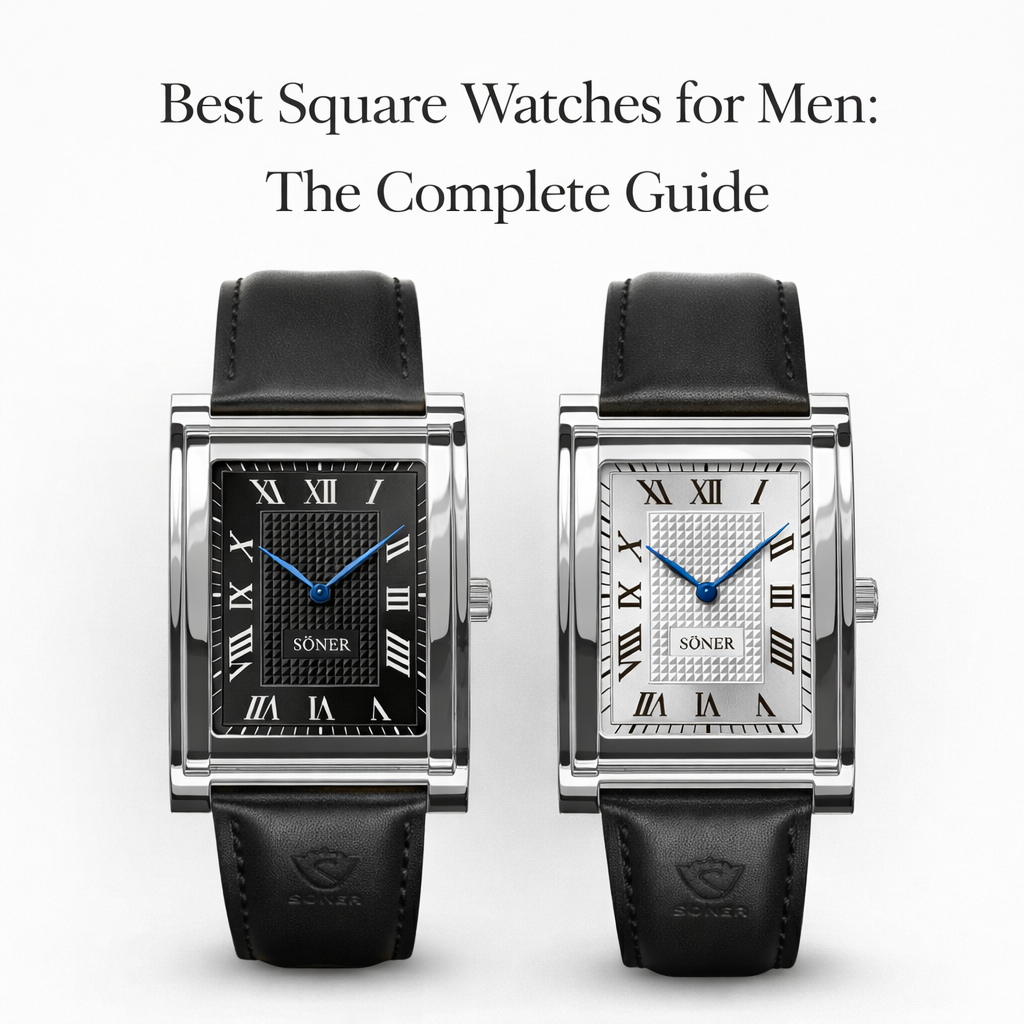
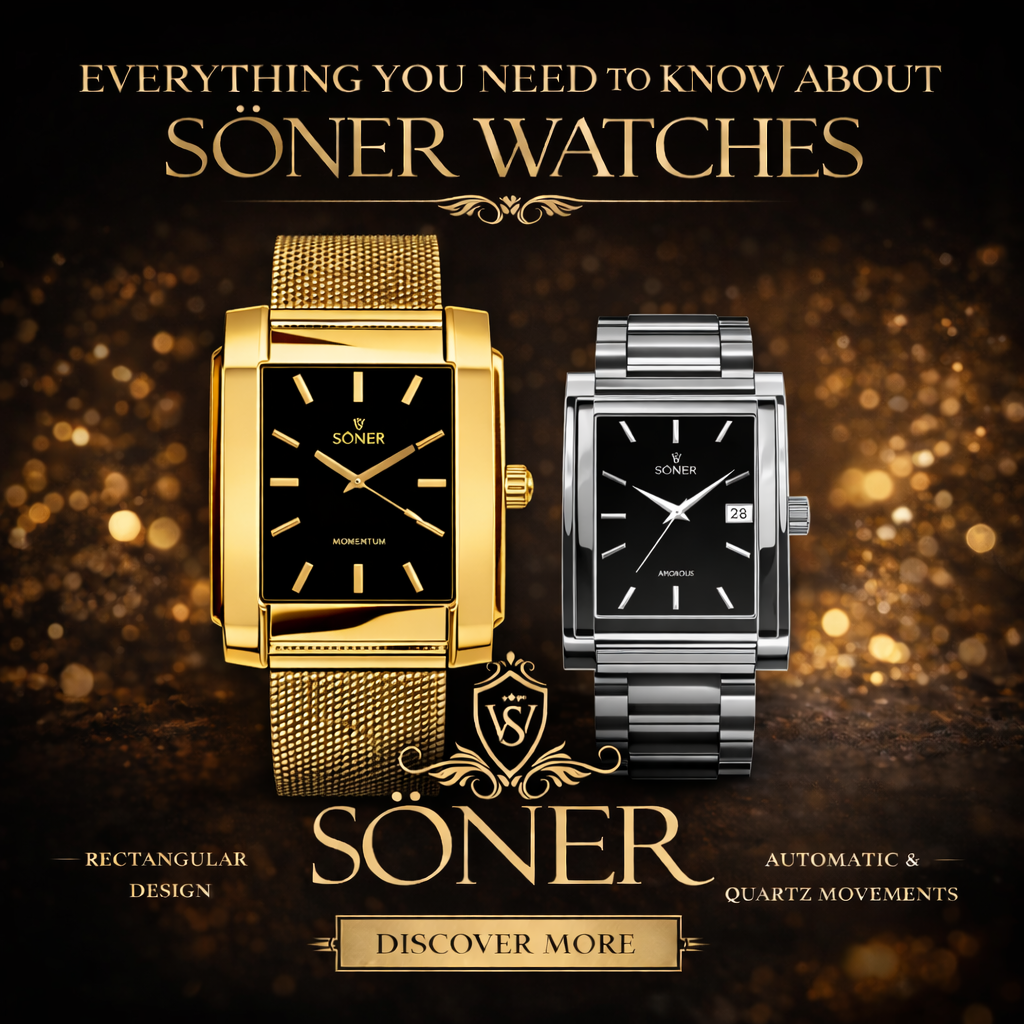
Söner is the world's only watch brand dedicated exclusively to rectangular and square watches, founded in Sweden in 2016 by Freddie Palmgren. Every watch in the collection - Legacy, Nostalgia, Amorous, Momentum - is rectangular. Movements are Swiss ETA and Sellita. Cases are extra-hardened 316L stainless steel with sapphire crystal across all models. Browse the full Söner collection.
Iconic models: Nostalgia Stockholm, Amorous Vienna, Momentum Hoover.
TAG Heuer
TAG Heuer built its identity around motorsport timing and the chronograph. The Carrera (1963) and Monaco (1969) define the house. The Monaco's square case made it the watch Steve McQueen wore in Le Mans and one of the most recognisable watch designs in the world.
Iconic models: Monaco, Carrera, Aquaracer.
Tissot
Tissot offers Swiss watchmaking at accessible price points with consistent quality. The PRX integrated-bracelet watch has been one of the strongest new introductions in the mid-range. The Le Locle covers classic dress. The T-Touch adds sensors for outdoor use.
Iconic models: PRX, Le Locle, T-Touch Expert Solar.
Tudor
Tudor is Rolex's sister brand, offering similar build quality at lower price points with its own in-house movements. The Black Bay is the benchmark affordable dive watch. The Pelagos serves serious technical diving. The Royal offers an integrated-bracelet sports option.
Iconic models: Black Bay, Pelagos, Royal.
Ulysse Nardin
Ulysse Nardin built its reputation on marine chronometers before moving into avant-garde complications. The Freak with its carousel movement and no hands is one of the most radical watch designs ever produced. The Marine and Blast complete the range.
Iconic models: Freak, Marine Chronometer, Blast.
Vacheron Constantin
Vacheron Constantin is the oldest watch manufacturer in continuous production, founded in 1755 in Geneva. The Overseas integrated sports watch, the Patrimony dress line, and the Traditionnelle complication series define the current collection. Finishing and complications are at the highest tier.
Iconic models: Overseas, Patrimony, Traditionnelle.
Zenith
Zenith created the El Primero, the first automatic chronograph movement, in 1969. That calibre still powers modern Zenith chronographs. The Chronomaster Sport and Revival series celebrate the El Primero heritage. The Defy line brings contemporary materials and design.
Iconic models: Chronomaster Original, Chronomaster Sport, Defy Skyline.
Frequently Asked Questions
What is the difference between a complication and a function?
In horology, a complication is any feature beyond simple hours, minutes, and seconds display. A date window is a complication. A chronograph is a complication. A tourbillon is a complication. The word does not imply difficulty of use - it refers to the mechanical addition required to produce the function.
What does COSC certified mean?
COSC stands for Contrôle Officiel Suisse des Chronomètres - the Swiss Official Chronometer Testing Institute. A COSC-certified movement has been tested over 16 days in five positions and two temperatures, meeting a daily rate of -4 to +6 seconds. A watch carrying COSC certification can legally be called a chronometer.
What is the difference between sapphire crystal and mineral glass?
Sapphire crystal is synthetic corundum, rated 9 on the Mohs hardness scale. It is significantly more scratch-resistant than mineral glass and is used on most watches above the entry level. Mineral glass is tempered silica glass, rated around 5-6 on the Mohs scale - it scratches more easily but is cheaper to produce and slightly more shatter-resistant than sapphire.
What does ATM mean for water resistance?
ATM stands for atmospheres - a unit of pressure. One ATM equals approximately 10 metres of static water depth. A watch rated 3 ATM can withstand splashes. 5 ATM covers hand washing and rain. 10 ATM covers swimming. 20 ATM and above covers snorkelling and diving. Note that dynamic pressure from movement in water means real-world ratings are lower than the static test figures suggest.
What is a manufacture movement?
A manufacture movement is one designed and produced in-house by the watch brand rather than purchased from an external movement supplier like ETA or Sellita. In-house movements are generally considered more prestigious and allow the brand full control over design, specifications, and production. Not all in-house movements are better than third-party movements - quality varies significantly.
What is the difference between a chronograph and a chronometer?
A chronograph is a watch with a built-in stopwatch function - start, stop, and reset. A chronometer is a watch whose movement has been independently certified for accuracy, most commonly by COSC. The terms are frequently confused. A watch can be a chronograph without being a chronometer, a chronometer without a chronograph function, or both.
What does PVD coating mean on a watch?
PVD stands for Physical Vapour Deposition - a vacuum process that applies a very thin, very hard metallic coating to a case. It is used to create gold, black, rose gold, and other coloured finishes on stainless steel cases. PVD coatings are harder than traditional gold plating and more durable in daily wear. For more detail, see our guide to PVD gold coating on watches.